







Question: please help 2. In lab 18B Part I, we've seen the mechanism: IO3+3HSO3I+3SO42+3H+(rds)IO3+5I+6H+3I2+3H2O a. The concentration of the bisulfite was purposely designed to be much
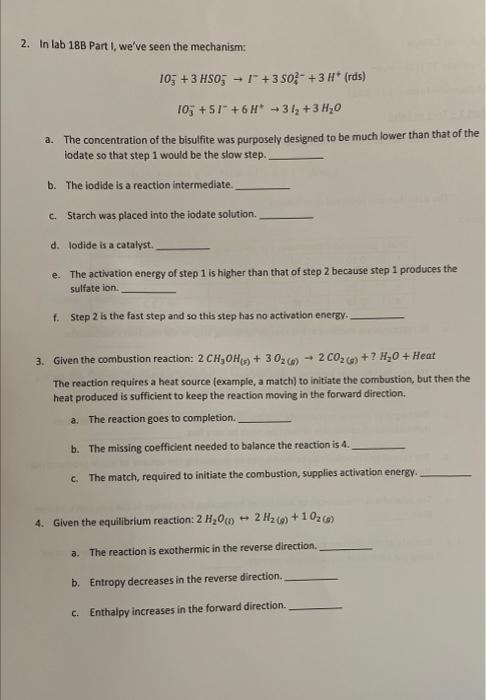
2. In lab 18B Part I, we've seen the mechanism: IO3+3HSO3I+3SO42+3H+(rds)IO3+5I+6H+3I2+3H2O a. The concentration of the bisulfite was purposely designed to be much lower than that of the iodate so that step 1 would be the slow step. b. The iodide is a reaction intermediate. c. Starch was placed into the iodate solution. d. lodide is a catalyst. e. The activation energy of step 1 is higher than that of step 2 because step 1 produces the sulfate ion. f. Step 2 is the fast step and so this step has no activation energy. 3. Given the combustion reaction: 2CH3OH(s)+3O2(s)2CO2(s)+2H2O+ Heat The reaction requires a heat source (example, a match) to initiate the combustion, but then the heat produced is sufficient to keep the reaction moving in the forward direction. a. The reaction goes to completion. b. The missing coefficient needed to balance the reaction is 4 . c. The match, required to initiate the combustion, supplies activation energV. 4. Given the equilibrium reaction: 2H2O(c)2H2()+1O2() a. The reaction is exothermic in the reverse direction. b. Entropy decreases in the reverse direction. c. Enthalpy increases in the forward direction
Step by Step Solution
There are 3 Steps involved in it

Get step-by-step solutions from verified subject matter experts
 Study Help