







Question: Please help! 3. (25 pts) Consider 3. peacock. With probability g the peacock is strong and with probability % he is weak. Knowing whether he
Please help!
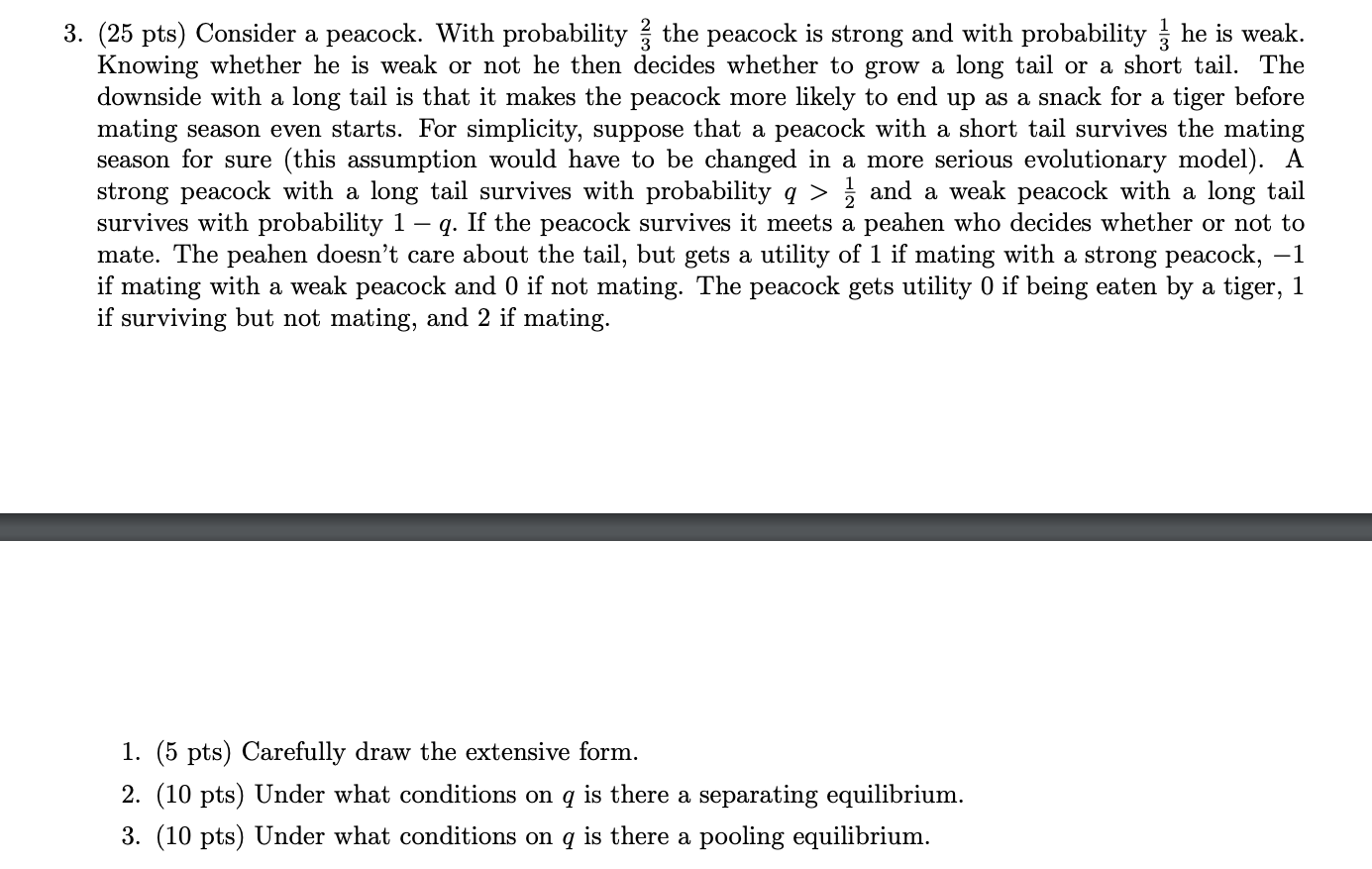
3. (25 pts) Consider 3. peacock. With probability g the peacock is strong and with probability % he is weak. Knowing whether he is weak or not he then decides whether to grow a long tail or a short tail. The downside with a long tail is that it makes the peacock more likely to end up as a snack for a tiger before mating season even starts. For simplicity, suppose that a peacock with a short tail survives the mating season for sure (this assumption would have to be changed in a more serious evolutionary model). A strong peacock with a long tail survives with probability q > 2% and a weak peacock with a long tail survives with probability 1 q. If the peacock survives it meets a peahen who decides whether or not to mate. The peahen doesn't care about the tail, but gets a utility of 1 if mating with a strong peacock, 1 if mating with a weak peacock and 0 if not mating. The peacock gets utility 0 if being eaten by a tiger, 1 if surviving but not mating, and 2 if mating. 1. (5 pts) Carefully draw the extensive form. 2. (10 pts) Under what conditions on (1 is there a separating equilibrium. 3. (10 pts) Under what conditions on q is there a pooling equilibrium
Step by Step Solution
There are 3 Steps involved in it

Get step-by-step solutions from verified subject matter experts
 Study Help