







Question: Please help =) 3. (50 points) Consider the equation cosn: = 6. a) Use a combination of bisection method and Newton's method implemented on a
Please help =)
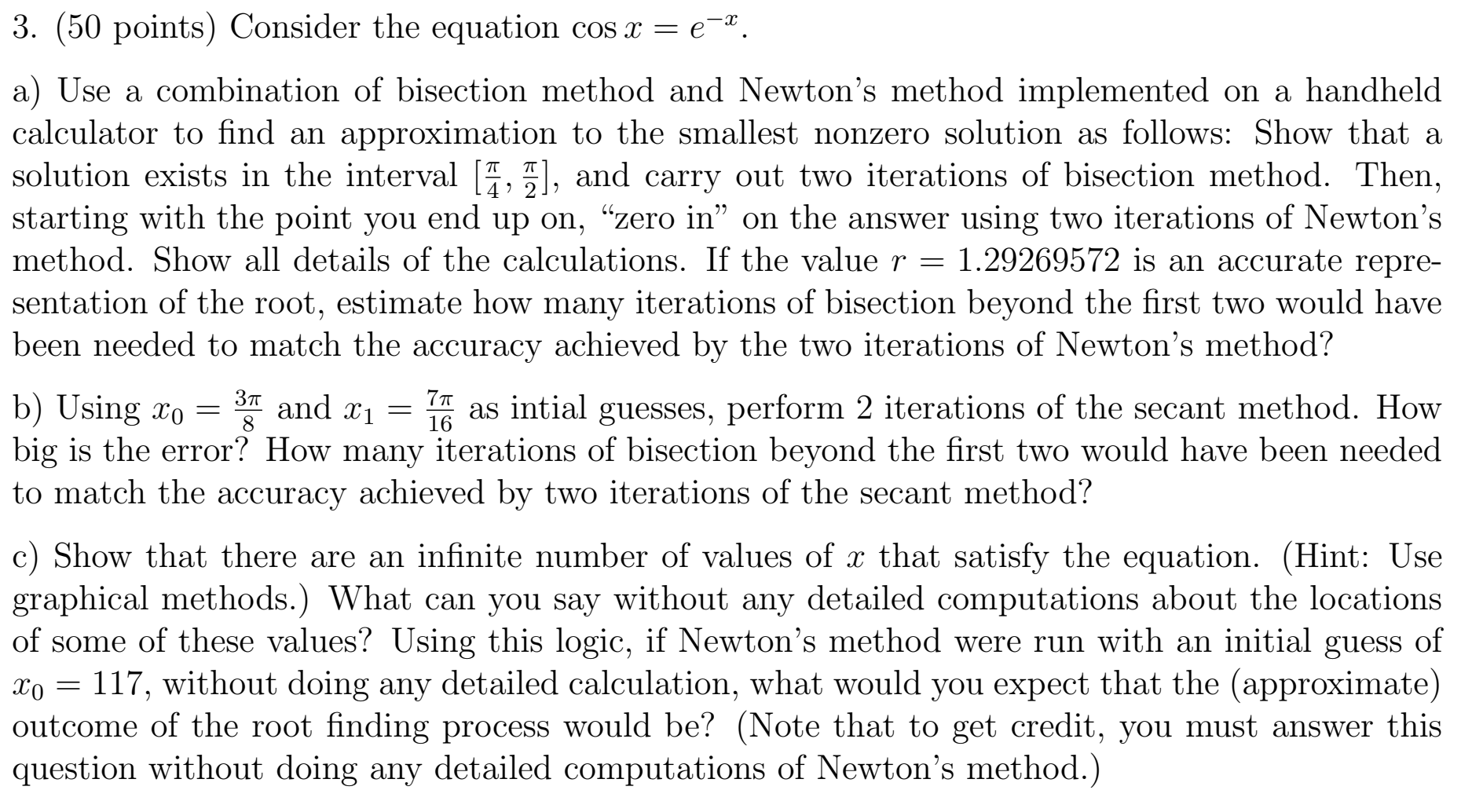
3. (50 points) Consider the equation cosn: = 6\"\". a) Use a combination of bisection method and Newton's method implemented on a handheld calculator to nd an approximation to the smallest nonzero solution as follows: Show that a solution exists in the interval E, 72;], and carry out two iterations of bisection method. Then, starting with the point you end up on, \"zero in\" on the answer using two iterations of Newton's method. Show all details of the calculations. If the value 7" = 129269572 is an accurate repre sentation of the root, estimate how many iterations of bisection beyond the rst two would have been needed to match the accuracy achieved by the two iterations of Newton's method? b) Using 3.00 = 3?\" and :31 = 17; as intial guesses7 perform 2 iterations of the secant method. How big is the error? How many iterations of bisection beyond the rst two would have been needed to match the accuracy achieved by two iterations of the secant method? c) Show that there are an innite number of values of x that satisfy the equation. (Hint: Use graphical methods.) What can you say without any detailed computations about the locations of some of these values? Using this logic, if Newton7s method were run with an initial guess of 1:0 : 117, without doing any detailed calculation, what would you expect that the (approximate) outcome of the root nding process would be? (Note that to get credit, you must answer this question without doing any detailed computations of Newton's method.)
Step by Step Solution
There are 3 Steps involved in it

Get step-by-step solutions from verified subject matter experts
 Study Help