







Question: Please help! 3. Given the following information, calculate the resolution between adjacent analyte zones as the leading edge of the fastest zone reaches the end

Please help!
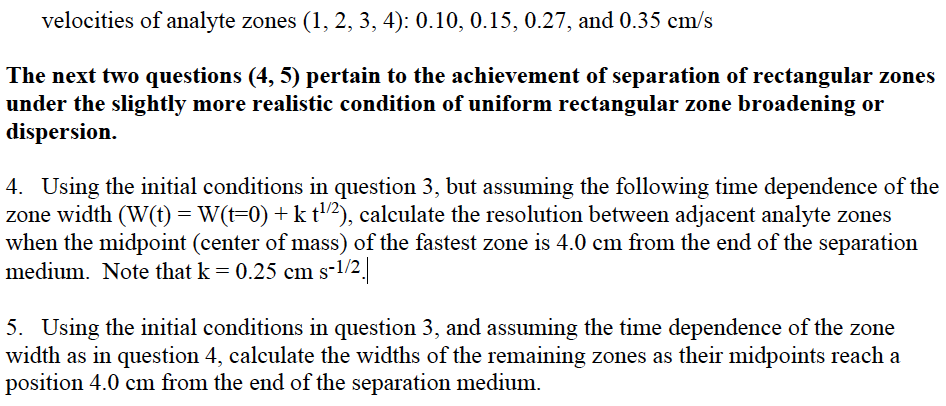
3. Given the following information, calculate the resolution between adjacent analyte zones as the leading edge of the fastest zone reaches the end of the separation medium. Either equation for the resolution, Rs = A/W or Rs = (L/W) (Av/Vavg), should provide the same answer if used appropriately. total length of our separation medium: 40.0 cm; width of sample introduced into the inlet side of the separation medium: 0.15 cm; velocities of analyte zones (1, 2, 3, 4): 0.10, 0.15, 0.27, and 0.35 cm/s The next two questions (4, 5) pertain to the achievement of separation of rectangular zones under the slightly more realistic condition of uniform rectangular zone broadening or dispersion. 4. Using the initial conditions in question 3, but assuming the following time dependence of the zone width (W(t) = W(t=0) + k t1/2), calculate the resolution between adjacent analyte zones when the midpoint (center of mass) of the fastest zone is 4.0 cm from the end of the separation medium. Note that k = 0.25 cm s-1/2 5. Using the initial conditions in question 3, and assuming the time dependence of the zone width as in question 4, calculate the widths of the remaining zones as their midpoints reach a position 4.0 cm from the end of the separation medium. 3. Given the following information, calculate the resolution between adjacent analyte zones as the leading edge of the fastest zone reaches the end of the separation medium. Either equation for the resolution, Rs = A/W or Rs = (L/W) (Av/Vavg), should provide the same answer if used appropriately. total length of our separation medium: 40.0 cm; width of sample introduced into the inlet side of the separation medium: 0.15 cm; velocities of analyte zones (1, 2, 3, 4): 0.10, 0.15, 0.27, and 0.35 cm/s The next two questions (4, 5) pertain to the achievement of separation of rectangular zones under the slightly more realistic condition of uniform rectangular zone broadening or dispersion. 4. Using the initial conditions in question 3, but assuming the following time dependence of the zone width (W(t) = W(t=0) + k t1/2), calculate the resolution between adjacent analyte zones when the midpoint (center of mass) of the fastest zone is 4.0 cm from the end of the separation medium. Note that k = 0.25 cm s-1/2 5. Using the initial conditions in question 3, and assuming the time dependence of the zone width as in question 4, calculate the widths of the remaining zones as their midpoints reach a position 4.0 cm from the end of the separation medium
Step by Step Solution
There are 3 Steps involved in it

Get step-by-step solutions from verified subject matter experts
 Study Help