







Question: Please help 5. Let f : X > Y be a function. As explained in Lecture 5-2, it is a bijection if it possesses a
Please help
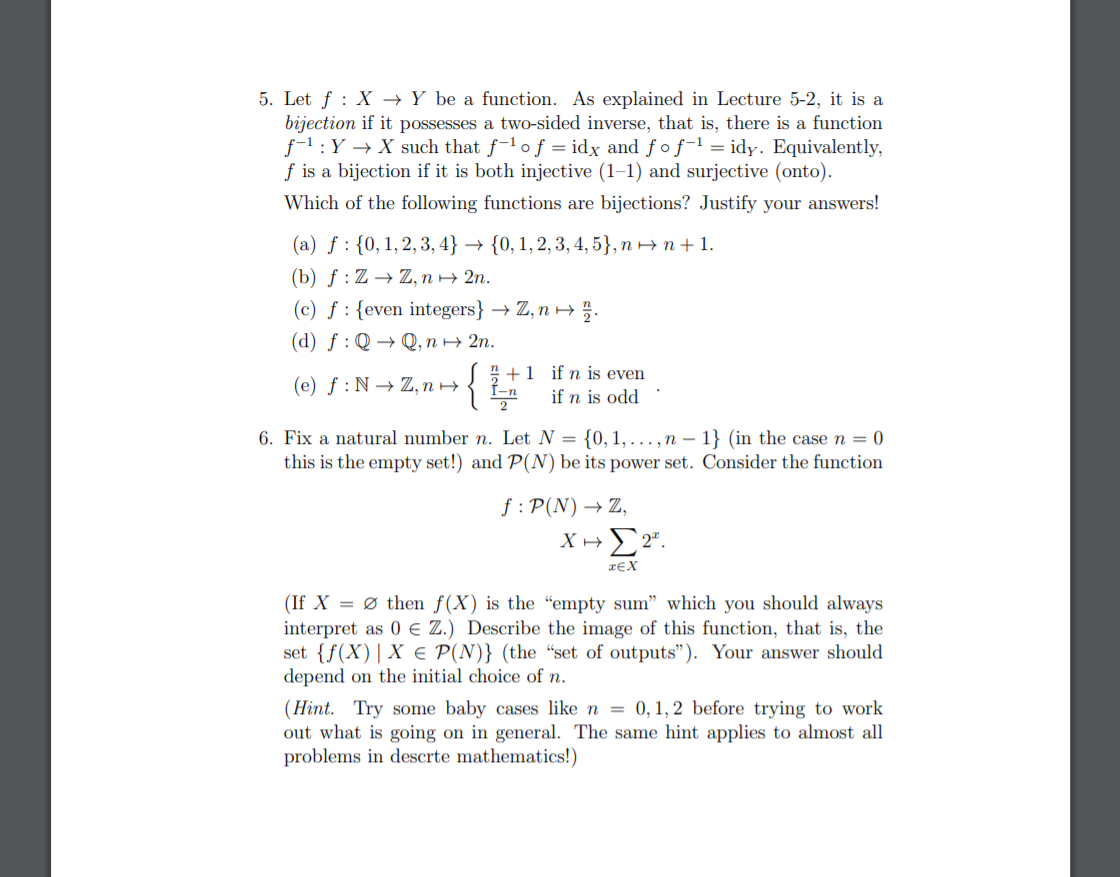
5. Let f : X > Y be a function. As explained in Lecture 5-2, it is a bijection if it possesses a two-sided inverse, that is, there is a function f'1:Y > X such that f'1 of = idX and fof1 = ldy. Equivalently, f is a bijection if it is both injective [11) and surjective (onto). Which of the following functions are bijections? Justify your answers! (a) f : {0,1,2,3,4} > {0,1,2,3,4,5},n I) 11+ 1. (b) f:Z) Emui 2n. 1 l [c (d f:Q>Q,ni)2n. f : {even integers} ) En I> g. +1ifniseven (e)f.N>Z,HH{LJ ifnisodd 6. Fix a natural number n. Let N = {0,1,... ,1: 1} (in the case n = 0 this is the empty set!) and 'P(N) be its power set. Consider the function f:P(N)>Z, XHZ2'Z (If X = Q then f (X ) is the \"empty sum\" which you should always interpret as 0 E Z.) Describe the image of this function, that is, the set { f (X ) | X E P(N)} (the \"set of outputs"), Your answer should depend on the initial choice of n. (Hint, Try some baby cases like 31 = 0,1,2 before trying to work out what is going on in general. The same hint applies to almost all problems in descrte mathematics!)
Step by Step Solution
There are 3 Steps involved in it

Get step-by-step solutions from verified subject matter experts
 Study Help