







Question: PLEASE HELP ANSWER 7. For internal record keeping purposes, there are three alternative methods for a parent company to monitor activities of its subsidiaries. Which
PLEASE HELP ANSWER
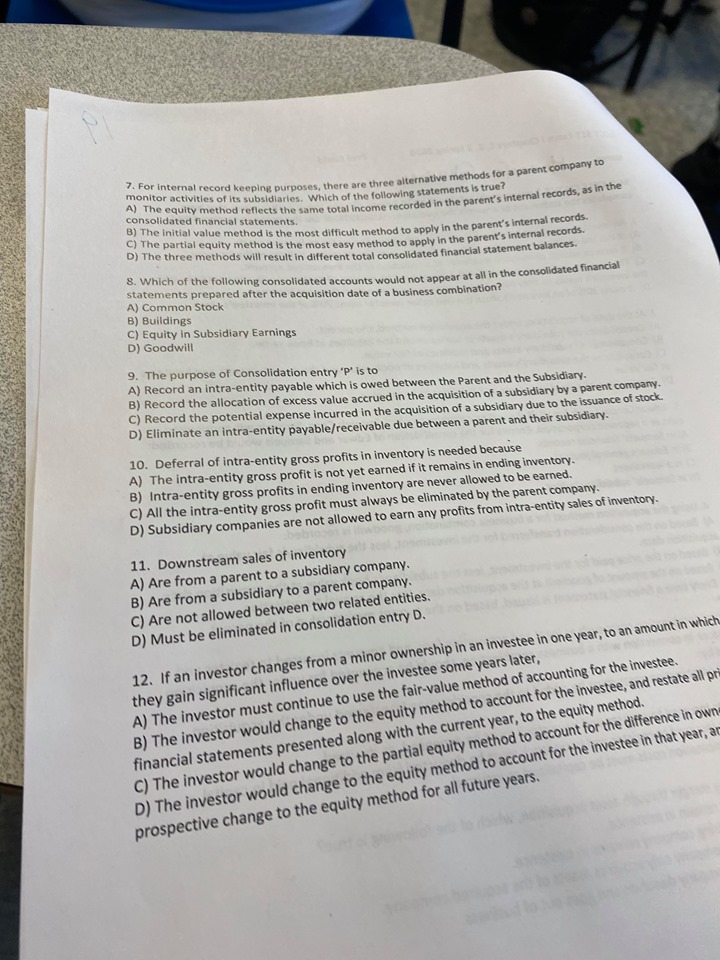
7. For internal record keeping purposes, there are three alternative methods for a parent company to monitor activities of its subsidiaries. Which of the following statements is true? A) The equity method reflects the same total Income recorded in the parent's internal records, as in the consolidated financial statements. B) The initial value method is the most difficult method to apply In the parent's internal records. C) The partial equity method is the most easy method to apply in the parent's internal records. D) The three methods will result in different total consolidated financial statement balances. 8. Which of the following consolidated accounts would not appear at all in the consolidated financial statements prepared after the acquisition date of a business combination? A) Common Stock B) Buildings C) Equity in Subsidiary Earnings D) Goodwill 9. The purpose of Consolidation entry 'P' is to A) Record an intra-entity payable which is owed between the Parent and the Subsidiary. B) Record the allocation of excess value accrued in the acquisition of a subsidiary by a parent company. C) Record the potential expense incurred in the acquisition of a subsidiary due to the issuance of stock. D) Eliminate an intra-entity payable/receivable due between a parent and their subsidiary. 10. Deferral of intra-entity gross profits in inventory is needed because A) The intra-entity gross profit is not yet earned if it remains in ending inventory. B) Intra-entity gross profits in ending inventory are never allowed to be earned. C) All the intra-entity gross profit must always be eliminated by the parent company. D) Subsidiary companies are not allowed to earn any profits from intra-entity sales of inventory. 11. Downstream sales of inventory A) Are from a parent to a subsidiary company. B) Are from a subsidiary to a parent company. C) Are not allowed between two related entities. D) Must be eliminated in consolidation entry D. 12. If an investor changes from a minor ownership in an investee in one year, to an amount in which they gain significant influence over the investee some years later, A) The investor must continue to use the fair-value method of accounting for the investee. B) The investor would change to the equity method to account for the investee, and restate all p financial statements presented along with the current year, to the equity method. C) The investor would change to the partial equity method to account for the difference in own D) The investor would change to the equity method to account for the investee in that year, a prospective change to the equity method for all future years
Step by Step Solution
There are 3 Steps involved in it

Get step-by-step solutions from verified subject matter experts
 Study Help