Question: Please help answer all questions without using AI. Thank you! 1. when acetone reacts with bromine under acidic conditions, a monohalogenated product results. However, when
Please help answer all questions without using AI. Thank you!
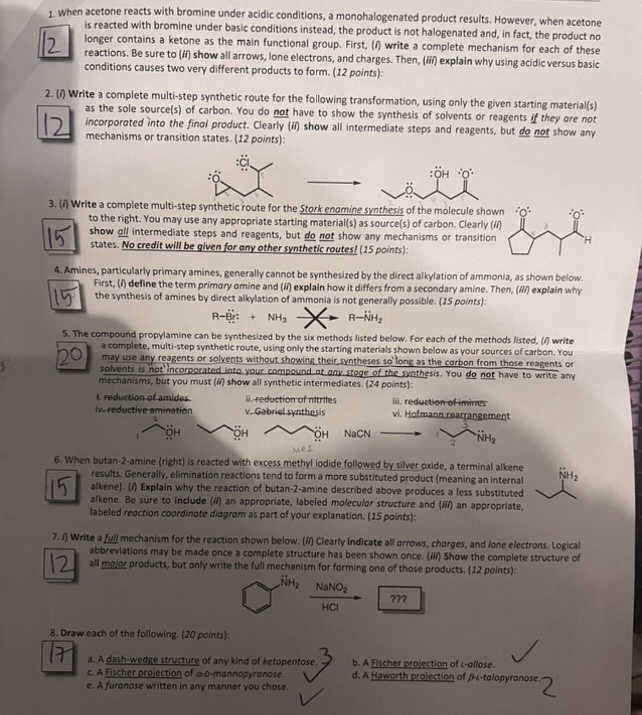
1. when acetone reacts with bromine under acidic conditions, a monohalogenated product results. However, when acetone is reacted with bromine under basic conditions instead, the product is not halogenated and, in fact, the product no 2 longer contains a ketone as the main functional group. First, (/) write a complete mechanism for each of these reactions. Be sure to (in) show all arrows, lone electrons, and charges. Then, (ill) explain why using acidic versus basic conditions causes two very different products to form. (12 points): 2. (/) Write a complete multi-step synthetic route for the following transformation, using only the given starting material(s) as the sole source(s) of carbon. You do not have to show the synthesis of solvents or reagents if they are not 12 incorporated into the final product. Clearly (I) show all intermediate steps and reagents, but do not show any mechanisms or transition states. (12 points): :OH .O' 3. [/) Write a complete multi-step synthetic route for the Stork engmine synthesis of the molecule shown to the right. You may use any appropriate starting material(s) as source(s) of carbon. Clearly (1) 15 show all intermediate steps and reagents, but do not show any mechanisms or transition states. No credit will be given for any other synthetic routes! (15 points): 4. Amines, particularly primary amines, generally cannot be synthesized by the direct alkylation of ammonia, as shown below. First, (1) define the term primary amine and (li) explain how it differs from a secondary amine. Then, (#1) explain why the synthesis of amines by direct alkylation of ammonia is not generally possible. (15 points): R-Br: + NH, X- R-NH2 5. The compound propylamine can be synthesized by the six methods listed below. For each of the methods listed, (/) write a complete, multi-step synthetic route, using only the starting materials shown below as your sources of carbon. You 20 may use any reagents or solvents without showing their syntheses so long as the carbon from those reagents or solvents is not incorporated into your compound at any stage of the synthesis. You do not have to write any mechanisms, but you must (#) show all synthetic intermediates. (24 points]: I reduction of amides. I. reduction of nitrites hi. reduction of Imines Tworeductive amination v. Gabriel synthesis vi. Hofmann rearrangement OH OH NaCN 6. When butan-2-amine (right) is reacted with excess methyl lodide followed by silver oxide, a terminal alkene results. Generally, elimination reactions tend to form a more substituted product (meaning an internal 15 alkene). (7) Explain why the reaction of butan-2-amine described above produces a less substituted alkene. Be sure to include (#) an appropriate, labeled molecular structure and (ili) an appropriate, labeled reaction coordinate diagram as part of your explanation. (15 points): 7. A Write a full mechanism for the reaction shown below. (/) Clearly indicate all arrows, charges, and lone electrons. Logical abbreviations may be made once a complete structure has been shown once. (M) Show the complete structure of 12 all major products, but only write the full mechanism for forming one of those products. (12 points): NH NaNO2 727 HC 8. Draw each of the following. (20 points): 17 a. A dash-wedge structure of any kind of ketopentose. 13 b. A Fischer projection of -allose. C. A Fischer projection of a D-mannopyranose d. A Haworth projection of At-talopyranose.- e. A furanose written in any manner you chose
Step by Step Solution
There are 3 Steps involved in it
1 Expert Approved Answer
Step: 1 Unlock
Question Has Been Solved by an Expert!
Get step-by-step solutions from verified subject matter experts
Step: 2 Unlock
Step: 3 Unlock
Students Have Also Explored These Related Accounting Questions!









 Study Help