







Question: Please help answer parts a b and c in scheme language. compile using DrRacket/emacs 1. Consider the following three examples: ; Example 1 (define fact
Please help answer parts a b and c in scheme language. compile using DrRacket/emacs
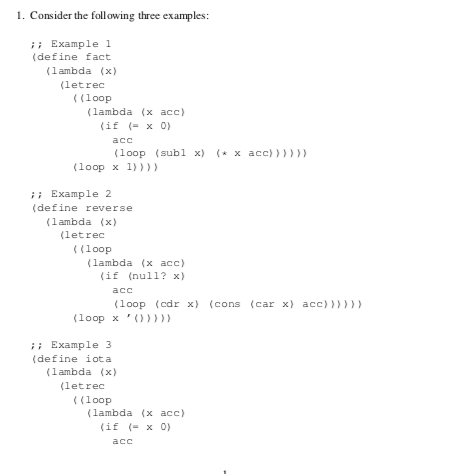
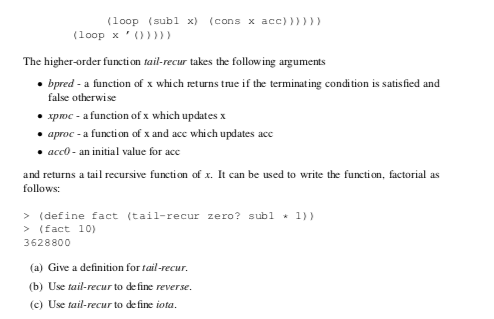
1. Consider the following three examples: ; Example 1 (define fact (lambda (x) (letrec ((loop (lambda (x acc) (if (= x 0) acc (loop (subl x) (* x acc)))))) (loop * 1)))) ;; Example 2 (define reverse (lambda (x) (letrec ((loop (lambda (x acc) (if (null? x) acc (loop (cdr x) (cons (car x) acc>>>>>> (loop x'03) ; Example 3 (define iota (lambda (x) (letrec ((loop (lambda (x acc) (if (= X 0) acc (loop (subl x) (cons x acc) >>>>> (loop x'())))) The higher-order function fail-recur takes the following arguments .bpred - a function of x which returns true if the terminating condition is satisfied and false otherwise xproc - a function of x which updates x aproc - a function of x and ace which updates acc acc0-an initial value for ace and returns a tail recursive function of x. It can be used to write the function, factorial as follows: > (define fact (tail-recur zero? subl * 1)) > (fact 10) 3628800 (a) Give a definition for tail-recur. (b) Use tail-recur to define reverse. C) Use fail-recur to define iota
Step by Step Solution
There are 3 Steps involved in it

Get step-by-step solutions from verified subject matter experts
 Study Help