







Question: Please help answer question 5-9. I need help ASAP please. A. Three families share a street and want to have streetlights on their street (to
Please help answer question 5-9. I need help ASAP please.
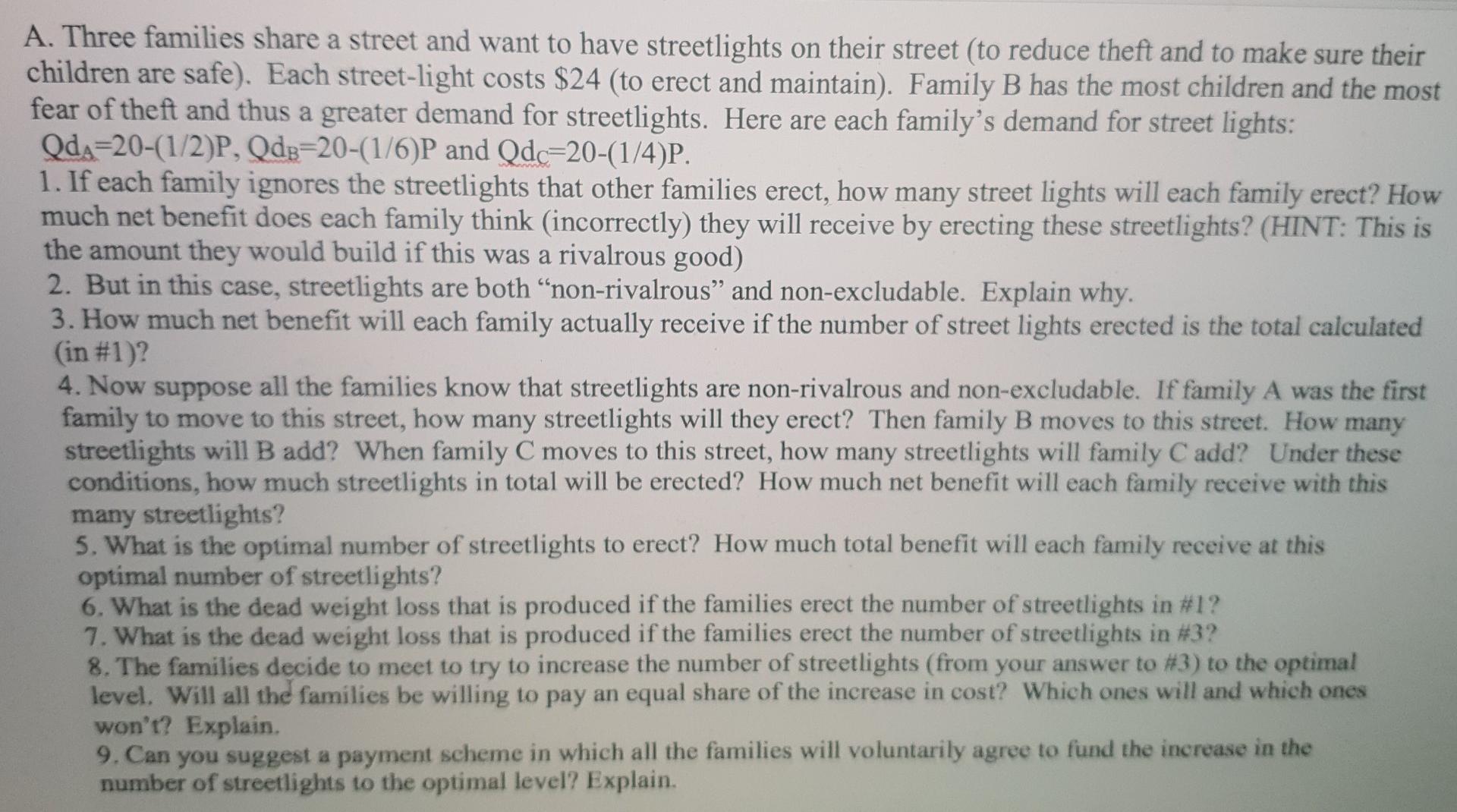
A. Three families share a street and want to have streetlights on their street (to reduce theft and to make sure their children are safe). Each street-light costs $24 (to erect and maintain). Family B has the most children and the most fear of theft and thus a greater demand for streetlights. Here are each family's demand for street lights: Qd =20-(1/2)P, Qd3=20-(1/6)P and Qdc=20-(1/4)P. 1. If each family ignores the streetlights that other families erect, how many street lights will each family erect? How much net benefit does each family think (incorrectly) they will receive by erecting these streetlights? (HINT: This is the amount they would build if this was a rivalrous good) 2. But in this case, streetlights are both non-rivalrous and non-excludable. Explain why. 3. How much net benefit will each family actually receive if the number of street lights erected is the total calculated (in #1)? 4. Now suppose all the families know that streetlights are non-rivalrous and non-excludable. If family A was the first family to move to this street, how many streetlights will they erect? Then family B moves to this street. How many streetlights will B add? When family C moves to this street, how many streetlights will family Cadd? Under these conditions, how much streetlights in total will be erected? How much net benefit will each family receive with this many streetlights? 5. What is the optimal number of streetlights to erect? How much total benefit will each family receive at this optimal number of streetlights? 6. What is the dead weight loss that is produced if the families erect the number of streetlights in #1? 7. What is the dead weight loss that is produced if the families erect the number of streetlights in #3? 8. The families decide to meet to try to increase the number of streetlights (from your answer to #3) to the optimal level. Will all the families be willing to pay an equal share of the increase in cost? Which ones will and which ones won't? Explain. 9. Can you suggest a payment scheme in which all the families will voluntarily agree to fund the increase in the number of streetlights to the optimal level? Explain
Step by Step Solution
There are 3 Steps involved in it

Get step-by-step solutions from verified subject matter experts
 Study Help