







Question: Please help answer the following question for my study guide. Thank you! Background: Your 1000 bed tertiary care healthcare institution has recently established a satellite
Please help answer the following question for my study guide. Thank you! 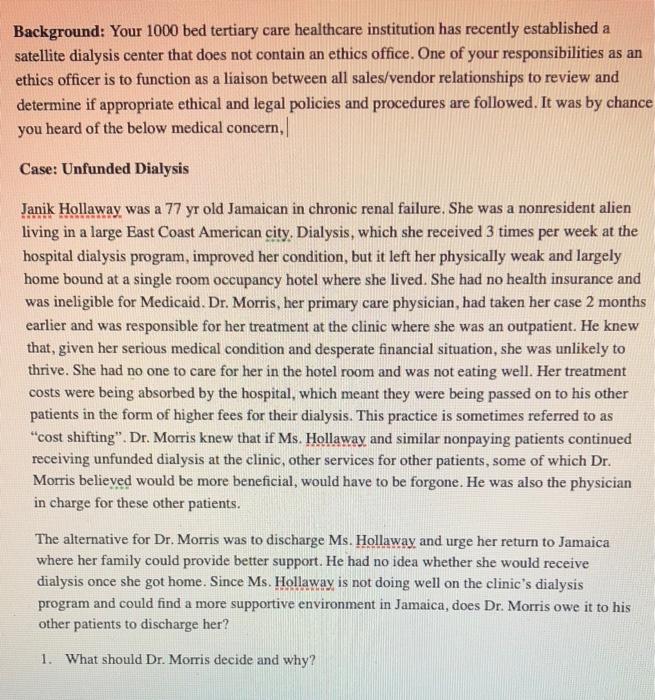
Background: Your 1000 bed tertiary care healthcare institution has recently established a satellite dialysis center that does not contain an ethics office. One of your responsibilities as an ethics officer is to function as a liaison between all sales/vendor relationships to review and determine if appropriate ethical and legal policies and procedures are followed. It was by chance you heard of the below medical concern, Case: Unfunded Dialysis Janik Hollaway was a 77 yr old Jamaican in chronic renal failure. She was a nonresident alien living in a large East Coast American city, Dialysis, which she received 3 times per week at the hospital dialysis program, improved her condition, but it left her physically weak and largely home bound at a single room occupancy hotel where she lived. She had no health insurance and was ineligible for Medicaid. Dr. Morris, her primary care physician, had taken her case 2 months earlier and was responsible for her treatment at the clinic where she was an outpatient. He knew that, given her serious medical condition and desperate financial situation, she was unlikely to thrive. She had no one to care for her in the hotel room and was not eating well. Her treatment costs were being absorbed by the hospital, which meant they were being passed on to his other patients in the form of higher fees for their dialysis. This practice is sometimes referred to as "cost shifting". Dr. Morris knew that if Ms. Hollaway and similar nonpaying patients continued receiving unfunded dialysis at the clinic, other services for other patients, some of which Dr. Morris believed would be more beneficial, would have to be forgone. He was also the physician in charge for these other patients. The alternative for Dr. Morris was to discharge Ms. Hollaway and urge her return to Jamaica where her family could provide better support. He had no idea whether she would receive dialysis once she got home. Since Ms. Hollaway is not doing well on the clinic's dialysis program and could find a more supportive environment in Jamaica, does Dr. Morris owe it to his other patients to discharge her? 1. What should Dr. Morris decide and why
Step by Step Solution
There are 3 Steps involved in it
1 Expert Approved Answer
Step: 1 Unlock

Question Has Been Solved by an Expert!
Get step-by-step solutions from verified subject matter experts
Step: 2 Unlock
Step: 3 Unlock
 Study Help