







Question: Please help answer the three multiple-choice questions. The New Union Battles: Public Unions vs. Rich World Governments While private sector unions may be rapidly declining
Please help answer the three multiple-choice questions.
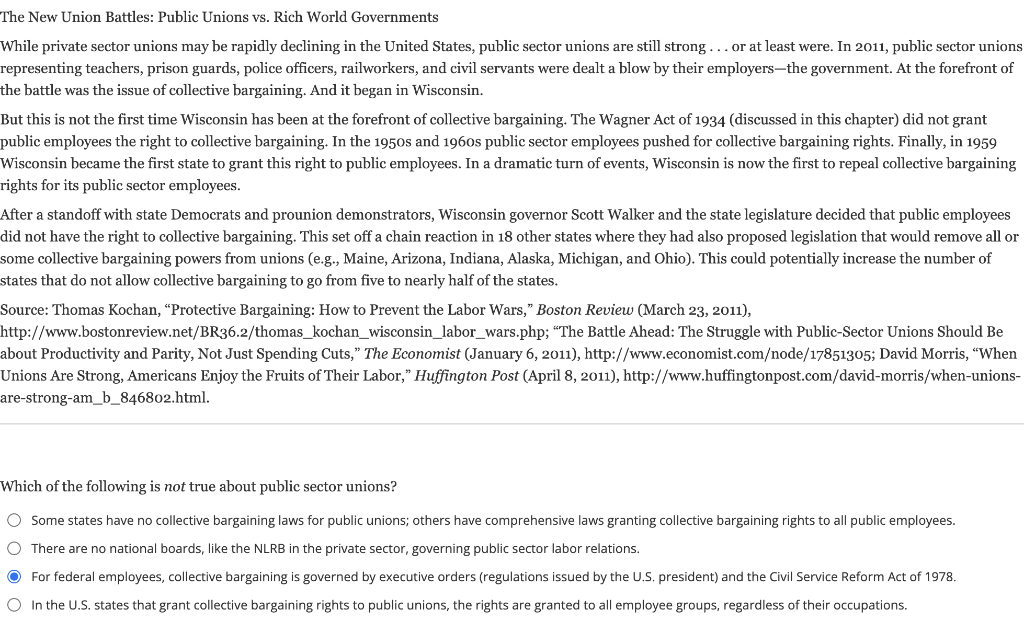
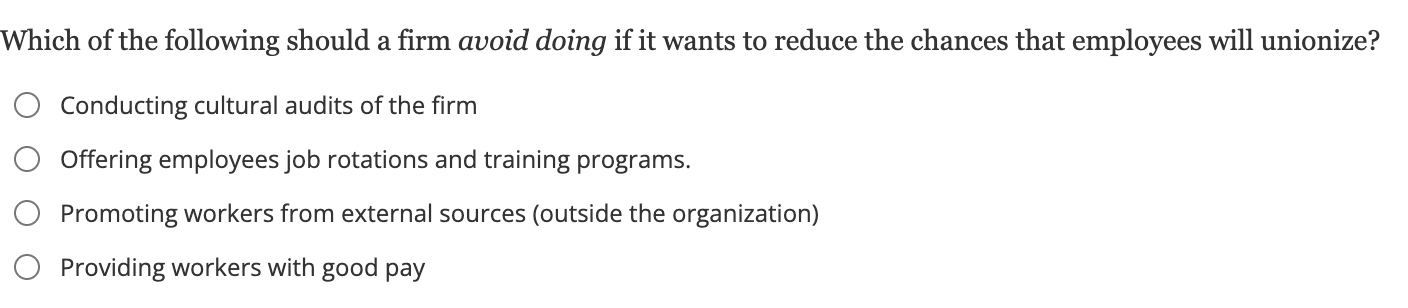
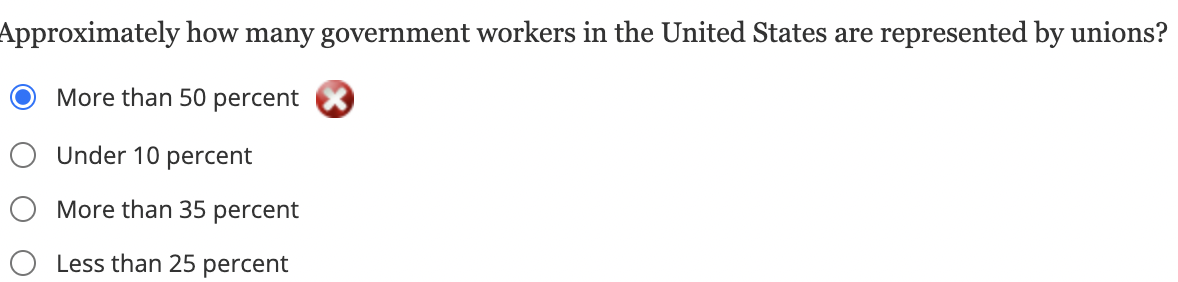
The New Union Battles: Public Unions vs. Rich World Governments While private sector unions may be rapidly declining in the United States, public sector unions are still strong ... or at least were. In 2011, public sector unions representing teachers, prison guards, police officers, railworkers, and civil servants were dealt a blow by their employers-the government. At the forefront of the battle was the issue of collective bargaining. And it began in Wisconsin. But this is not the first time Wisconsin has been at the forefront of collective bargaining. The Wagner Act of 1934 (discussed in this chapter) did not grant public employees the right to collective bargaining. In the 1950s and 1960s public sector employees pushed for collective bargaining rights. Finally, in 1959 Wisconsin became the first state to grant this right to public employees. In a dramatic turn of events, Wisconsin is now the first to repeal collective bargaining rights for its public sector employees. After a standoff with state Democrats and prounion demonstrators, Wisconsin governor Scott Walker and the state legislature decided that public employees did not have the right to collective bargaining. This set off a chain reaction in 18 other states where they had also proposed legislation that would remove all or some collective bargaining powers from unions (e.g., Maine, Arizona, Indiana, Alaska, Michigan, and Ohio). This could potentially increase the number of states that do not allow collective bargaining to go from five to nearly half of the states. Source: Thomas Kochan, Protective Bargaining: How to Prevent the Labor Wars," Boston Review (March 23, 2011), http://www.bostonreview.net/BR36.2/thomas_kochan_wisconsin_labor_wars.php; "The Battle Ahead: The Struggle with Public-Sector Unions Should Be about Productivity and Parity, Not Just Spending Cuts," The Economist (January 6, 2011), http://www.economist.comode/17851305; David Morris, When Unions Are Strong, Americans Enjoy the Fruits of Their Labor," Huffington Post (April 8, 2011), http://www.huffingtonpost.com/david-morris/when-unions- are-strong-am_b_846802.html. Which of the following is not true about public sector unions? Some states have no collective bargaining laws for public unions; others have comprehensive laws granting collective bargaining rights to all public employees. There are no national boards, like the NLRB in the private sector, governing public sector labor relations. For federal employees, collective bargaining is governed by executive orders (regulations issued by the U.S. president) and the Civil Service Reform Act of 1978. In the U.S. states that grant collective bargaining rights to public unions, the rights are granted to all employee groups, regardless of their occupations. Which of the following should a firm avoid doing if it wants to reduce the chances that employees will unionize? Conducting cultural audits of the firm Offering employees job rotations and training programs. O Promoting workers from external sources (outside the organization) O Providing workers with good pay Approximately how many government workers in the United States are represented by unions? More than 50 percent O Under 10 percent More than 35 percent O Less than 25 percentStep by Step Solution
There are 3 Steps involved in it
1 Expert Approved Answer
Step: 1 Unlock

Question Has Been Solved by an Expert!
Get step-by-step solutions from verified subject matter experts
Step: 2 Unlock
Step: 3 Unlock
 Study Help