







Question: Please help answer this! 6. In a study published in the American Journal of Public Health , researchers report the results of analyses based on
Please help answer this!
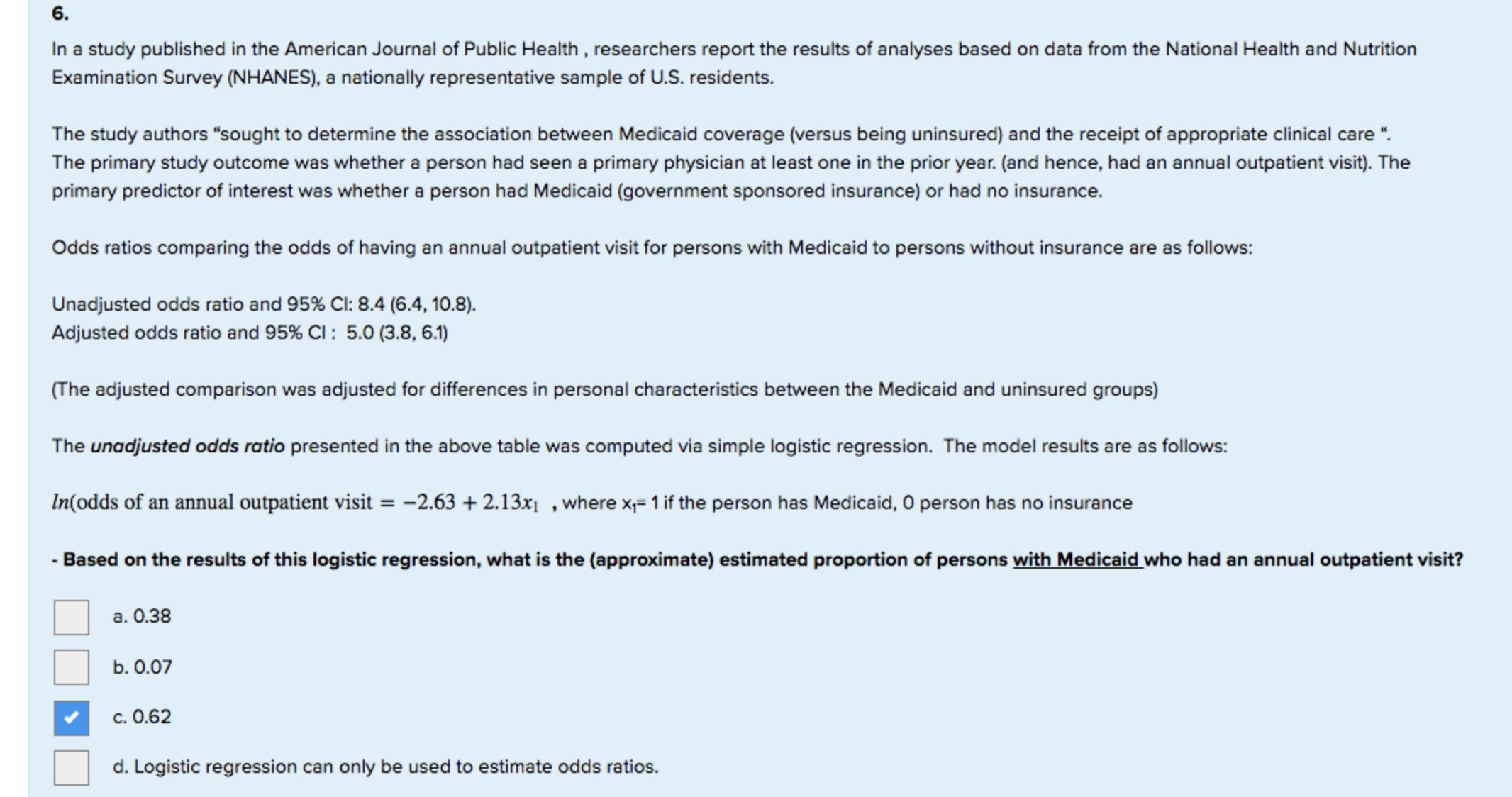
6. In a study published in the American Journal of Public Health , researchers report the results of analyses based on data from the National Health and Nutrition Examination Survey (NHANES), a nationally representative sample of U.S. residents. The study authors "sought to determine the association between Medicaid coverage (versus being uninsured) and the receipt of appropriate clinical care ". The primary study outcome was whether a person had seen a primary physician at least one in the prior year. (and hence, had an annual outpatient visit). The primary predictor of interest was whether a person had Medicaid (government sponsored insurance) or had no insurance. Odds ratios comparing the odds of having an annual outpatient visit for persons with Medicaid to persons without insurance are as follows: Unadjusted odds ratio and 95% Cl: 8.4 (6.4, 10.8). Adjusted odds ratio and 95% CI : 5.0 (3.8, 6.1) (The adjusted comparison was adjusted for differences in personal characteristics between the Medicaid and uninsured groups) The unadjusted odds ratio presented in the above table was computed via simple logistic regression. The model results are as follows: In(odds of an annual outpatient visit = -2.63 + 2.13x1 , where x,= 1 if the person has Medicaid, 0 person has no insurance - Based on the results of this logistic regression, what is the (approximate) estimated proportion of persons with Medicaid who had an annual outpatient visit? a. 0.38 b. 0.07 c. 0.62 d. Logistic regression can only be used to estimate odds ratios
Step by Step Solution
There are 3 Steps involved in it

Get step-by-step solutions from verified subject matter experts
 Study Help