





Question: Please help by showing workout on excel with steps. Thanks! You have just received a windfall from an investment you made in a friend's business.

Please help by showing workout on excel with steps. Thanks!
Please help by showing workout on excel with
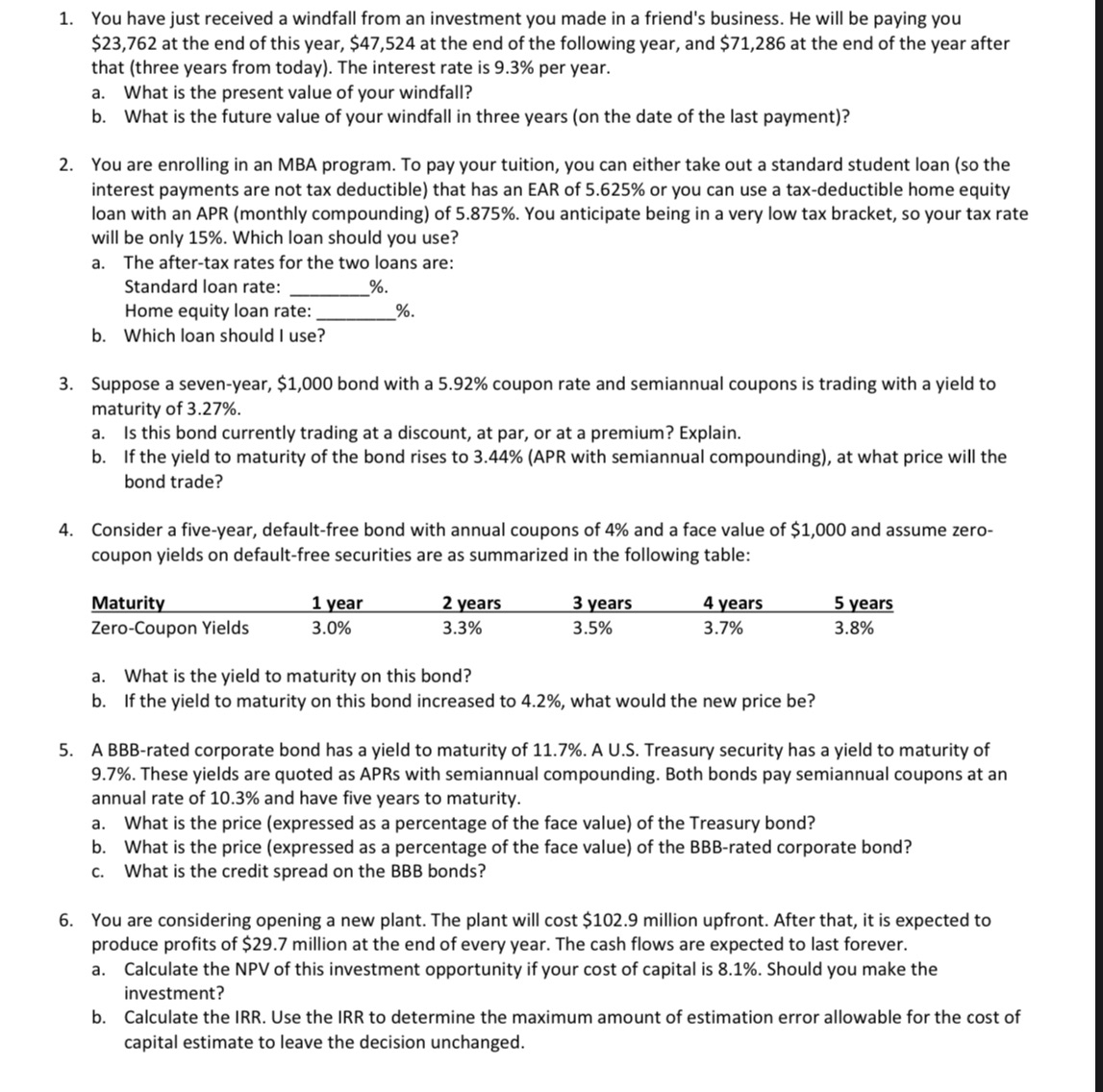
You have just received a windfall from an investment you made in a friend's business. He will be paying you $23,762 at the end of this year, $47,524 at the end ofthe following year, and $71,286 at the end of the year after that (three years from today). The interest rate is 9.3% per year. a. What is the present value of your windfall? b. What is the future value of your windfall in three years (on the date of the last payment)? You are enrolling in an MBA program. To pay your tuition, you can either take out a standard student loan (so the interest payments are not tax deductible) that has an EAR of 5.625% or you can use a tax-deductible home equity loan with an APR (monthly compounding} of 5.875%. You anticipate being in a very low tax bracket, so your tax rate will be only 15%. Which loan should you use? a. The after-tax rates for the two loans are: Standard loan rate: %. Home equity loan rate: %. b. Which loan should I use? Suppose a seven-year, $1,000 bond with a 5.92% coupon rate and semiannual coupons is trading with a yield to maturity of 3.27%. a. Is this bond currently trading at a discount, at par, or at a premium? Explain. b. If the yield to maturity of the bond rises to 3.44% (APR with semiannual compounding), at what price will the bond trade? Consider a five-year, default-free bond with annual coupons of 4% and a face value of $1,000 and assume zero- coupon yields on default-free securities are as summarized in the following table: Maturity 1 year 2 years 3 gears 4 years 5 years Zero-Coupon Yields 3.0% 3.3% 3.5% 3.7% 3.8% a. What is the yield to maturity on this bond? b. If the yield to maturity on this bond increased to 4.2%, what would the new price be? A BBB-rated corporate bond has a yield to maturity of 11.7%. A US. Treasury security has a yield to maturity of 9.7%. These yields are quoted as APRs with semiannual compounding. Both bonds pay semiannual coupons at an annual rate of 10.3% and have five years to maturity. a. What is the price (expressed as a percentage of the face value) of the Treasury bond? b. What is the price (expressed as a percentage of the face value) of the BBB-rated corporate bond? c. What is the credit spread on the BBB bonds? You are considering opening a new plant. The plant will cost $102.9 million upfront. After that, it is expected to produce prots of $29.7 million at the end of every year. The cash flows are expected to last forever. a. Calculate the NW of this investment opportunity if your cost of capital is 8.1%. Should you make the investment? b. Calculate the IRR. Use the IRR to determine the maximum amount of estimation error allowable for the cost of capital estimate to leave the decision unchanged

Step by Step Solution

There are 3 Steps involved in it

1 Expert Approved Answer
Step: 1 Unlock blur-text-image

Question Has Been Solved by an Expert!

Get step-by-step solutions from verified subject matter experts

Step: 2 Unlock
Step: 3 Unlock

Students Have Also Explored These Related Finance Questions!