







Question: Please help create equations and provide insight on how. All help is appreciated. Dear Differential Equations Students: As you may know, rapidly growing feral cat
Please help create equations and provide insight on how. All help is appreciated.
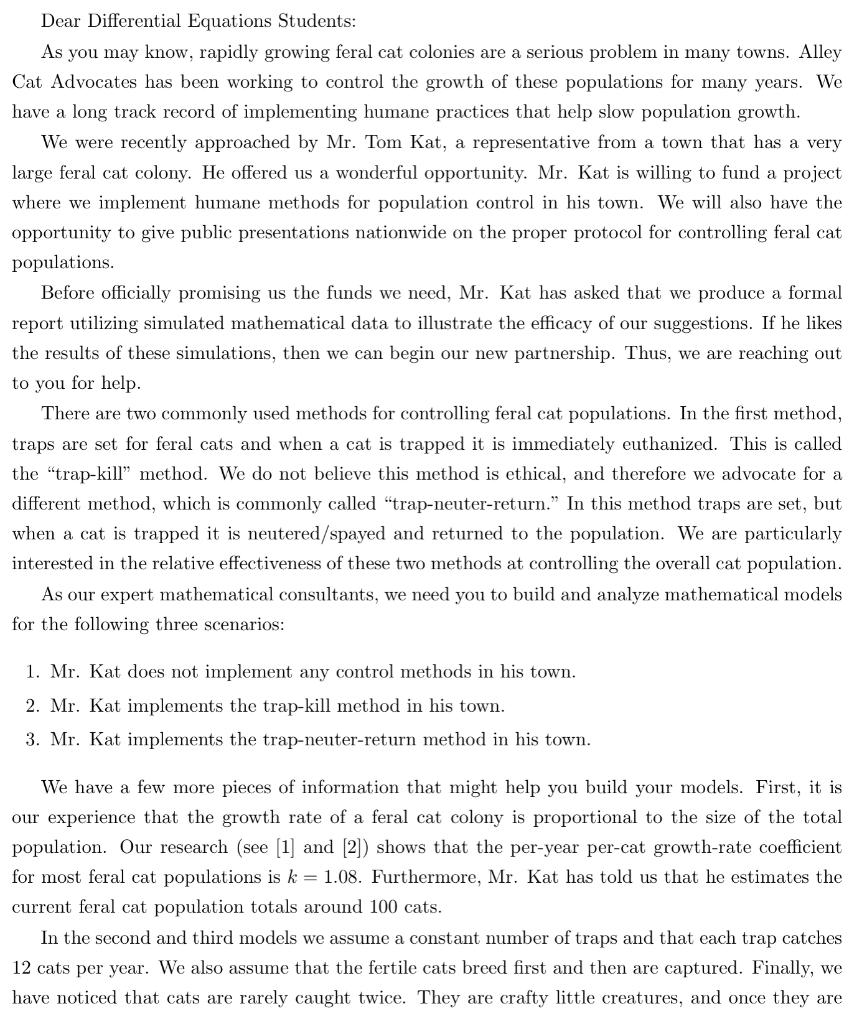
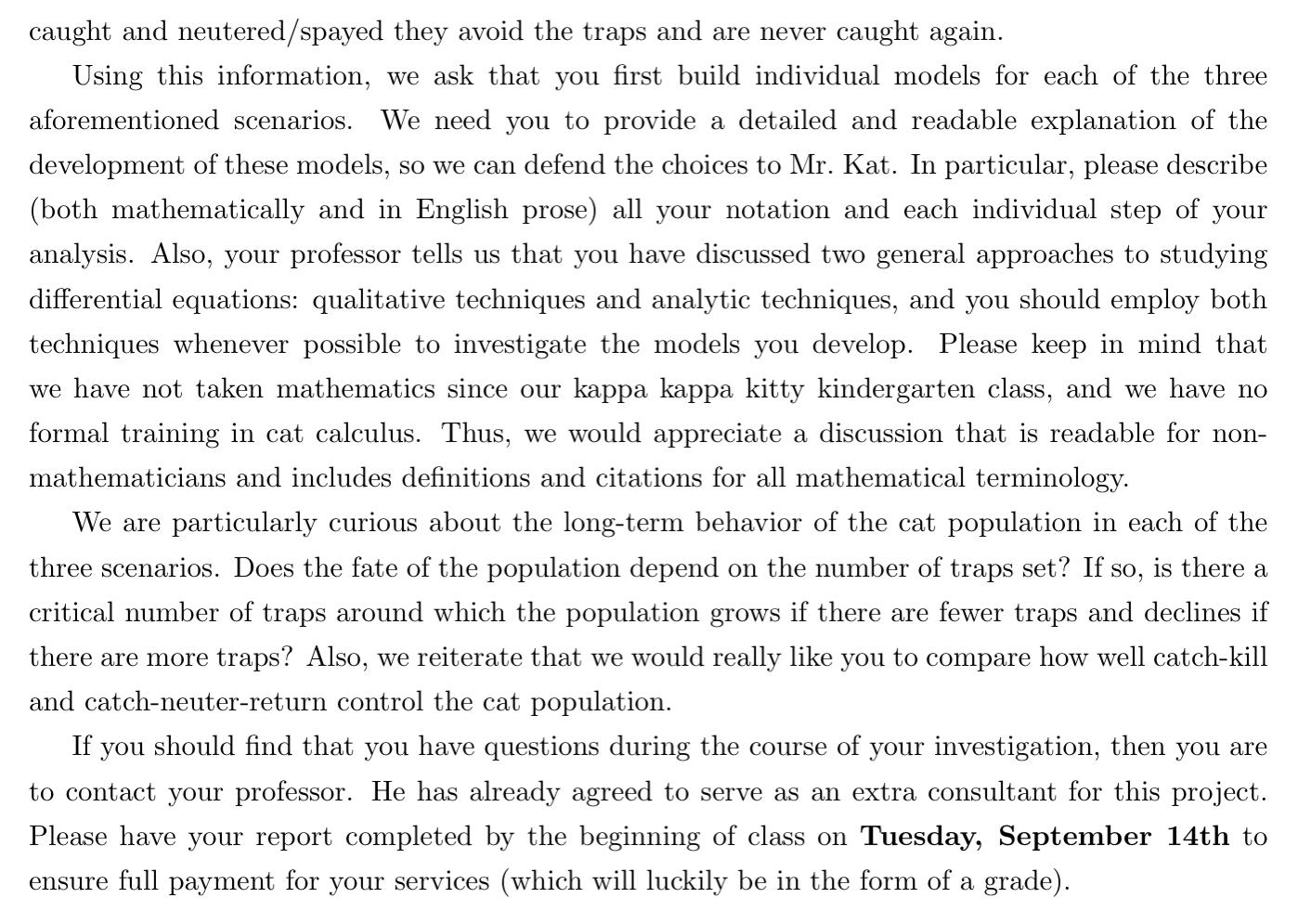
Dear Differential Equations Students: As you may know, rapidly growing feral cat colonies are a serious problem in many towns. Alley Cat Advocates has been working to control the growth of these populations for many years. We have a long track record of implementing humane practices that help slow population growth. We were recently approached by Mr. Tom Kat, a representative from a town that has a very large feral cat colony. He offered us a wonderful opportunity. Mr. Kat is willing to fund a project where we implement humane methods for population control in his town. We will also have the opportunity to give public presentations nationwide on the proper protocol for controlling feral cat populations. Before officially promising us the funds we need, Mr. Kat has asked that we produce a formal report utilizing simulated mathematical data to illustrate the efficacy of our suggestions. If he likes the results of these simulations, then we can begin our new partnership. Thus, we are reaching out to you for help. There are two commonly used methods for controlling feral cat populations. In the first method, traps are set for feral cats and when a cat is trapped it is immediately euthanized. This is called the "trap-kill" method. We do not believe this method is ethical, and therefore we advocate for a different method, which is commonly called "trap-neuter-return." In this method traps are set, but when a cat is trapped it is neutered/spayed and returned to the population. We are particularly interested in the relative effectiveness of these two methods at controlling the overall cat population. As our expert mathematical consultants, we need you to build and analyze mathematical models for the following three scenarios: 1. Mr. Kat does not implement any control methods in his town. 2. Mr. Kat implements the trap-kill method in his town. 3. Mr. Kat implements the trap-neuter-return method in his town. We have a few more pieces of information that might help you build your models. First, it is our experience that the growth rate of a feral cat colony is proportional to the size of the total population. Our research (see (1) and (2]) shows that the per-year per-cat growth-rate coefficient for most feral cat populations is k = 1.08. Furthermore, Mr. Kat has told us that he estimates the current feral cat population totals around 100 cats. In the second and third models we assume a constant number of traps and that each trap catches 12 cats per year. We also assume that the fertile cats breed first and then are captured. Finally, we have noticed that cats are rarely caught twice. They are crafty little creatures, and once they are caught and neutered/spayed they avoid the traps and are never caught again. Using this information, we ask that you first build individual models for each of the three aforementioned scenarios. We need you to provide a detailed and readable explanation of the development of these models, so we can defend the choices to Mr. Kat. In particular, please describe (both mathematically and in English prose) all your notation and each individual step of your analysis. Also, your professor tells us that you have discussed two general approaches to studying differential equations: qualitative techniques and analytic techniques, and you should employ both techniques whenever possible to investigate the models you develop. Please keep in mind that we have not taken mathematics since our kappa kappa kitty kindergarten class, and we have no formal training in cat calculus. Thus, we would appreciate a discussion that is readable for non- mathematicians and includes definitions and citations for all mathematical terminology. We are particularly curious about the long-term behavior of the cat population in each of the three scenarios. Does the fate of the population depend on the number of traps set? If so, is there a critical number of traps around which the population grows if there are fewer traps and declines if there are more traps? Also, we reiterate that we would really like you to compare how well catch-kill and catch-neuter-return control the cat population. If you should find that you have questions during the course of your investigation, then you are to contact your professor. He has already agreed to serve as an extra consultant for this project. Please have your report completed by the beginning of class on Tuesday, September 14th to ensure full payment for your services (which will luckily be in the form of a grade). Dear Differential Equations Students: As you may know, rapidly growing feral cat colonies are a serious problem in many towns. Alley Cat Advocates has been working to control the growth of these populations for many years. We have a long track record of implementing humane practices that help slow population growth. We were recently approached by Mr. Tom Kat, a representative from a town that has a very large feral cat colony. He offered us a wonderful opportunity. Mr. Kat is willing to fund a project where we implement humane methods for population control in his town. We will also have the opportunity to give public presentations nationwide on the proper protocol for controlling feral cat populations. Before officially promising us the funds we need, Mr. Kat has asked that we produce a formal report utilizing simulated mathematical data to illustrate the efficacy of our suggestions. If he likes the results of these simulations, then we can begin our new partnership. Thus, we are reaching out to you for help. There are two commonly used methods for controlling feral cat populations. In the first method, traps are set for feral cats and when a cat is trapped it is immediately euthanized. This is called the "trap-kill" method. We do not believe this method is ethical, and therefore we advocate for a different method, which is commonly called "trap-neuter-return." In this method traps are set, but when a cat is trapped it is neutered/spayed and returned to the population. We are particularly interested in the relative effectiveness of these two methods at controlling the overall cat population. As our expert mathematical consultants, we need you to build and analyze mathematical models for the following three scenarios: 1. Mr. Kat does not implement any control methods in his town. 2. Mr. Kat implements the trap-kill method in his town. 3. Mr. Kat implements the trap-neuter-return method in his town. We have a few more pieces of information that might help you build your models. First, it is our experience that the growth rate of a feral cat colony is proportional to the size of the total population. Our research (see (1) and (2]) shows that the per-year per-cat growth-rate coefficient for most feral cat populations is k = 1.08. Furthermore, Mr. Kat has told us that he estimates the current feral cat population totals around 100 cats. In the second and third models we assume a constant number of traps and that each trap catches 12 cats per year. We also assume that the fertile cats breed first and then are captured. Finally, we have noticed that cats are rarely caught twice. They are crafty little creatures, and once they are caught and neutered/spayed they avoid the traps and are never caught again. Using this information, we ask that you first build individual models for each of the three aforementioned scenarios. We need you to provide a detailed and readable explanation of the development of these models, so we can defend the choices to Mr. Kat. In particular, please describe (both mathematically and in English prose) all your notation and each individual step of your analysis. Also, your professor tells us that you have discussed two general approaches to studying differential equations: qualitative techniques and analytic techniques, and you should employ both techniques whenever possible to investigate the models you develop. Please keep in mind that we have not taken mathematics since our kappa kappa kitty kindergarten class, and we have no formal training in cat calculus. Thus, we would appreciate a discussion that is readable for non- mathematicians and includes definitions and citations for all mathematical terminology. We are particularly curious about the long-term behavior of the cat population in each of the three scenarios. Does the fate of the population depend on the number of traps set? If so, is there a critical number of traps around which the population grows if there are fewer traps and declines if there are more traps? Also, we reiterate that we would really like you to compare how well catch-kill and catch-neuter-return control the cat population. If you should find that you have questions during the course of your investigation, then you are to contact your professor. He has already agreed to serve as an extra consultant for this project. Please have your report completed by the beginning of class on Tuesday, September 14th to ensure full payment for your services (which will luckily be in the form of a grade)
Step by Step Solution
There are 3 Steps involved in it

Get step-by-step solutions from verified subject matter experts
 Study Help