



Question: please help due very soon Harper is considering three alternative investments of $10,000. Assume that the taxpayer is in the 24% marginal tax bricket for
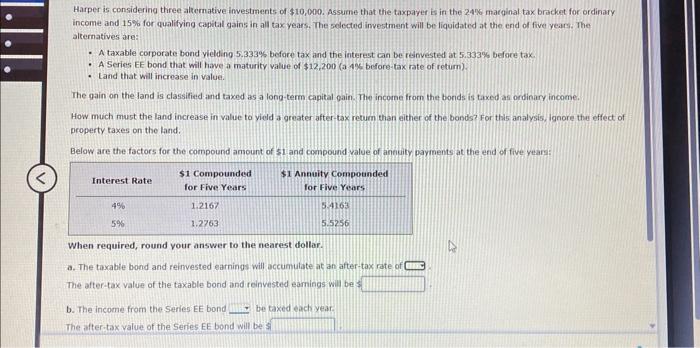
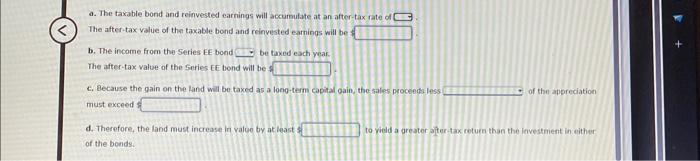
Harper is considering three alternative investments of $10,000. Assume that the taxpayer is in the 24% marginal tax bricket for ordinary income and 15% for qualifying caphtal gains in all tax years. The selected investrment will be liquidated at the end of five years. The alternatives are: - A taxable corporate bond yielding 5.333% befare tax and the interest can be reinvested at 5.333% before tax. - A Serises EE bond that will have a maturity value of $12,200 (a 4% before-tax rate of returm). - Land that will increase in value. The gain on the land is classifietd and taxed as a long-term capital gain. The incorne frorn the borids is taxed as ordinary income. How much must the land increase in value to yiold a greater after-tax retum than aither of the bonds? For this analysis, lgnore the effect of property taxes on the land. Below are the factors for the compound amsount of $1 and compound value of anauity payinents at the end of five years: When required, round your answer to the nearest dollar. a. The taxable bond and reimvested earnings will bccumulate at an after-tax rate of The after-tax value of the taxable bond and reinvested earnings will be b. The income from the Series; EE bond be taxed each year: The after-tax value of the Series EE bond will be? a. The taxabie bond and reinvested earnings will accumulate at an after-tax rate of The after-tax value of tha taxable bond and reinvested earnings will be 1 b. The income from the Series EE-bond be taxed each year. The after-tax value of the Series EE bond will be s c. Because the gain on the Rand wil be taxed as a long-term copital gain, the sales proceegl less: of the appreciation must excesd 1 d. Therefore, the land must increase in value by at least 3 to vield a areater after-tax return than the investrient in either of the bonds. Harper is considering three alternative investments of $10,000. Assume that the taxpayer is in the 24% marginal tax bricket for ordinary income and 15% for qualifying caphtal gains in all tax years. The selected investrment will be liquidated at the end of five years. The alternatives are: - A taxable corporate bond yielding 5.333% befare tax and the interest can be reinvested at 5.333% before tax. - A Serises EE bond that will have a maturity value of $12,200 (a 4% before-tax rate of returm). - Land that will increase in value. The gain on the land is classifietd and taxed as a long-term capital gain. The incorne frorn the borids is taxed as ordinary income. How much must the land increase in value to yiold a greater after-tax retum than aither of the bonds? For this analysis, lgnore the effect of property taxes on the land. Below are the factors for the compound amsount of $1 and compound value of anauity payinents at the end of five years: When required, round your answer to the nearest dollar. a. The taxable bond and reimvested earnings will bccumulate at an after-tax rate of The after-tax value of the taxable bond and reinvested earnings will be b. The income from the Series; EE bond be taxed each year: The after-tax value of the Series EE bond will be? a. The taxabie bond and reinvested earnings will accumulate at an after-tax rate of The after-tax value of tha taxable bond and reinvested earnings will be 1 b. The income from the Series EE-bond be taxed each year. The after-tax value of the Series EE bond will be s c. Because the gain on the Rand wil be taxed as a long-term copital gain, the sales proceegl less: of the appreciation must excesd 1 d. Therefore, the land must increase in value by at least 3 to vield a areater after-tax return than the investrient in either of the bonds
Step by Step Solution
There are 3 Steps involved in it

Get step-by-step solutions from verified subject matter experts