







Question: please help! e Assume ideal vapours and derive the set of equations applied in Barker's approach to VLE data reduction Explain this algorithm step-by step.
please help!
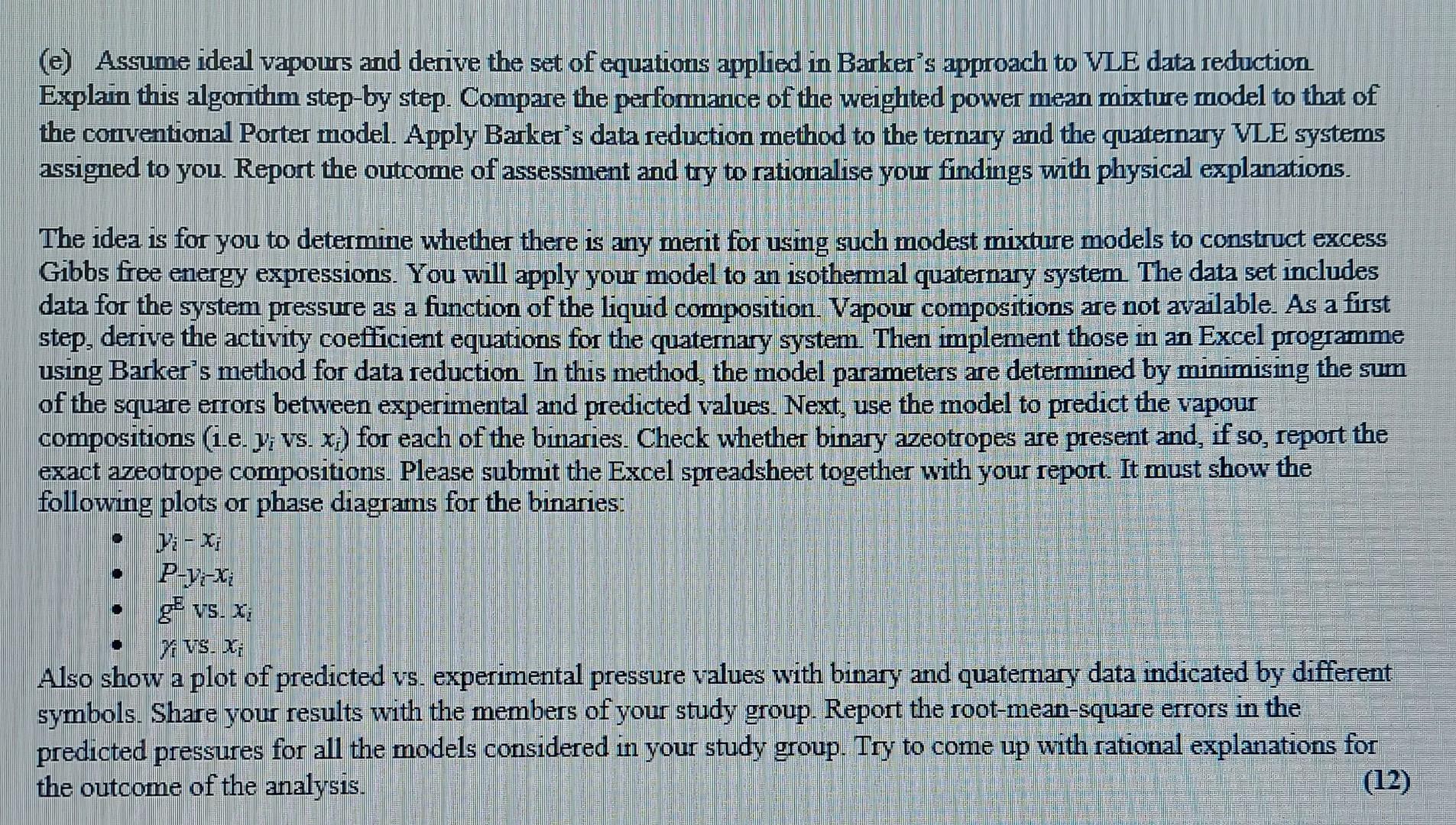
e Assume ideal vapours and derive the set of equations applied in Barker's approach to VLE data reduction Explain this algorithm step-by step. Compare the performance of the weighted power mean mixture model to that of the conventional Porter model. Apply Barker's data reduction method to the ternary and the quaternary VLE systems assigned to you. Report the outcome of assessment and try to rationalise you findings with physical explanations. The idea is for you to determine whether there is any merit for using such modest mixture models to construct excess Gibbs free energy expressions. You will apply your model to an isothermal quaternary system. The data set includes data for the system pressure as a function of the liquid composition. Vapour compositions are not available. As a first step, derive the activity coefficient equations for the quaternary system. Then implement those in an Excel programme using Barker's method for data reduction In this methodthe model parameters are determined by minimising the sum of the square errors between experimental and predicted values. Next, use the model to predict the vapour compositions (ie. y; Vs. X:) for each of the binaries. Check whether binary azeotropes are present and, if so, report the exact azeotrope compositions. Please submit the Excel spreadsheet together with your report. It must show the following plots or phase diagrams for the binaries: P-V-X; g vs. x; 7 VS. I Also show a plot of predicted vs. experimental pressure values with binary and quatemary data indicated by different symbols. Share your results with the members of your study group. Report the root-mean-square errors in the predicted pressures for all the models considered in your study group. Try to come up with rational explanations for the outcome of the analysis. (12) e Assume ideal vapours and derive the set of equations applied in Barker's approach to VLE data reduction Explain this algorithm step-by step. Compare the performance of the weighted power mean mixture model to that of the conventional Porter model. Apply Barker's data reduction method to the ternary and the quaternary VLE systems assigned to you. Report the outcome of assessment and try to rationalise you findings with physical explanations. The idea is for you to determine whether there is any merit for using such modest mixture models to construct excess Gibbs free energy expressions. You will apply your model to an isothermal quaternary system. The data set includes data for the system pressure as a function of the liquid composition. Vapour compositions are not available. As a first step, derive the activity coefficient equations for the quaternary system. Then implement those in an Excel programme using Barker's method for data reduction In this methodthe model parameters are determined by minimising the sum of the square errors between experimental and predicted values. Next, use the model to predict the vapour compositions (ie. y; Vs. X:) for each of the binaries. Check whether binary azeotropes are present and, if so, report the exact azeotrope compositions. Please submit the Excel spreadsheet together with your report. It must show the following plots or phase diagrams for the binaries: P-V-X; g vs. x; 7 VS. I Also show a plot of predicted vs. experimental pressure values with binary and quatemary data indicated by different symbols. Share your results with the members of your study group. Report the root-mean-square errors in the predicted pressures for all the models considered in your study group. Try to come up with rational explanations for the outcome of the analysis. (12)
Step by Step Solution
There are 3 Steps involved in it

Get step-by-step solutions from verified subject matter experts
 Study Help