







Question: Please help!! Exercise 2.2 (25 pts): This exercise has three parts. (a) Use the chain rule to write the partial derivatives # and ,, in
Please help!!
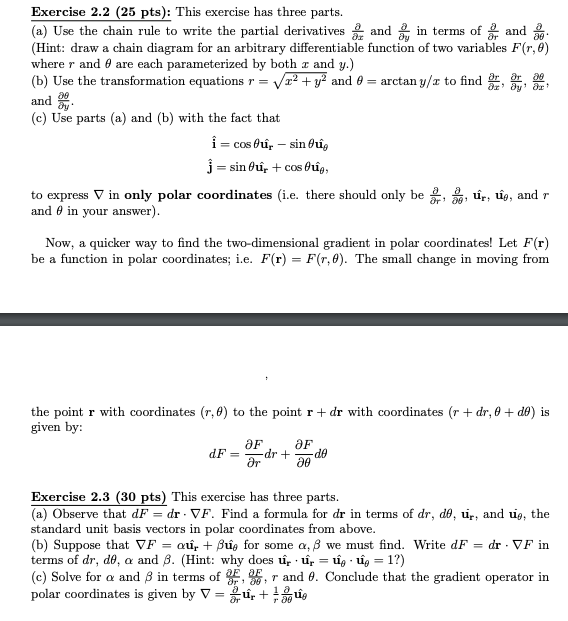
Exercise 2.2 (25 pts): This exercise has three parts. (a) Use the chain rule to write the partial derivatives # and ,, in terms of # and a. (Hint: draw a chain diagram for an arbitrary differentiable function of two variables F(r, 0) where r and # are each parameterized by both r and y.) (b) Use the transformation equations r = vr" + y' and 0 = arctany/ to find of, dy' ar: and Dy' (c) Use parts (a) and (b) with the fact that i = cos fur - sin dug j = sin dur + cosdue, to express V in only polar coordinates (i.e. there should only be #, #, up, up, and r and # in your answer). Now, a quicker way to find the two-dimensional gradient in polar coordinates! Let F(r) be a function in polar coordinates; i.e. F(r) = F(r, #). The small change in moving from the point r with coordinates (r, ) to the point r + dr with coordinates (r + dr, # + do) is given by: dF = OF or -dr + OF de Exercise 2.3 (30 pts) This exercise has three parts. (a) Observe that dF = dr . VF. Find a formula for dr in terms of dr, do, up, and up, the standard unit basis vectors in polar coordinates from above. (b) Suppose that VF = our + Bus for some a, 8 we must find. Write dF = dr . VF in terms of dr, de, a and B. (Hint: why does up . up = up . up = 1?) (c) Solve for a and 8 in terms of &5, DE draws: " and e. Conclude that the gradient operator in polar coordinates is given by V = Zu,+ lau
Step by Step Solution
There are 3 Steps involved in it

Get step-by-step solutions from verified subject matter experts
 Study Help