







Question: please help! Exercise 6-14 Physical Flow, Equivalent Units, Unit Costs, No Beginning WIP Inventory, Activity-Based Costing, DBC McKay, Inc, produces a subassembly used in the
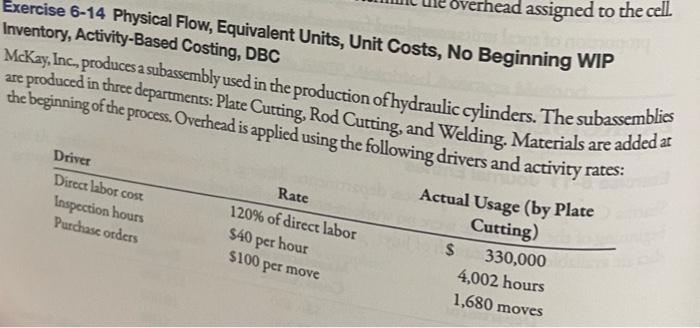
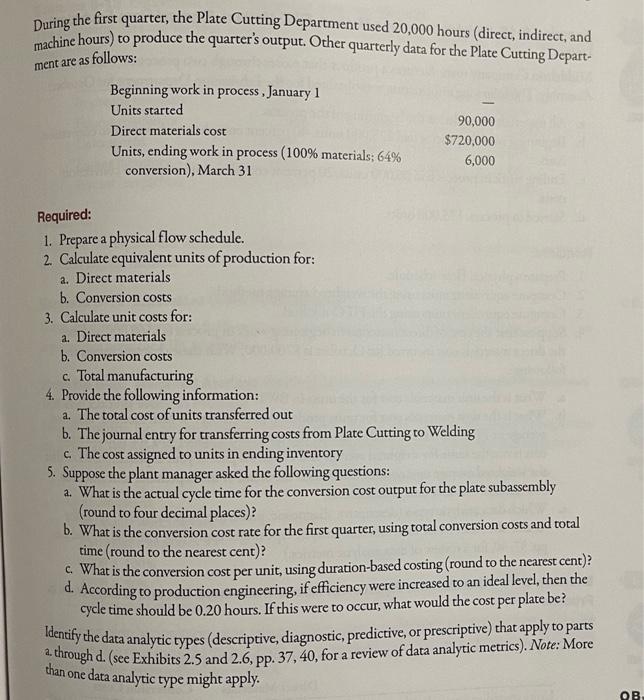
Exercise 6-14 Physical Flow, Equivalent Units, Unit Costs, No Beginning WIP Inventory, Activity-Based Costing, DBC McKay, Inc, produces a subassembly used in the production of hydraulic cylinders. The subassemblies are produced in three departments: Plate Cutting, Rod Cutting, and Welding. Materinle ner ndded at the boginning of the process. Overhead is applied usino th. C.II2 During the first quarter, the Plate Cutting Department used 20,000 hours (direct, indirect, and machine hours) to produce the quarter's output. Other quarterly data for the Plate Cutting Department are as follows: Required: 1. Prepare a physical flow schedule. 2. Calculate equivalent units of production for: 2. Direct materials b. Conversion costs 3. Calculate unit costs for: 2. Direct materials b. Conversion costs c. Total manufacturing 4. Provide the following information: a. The total cost of units transferred out b. The journal entry for transferring costs from Plate Cutting to Welding c. The cost assigned to units in ending inventory 5. Suppose the plant manager asked the following questions: a. What is the actual cycle time for the conversion cost output for the plate subassembly (round to four decimal places)? b. What is the conversion cost rate for the first quarter, using total conversion costs and total time (round to the nearest cent)? c. What is the conversion cost per unit, using duration-based costing (round to the nearest cent)? d. According to production engineering, if efficiency were increased to an ideal level, then the cycle time should be 0.20 hours. If this were to occur, what would the cost per plate be? Identify the data analytic types (descriptive, diagnostic, predictive, or prescriptive) that apply to parts a. through d. (see Exhibits 2.5 and 2.6, pp. 37,40 , for a review of data analytic metrics). Note: More than one data analytic type might apply
Step by Step Solution
There are 3 Steps involved in it

Get step-by-step solutions from verified subject matter experts
 Study Help