







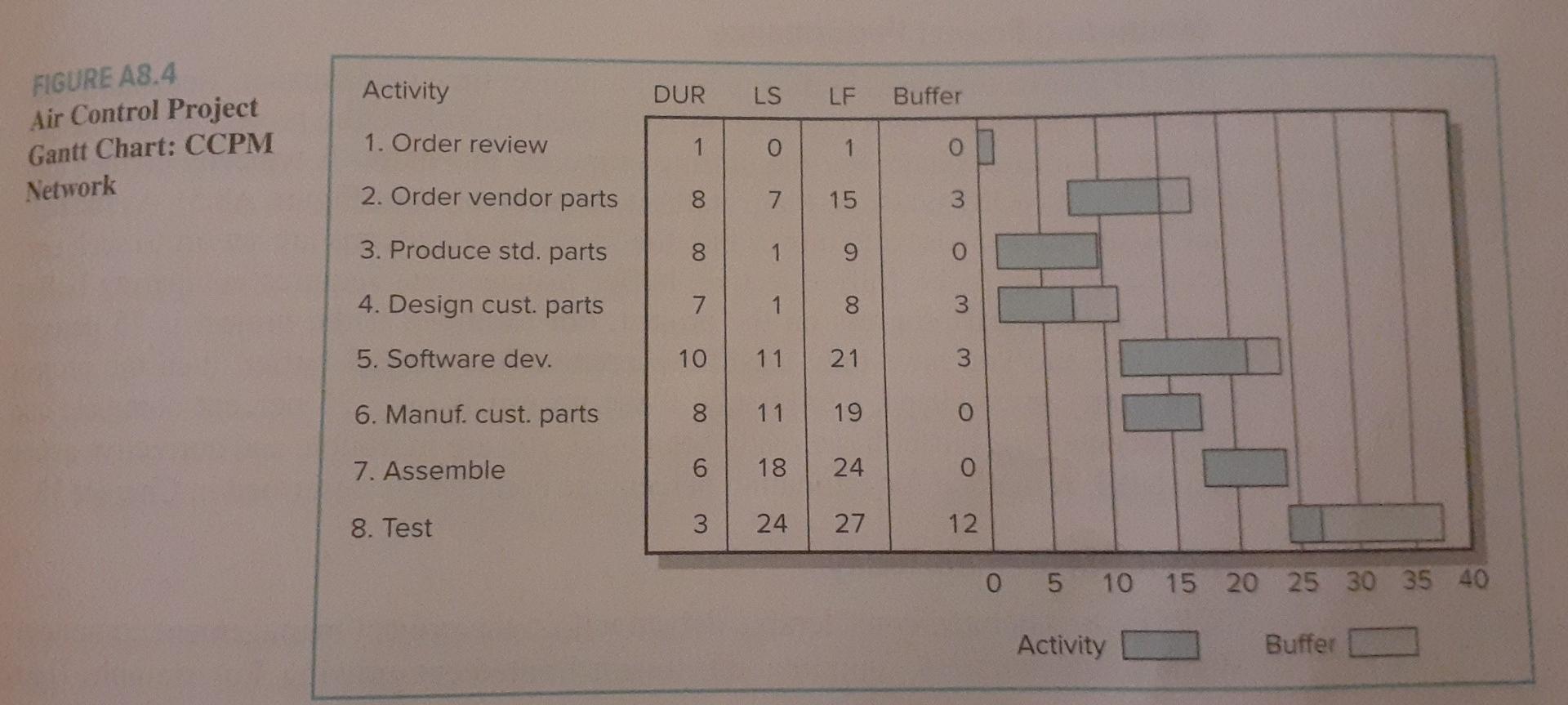
Question: please help FIGURE A8.4 Air Control Project Gantt Chart: CCPM Network order review. Instead they are scheduled later in the project. Three-day have been added
please help
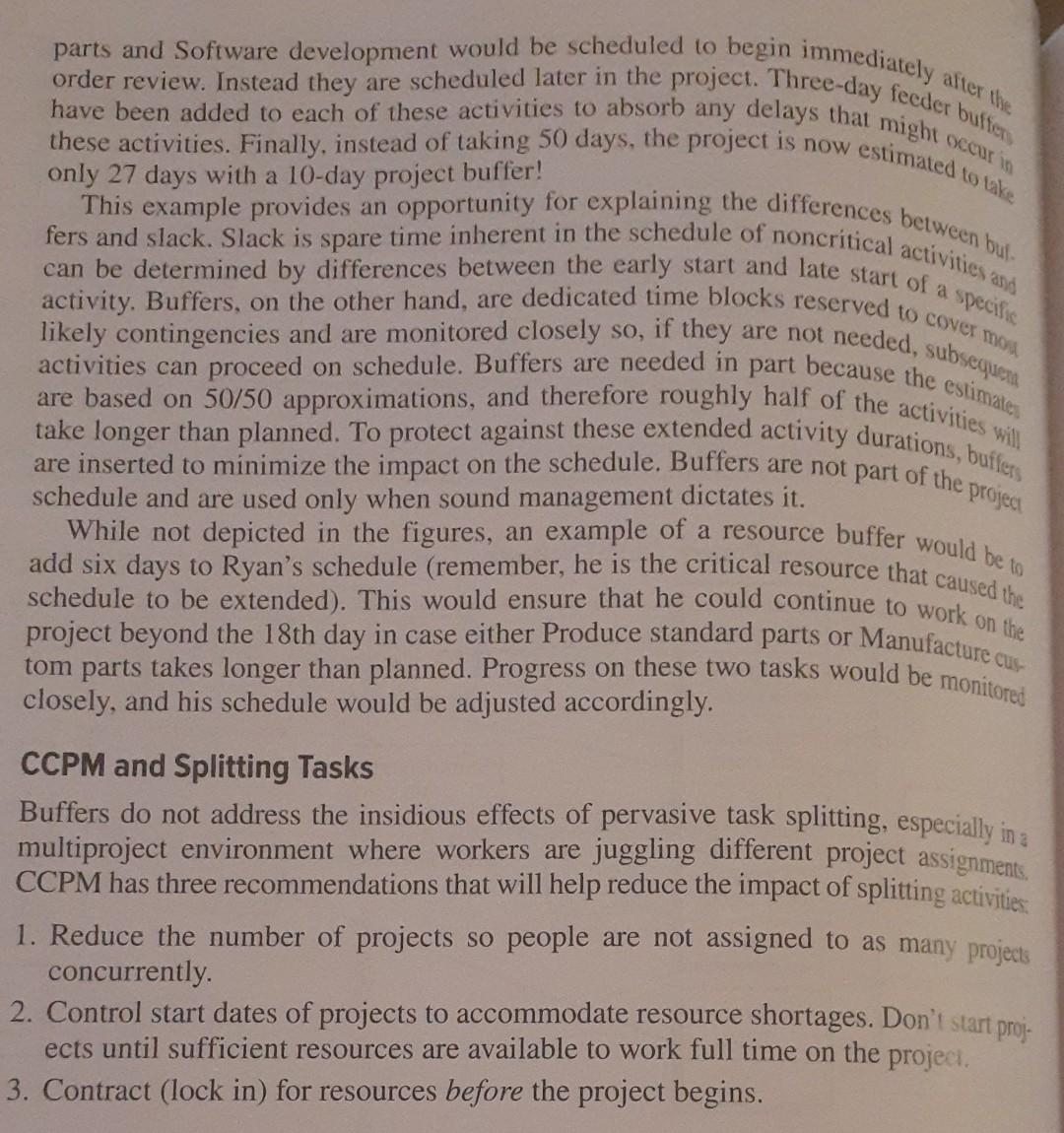
FIGURE A8.4 Air Control Project Gantt Chart: CCPM Network order review. Instead they are scheduled later in the project. Three-day have been added to each of these activities to absorb any delays that might ofe to these activities. Finally, instead of taking 50 days, the project is now estimated to to the only 27 days with a 10 -day project buffer! This example provides an opportunity for explaining the differences between buf. fers and slack. Slack is spare time inherent in the schedule of noncritical activities and activity. Buffers, on the other hand, are dedicated time blocks reserved to cover moy likely contingencies and are monitored closely so, if they are not needed, subsecluenty activities can proceed on schedule. Buffers are needed in part because the estimatef are based on 50/50 approximations, and therefore roughly half of the activities will take longer than planned. To protect against these extended activity durations, buffery are inserted to minimize the impact on the schedule. Buffers are not part of the projeg schedule and are used only when sound management dictates it. While not depicted in the figures, an example of a resource buffer would be to add six days to Ryan's schedule (remember, he is the critical resource that caused the schedule to be extended). This would ensure that he could continue to work on the project beyond the 18 th day in case either Produce standard parts or Manufacture curtom parts takes longer than planned. Progress on these two tasks would be monitored closely, and his schedule would be adjusted accordingly. CCPM and Splitting Tasks Buffers do not address the insidious effects of pervasive task splitting, especially in a multiproject environment where workers are juggling different project assignments, CCPM has three recommendations that will help reduce the impact of splitting activities: 1. Reduce the number of projects so people are not assigned to as many projects concurrently. 2. Control start dates of projects to accommodate resource shortages. Don't start projects until sufficient resources are available to work full time on the project. 3. Contract (lock in) for resources before the project begins. FIGURE A8.4 Air Control Project Gantt Chart: CCPM Network order review. Instead they are scheduled later in the project. Three-day have been added to each of these activities to absorb any delays that might ofe to these activities. Finally, instead of taking 50 days, the project is now estimated to to the only 27 days with a 10 -day project buffer! This example provides an opportunity for explaining the differences between buf. fers and slack. Slack is spare time inherent in the schedule of noncritical activities and activity. Buffers, on the other hand, are dedicated time blocks reserved to cover moy likely contingencies and are monitored closely so, if they are not needed, subsecluenty activities can proceed on schedule. Buffers are needed in part because the estimatef are based on 50/50 approximations, and therefore roughly half of the activities will take longer than planned. To protect against these extended activity durations, buffery are inserted to minimize the impact on the schedule. Buffers are not part of the projeg schedule and are used only when sound management dictates it. While not depicted in the figures, an example of a resource buffer would be to add six days to Ryan's schedule (remember, he is the critical resource that caused the schedule to be extended). This would ensure that he could continue to work on the project beyond the 18 th day in case either Produce standard parts or Manufacture curtom parts takes longer than planned. Progress on these two tasks would be monitored closely, and his schedule would be adjusted accordingly. CCPM and Splitting Tasks Buffers do not address the insidious effects of pervasive task splitting, especially in a multiproject environment where workers are juggling different project assignments, CCPM has three recommendations that will help reduce the impact of splitting activities: 1. Reduce the number of projects so people are not assigned to as many projects concurrently. 2. Control start dates of projects to accommodate resource shortages. Don't start projects until sufficient resources are available to work full time on the project. 3. Contract (lock in) for resources before the project beginsStep by Step Solution
There are 3 Steps involved in it
1 Expert Approved Answer
Step: 1 Unlock

Question Has Been Solved by an Expert!
Get step-by-step solutions from verified subject matter experts
Step: 2 Unlock
Step: 3 Unlock
 Study Help