







Question: Please help fill in spreadsheet. I am completely lost beyond what I have completed. Scenarior Info: -fully depreciated building -the project was expected to be
Please help fill in spreadsheet. I am completely lost beyond what I have completed. 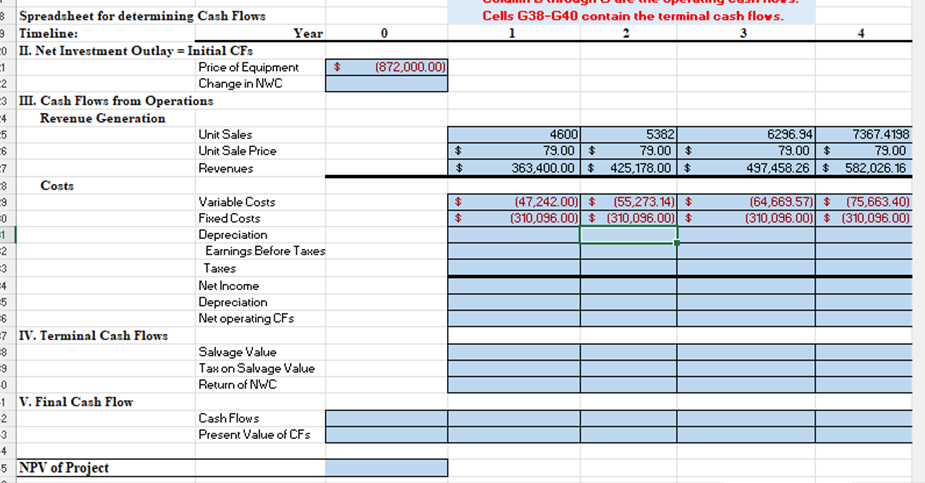
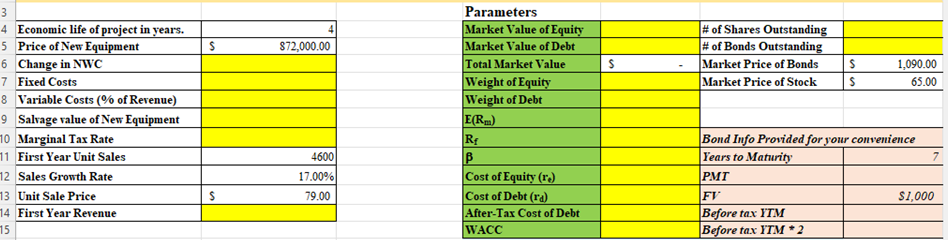
| Scenarior Info: -fully depreciated building -the project was expected to be discontinued in four years. -expected to sell for $ 79 per unit -projected sales of 4600 units in the first year with a projected 17.0 % growth rate per year for subsequent years -total investment of $ 872,000 for new equipment -equipment had fixed maintenance contracts of $ 310,096 per year with a salvage value of $ 172,629 -variable costs were 13 % of revenues -Best-Case and Worst-Case scenarios in the analysis with growth rates of 27.00 % and 1.70 % respectively |
| -The new equipment would be depreciated to zero using straight line depreciation -The new project required an increase in working capital of $ 197,890 and $ 31,662 of this increase would be offset with accounts payable. -The company currently has 966000 shares of stock outstanding at a current price of $ 65.00. - equity beta is 0.88 |
| -117,000 bonds outstanding, with a current price of $ 1,090.00. -The bonds pay interest semi-annually at a coupon rate of 7.40 %. -The bonds have a par value of $1,000 and will mature in 7 years. -average corporate tax rate is 35 %. -the cost of equity is calculated using the company's equity beta and the market risk premium based on the S&P 500 annual expected rate of return (calculate the monthly expected market return using 5 years of past monthly price data available in the worksheet Marketdata then multiply by 12 to estimate the annual expected rate. - if the expected rate of return for the market was too low, too high, or negative, a forward looking rate of an historical average of about 9.5% would have to be used, as the calculated value for the current 5-year period may not be representative of the future. -calculate the market risk premium: E(Rm) - Rf from the previous calculations using the risk-free rate data available in the worksheet Marketdata -the risk-free rate ison an annual basis -calculate the rate at which the project would have to be discounted to calculate the Net Present Value (NPV) of the proposed project based on the decision of raising capital and the current capital market environment. This discount rate, the WACC, would obviously influence the NPV and could affect the decision of whether to accept or reject the project. |
NPV of Project \begin{tabular}{|l|l|r|} \hline 3 & & \\ \hline 4 & Economic life of project in years. & \\ 5 & Price of New Equipment & $ \\ \hline 6 & Change in NWC & \\ 7 & Fixed Costs \\ 8 & Variable Costs (\% of Revenue) & \\ 9 & Salvage ralue of New Equipment & \\ \hline 10 & Marginal Tax Rate & \\ 11 & First Year Unit Sales & \\ \hline 12 & Sales Growth Rate & \\ \hline 13 & Unit Sale Price & $ \\ \hline 14 & First Year Revenue & \\ \hline \end{tabular} Parameters NPV of Project \begin{tabular}{|l|l|r|} \hline 3 & & \\ \hline 4 & Economic life of project in years. & \\ 5 & Price of New Equipment & $ \\ \hline 6 & Change in NWC & \\ 7 & Fixed Costs \\ 8 & Variable Costs (\% of Revenue) & \\ 9 & Salvage ralue of New Equipment & \\ \hline 10 & Marginal Tax Rate & \\ 11 & First Year Unit Sales & \\ \hline 12 & Sales Growth Rate & \\ \hline 13 & Unit Sale Price & $ \\ \hline 14 & First Year Revenue & \\ \hline \end{tabular} Parameters
Step by Step Solution
There are 3 Steps involved in it

Get step-by-step solutions from verified subject matter experts
 Study Help