







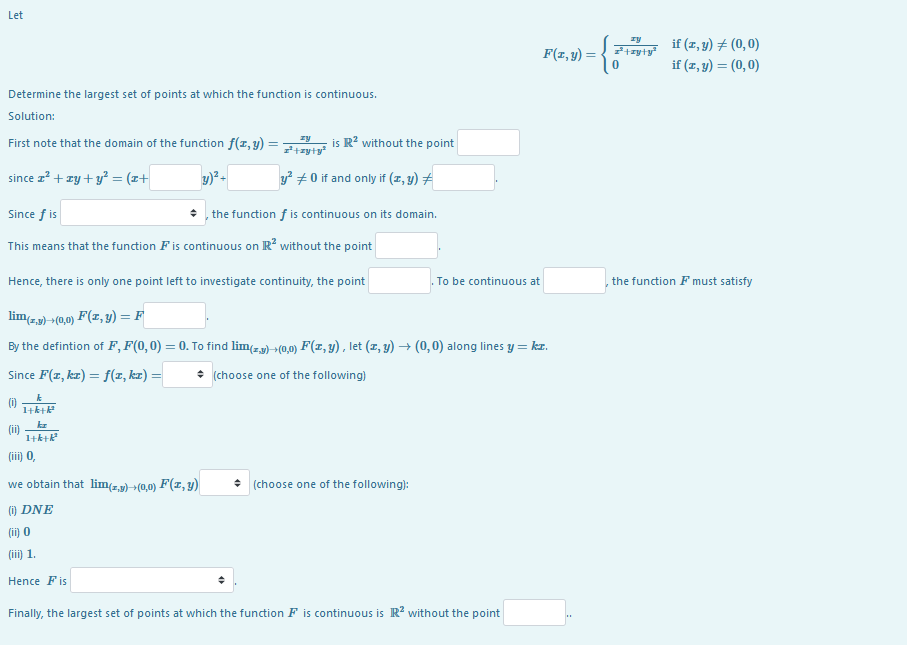
Question: Please Help fLet F(I, y) = if (I, y) # (0, 0) 0 if (x, y) = (0, 0) Determine the largest set of points

Please Help


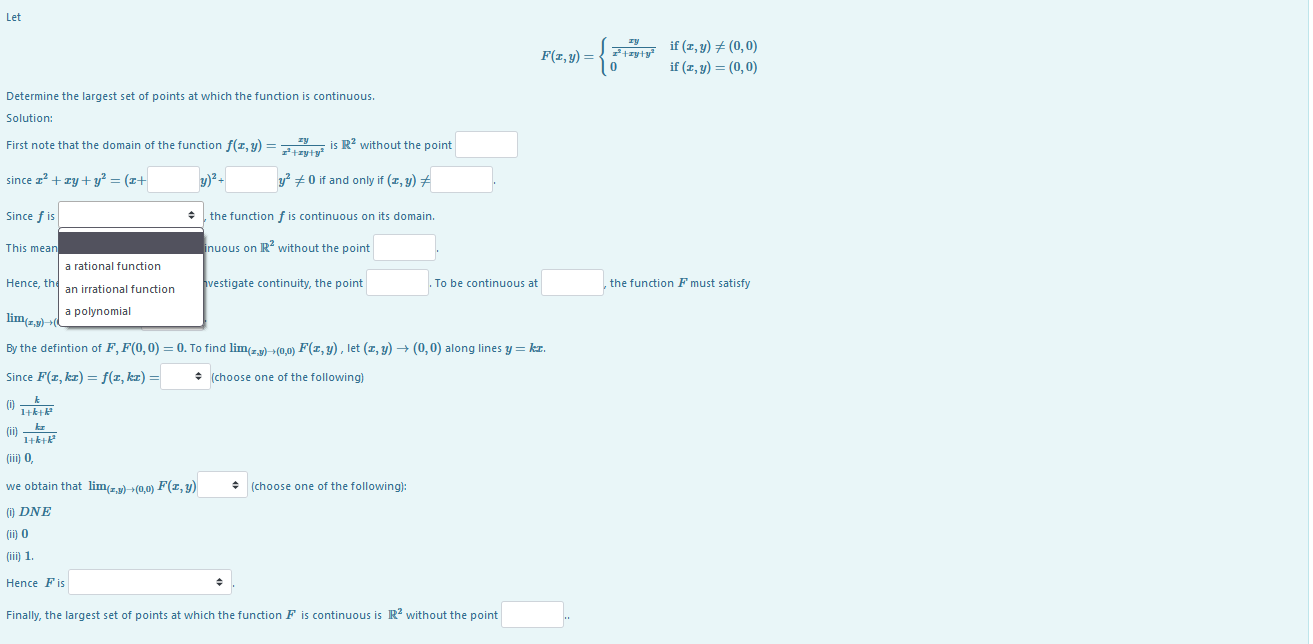
\fLet F(I, y) = if (I, y) # (0, 0) 0 if (x, y) = (0, 0) Determine the largest set of points at which the function is continuous. Solution: First note that the domain of the function f(I, y) = is R without the point since ' + ry + y? = (x+ y ) 2 y? # 0 if and only if (I, y) # Since f is the function f is continuous on its domain. This mean nuous on R without the point a rational function Hence, the an irrational function Investigate continuity, the point To be continuous at the function F must satisfy a polynomial lim(z,y) + By the defintion of F, F(0, 0) = 0. To find lim(z,3) +(0,0) F(I, y) , let (I, y) - (0, 0) along lines y = kr. Since F(I, kr) = f(I, kr) = * (choose one of the following) k (ii) - kr (iii) O, we obtain that lim(z,y) +(0,0) F(I, y) * (choose one of the following): (i) DNE (ii) 0 (iii) 1. Hence F is Finally, the largest set of points at which the function F is continuous is R without the pointLet F(I, y) = tryty" if (I, y) # (0, 0) if (I, y) = (0,0) Determine the largest set of points at which the function is continuous. Solution: First note that the domain of the function f(I, y) = , is R without the point since I' + ry + y' = (x+ y ) 2 + y' # 0 if and only if (I, y) # Since f is * , the function f is continuous on its domain. This means that the function F is continuous on R without the point Hence, there is only one point left to investigate continuity, the point To be continuous at the function F must satisfy lim(z,3) +(0,0) F(I, y) = F By the defintion of F, F(0, 0) = 0. To find lim(z,y) +(0,0) F(z, y) . let (z, y) - (0, 0) along lines y = kr. Since F(1, kr) = f(I, kx) = * (choose one of the following) (1) - k 1 + K + 13 (ii] KI 1 +k+k " (iii) O, we obtain that lim(z,y) +(0,0) F(I, y) * (choose one of the following): (i) DNE (ii) 0 (iii) 1. Hence F is Finally, the function F is continuous is IR without the point is not continuous at (0,0) is continuous at (0,0)
Step by Step Solution
There are 3 Steps involved in it

Get step-by-step solutions from verified subject matter experts
 Study Help