Question: please help how does lean production, customer value, and waste link into the article? The Toyota Production System's Forgotten Production Concepts As argued earlier, popular
please help how does lean production, customer value, and waste link into the article?
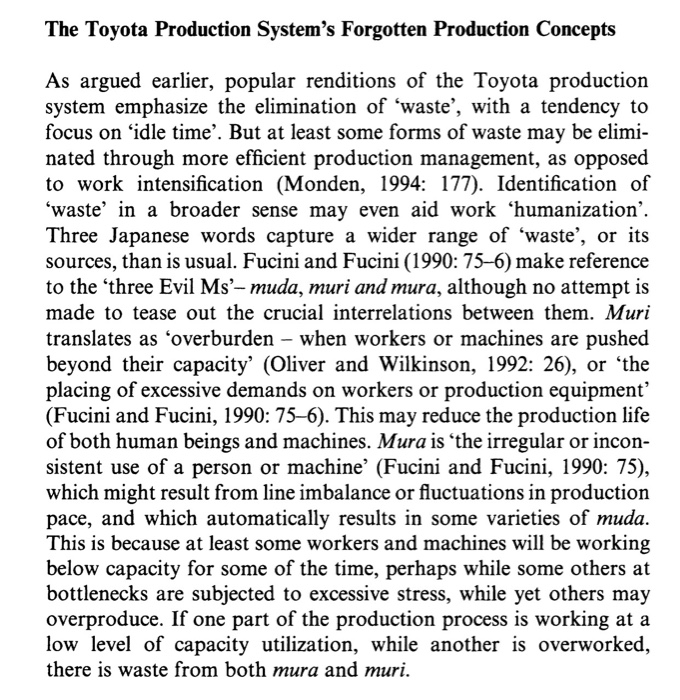
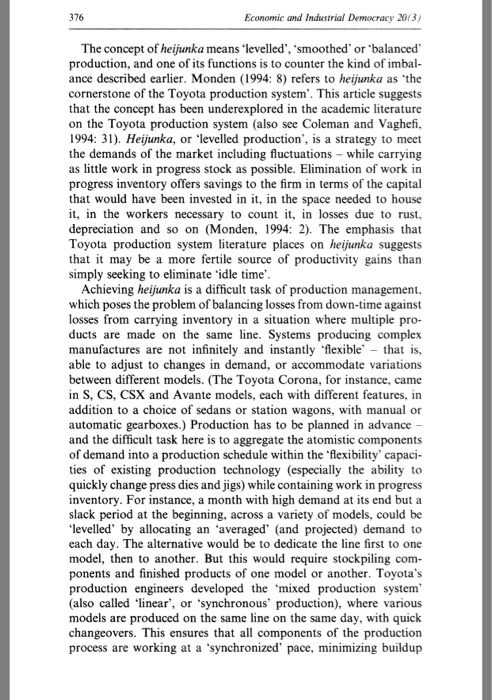
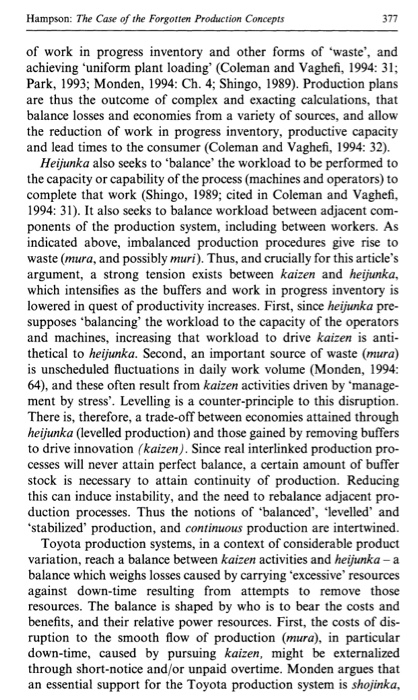
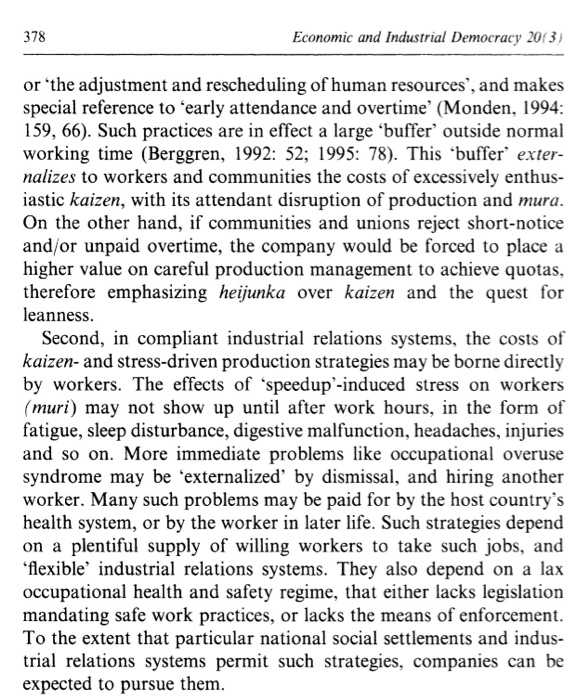
The Toyota Production System's Forgotten Production Concepts As argued earlier, popular renditions of the Toyota production system emphasize the elimination of 'waste', with a tendency to focus on 'idle time'. But at least some forms of waste may be elimi- nated through more efficient production management, as opposed to work intensification (Monden, 1994: 177). Identification of 'waste' in a broader sense may even aid work 'humanization'. Three Japanese words capture a wider range of 'waste', or its sources, than is usual. Fucini and Fucini (1990: 75-6) make reference to the three Evil Ms- muda, muri and mura, although no attempt is made to tease out the crucial interrelations between them. Muri translates as 'overburden - when workers or machines are pushed beyond their capacity (Oliver and Wilkinson, 1992: 26), or 'the placing of excessive demands on workers or production equipment' (Fucini and Fucini, 1990: 756). This may reduce the production life of both human beings and machines. Mura is 'the irregular or incon- sistent use of a person or machine' (Fucini and Fucini, 1990: 75), which might result from line imbalance or fluctuations in production pace, and which automatically results in some varieties of muda. This is because at least some workers and machines will be working below capacity for some of the time, perhaps while some others at bottlenecks are subjected to excessive stress, while yet others may overproduce. If one part of the production process is working at a low level of capacity utilization, while another is overworked, there is waste from both mura and muri. 176 Economic and Industrial Democracy 2013) The concept of heijunka means 'levelled', 'smoothed' or 'balanced production, and one of its functions is to counter the kind of imbal- ance described earlier. Monden (1994: 8) refers to heijunka as the cornerstone of the Toyota production system. This article suggests that the concept has been underexplored in the academic literature on the Toyota production system (also see Coleman and Vaghefi, 1994: 31). Heijunka, or 'levelled production, is a strategy to meet the demands of the market including fluctuations - while carrying as little work in progress stock as possible. Elimination of work in progress inventory offers savings to the firm in terms of the capital that would have been invested in it, in the space needed to house it, in the workers necessary to count it, in losses due to rust, depreciation and so on (Monden, 1994: 2). The emphasis that Toyota production system literature places on heijunka suggests that it may be a more fertile source of productivity gains than simply seeking to eliminate 'idle time'. Achieving heijunka is a difficult task of production management, which poses the problem of balancing losses from down-time against losses from carrying inventory in a situation where multiple pro- ducts are made on the same line. Systems producing complex manufactures are not infinitely and instantly flexible' - that is able to adjust to changes in demand, or accommodate variations between different models. (The Toyota Corona, for instance, came in S, CS, CSX and Avante models, each with different features, in addition to a choice of sedans or station wagons, with manual or automatic gearboxes.) Production has to be planned in advance - and the difficult task here is to aggregate the atomistic components of demand into a production schedule within the flexibility capaci- ties of existing production technology (especially the ability to quickly change press dies and jigs) while containing work in progress inventory. For instance, a month with high demand at its end but a slack period at the beginning, across a variety of models, could be 'levelled' by allocating an averaged and projected) demand to each day. The alternative would be to dedicate the line first to one model, then to another. But this would require stockpiling com- ponents and finished products of one model or another. Toyota's production engineers developed the 'mixed production system (also called 'linear", or "synchronous production), where various models are produced on the same line on the same day, with quick changeovers. This ensures that all components of the production process are working at a 'synchronized' pace, minimizing buildup Hampson: The Case of the Forgotten Production Concepts 377 of work in progress inventory and other forms of 'waste', and achieving 'uniform plant loading' (Coleman and Vaghefi, 1994: 31; Park, 1993; Monden, 1994: Ch. 4: Shingo, 1989). Production plans are thus the outcome of complex and exacting calculations, that balance losses and economies from a variety of sources, and allow the reduction of work in progress inventory, productive capacity and lead times to the consumer (Coleman and Vaghefi, 1994: 32). Heijunka also seeks to "balance the workload to be performed to the capacity or capability of the process (machines and operators) to complete that work (Shingo, 1989; cited in Coleman and Vaghefi, 1994: 31). It also seeks to balance workload between adjacent com- ponents of the production system, including between workers. As indicated above, imbalanced production procedures give rise to waste (mura, and possibly muri). Thus, and crucially for this article's argument, a strong tension exists between kaizen and heijunka, which intensifies as the buffers and work in progress inventory is lowered in quest of productivity increases. First, since heijunka pre- supposes 'balancing the workload to the capacity of the operators and machines, increasing that workload to drive kaizen is anti- thetical to heijunka. Second, an important source of waste (mura) is unscheduled fluctuations in daily work volume (Monden, 1994: 64), and these often result from kaizen activities driven by 'manage- ment by stress'. Levelling is a counter-principle to this disruption. There is, therefore, a trade-off between economies attained through heijunka (levelled production) and those gained by removing buffers to drive innovation (kaizen). Since real interlinked production pro- cesses will never attain perfect balance, a certain amount of buffer stock is necessary to attain continuity of production. Reducing this can induce instability, and the need to rebalance adjacent pro- duction processes. Thus the notions of "balanced', 'levelled" and stabilized production, and continuous production are intertwined. Toyota production systems, in a context of considerable product variation, reach a balance between kaizen activities and heijunka-a balance which weighs losses caused by carrying 'excessive resources against down-time resulting from attempts to remove those resources. The balance is shaped by who is to bear the costs and benefits, and their relative power resources. First, the costs of dis- ruption to the smooth flow of production (mura), in particular down-time, caused by pursuing kaizen, might be externalized through short-notice and/or unpaid overtime. Monden argues that an essential support for the Toyota production system is shojinka, 378 Economic and Industrial Democracy 2013) or 'the adjustment and rescheduling of human resources', and makes special reference to "early attendance and overtime' (Monden, 1994: 159, 66). Such practices are in effect a large buffer' outside normal working time (Berggren, 1992: 52; 1995: 78). This 'buffer exter- nalizes to workers and communities the costs of excessively enthus- iastic kaizen, with its attendant disruption of production and mura. On the other hand, if communities and unions reject short-notice and/or unpaid overtime, the company would be forced to place a higher value on careful production management to achieve quotas, therefore emphasizing heijunka over kaizen and the quest for leanness. Second, in compliant industrial relations systems, the costs of kaizen-and stress-driven production strategies may be borne directly by workers. The effects of 'speedup'-induced stress on workers (muri) may not show up until after work hours, in the form of fatigue, sleep disturbance, digestive malfunction, headaches, injuries and so on. More immediate problems like occupational overuse syndrome may be 'externalized' by dismissal, and hiring another worker. Many such problems may be paid for by the host country's health system, or by the worker in later life. Such strategies depend on a plentiful supply of willing workers to take such jobs, and 'flexible' industrial relations systems. They also depend on a lax occupational health and safety regime, that either lacks legislation mandating safe work practices, or lacks the means of enforcement. To the extent that particular national social settlements and indus- trial relations systems permit such strategies, companies can be expected to pursue them









 Study Help