







Question: PLEASE HELP! I am so lost. TY ! You must write out each step of the calculation. Show the equations you are using at each
PLEASE HELP! I am so lost. TY
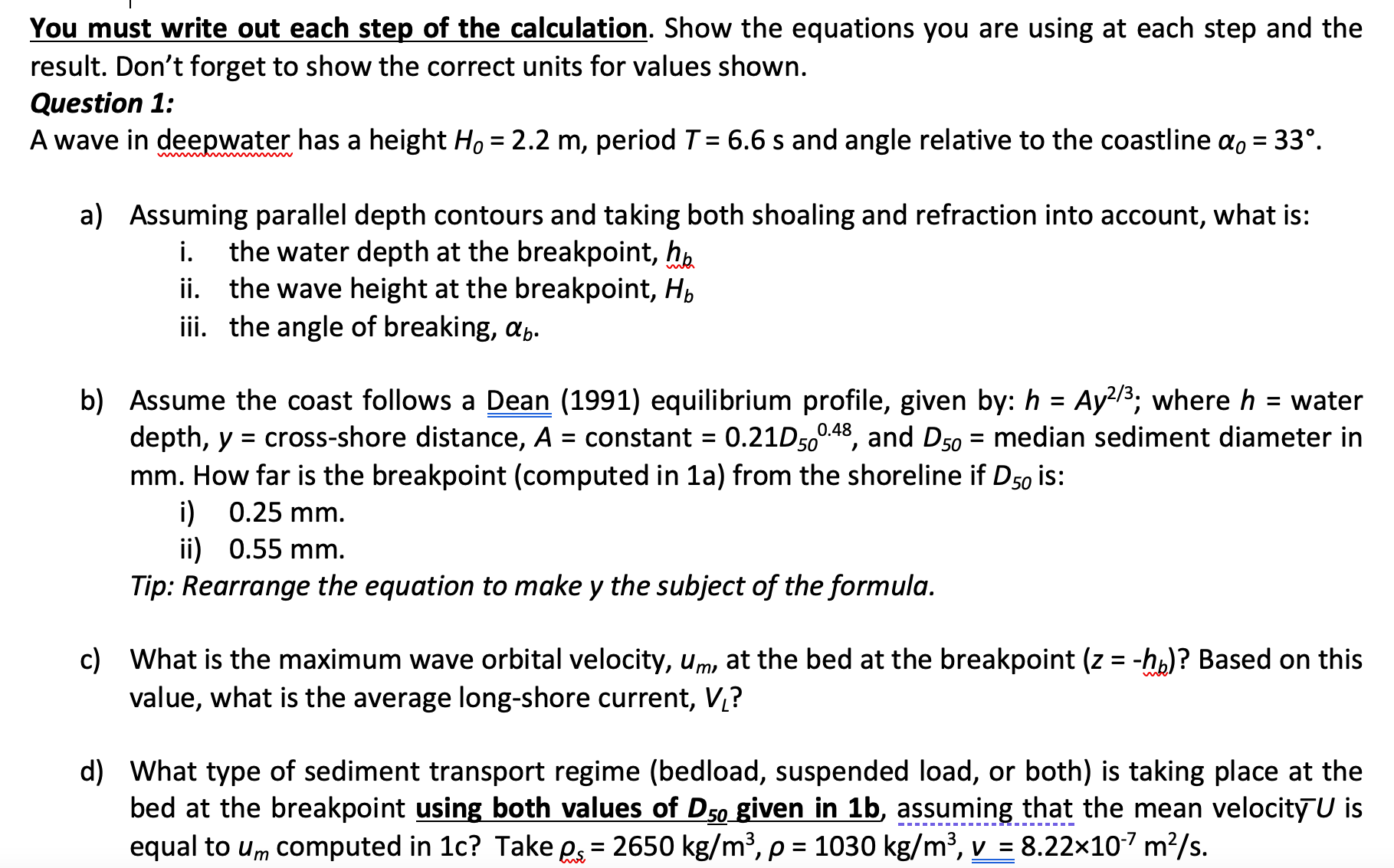
You must write out each step of the calculation. Show the equations you are using at each step and the
result. Don't forget to show the correct units for values shown.
Question :
A wave in deepwater has a height period and angle relative to the coastline
a Assuming parallel depth contours and taking both shoaling and refraction into account, what is:
i the water depth at the breakpoint,
ii the wave height at the breakpoint,
iii. the angle of breaking,
b Assume the coast follows a Dean equilibrium profile, given by: ; where water
depth, crossshore distance, constant and median sediment diameter in
How far is the breakpoint computed in a from the shoreline if is:
i
ii
Tip: Rearrange the equation to make y the subject of the formula.
c What is the maximum wave orbital velocity, at the bed at the breakpoint Based on this
value, what is the average longshore current,
d What type of sediment transport regime bedload suspended load, or both is taking place at the
bed at the breakpoint using both values of given in assuming that the mean velocity is
equal to computed in Take
Step by Step Solution
There are 3 Steps involved in it
1 Expert Approved Answer
Step: 1 Unlock

Question Has Been Solved by an Expert!
Get step-by-step solutions from verified subject matter experts
Step: 2 Unlock
Step: 3 Unlock
 Study Help