



Question: Please help! I believe I did it correctly on my own but I'm a bit confused. I chose fisher's LSD for c). This is all
Please help! I believe I did it correctly on my own but I'm a bit confused. I chose fisher's LSD for c). This is all the info I'm given for this question.
I first computed the Dunns test then c) would be fishers. The R-output gives the means which would be x_bar1-x_bar2.
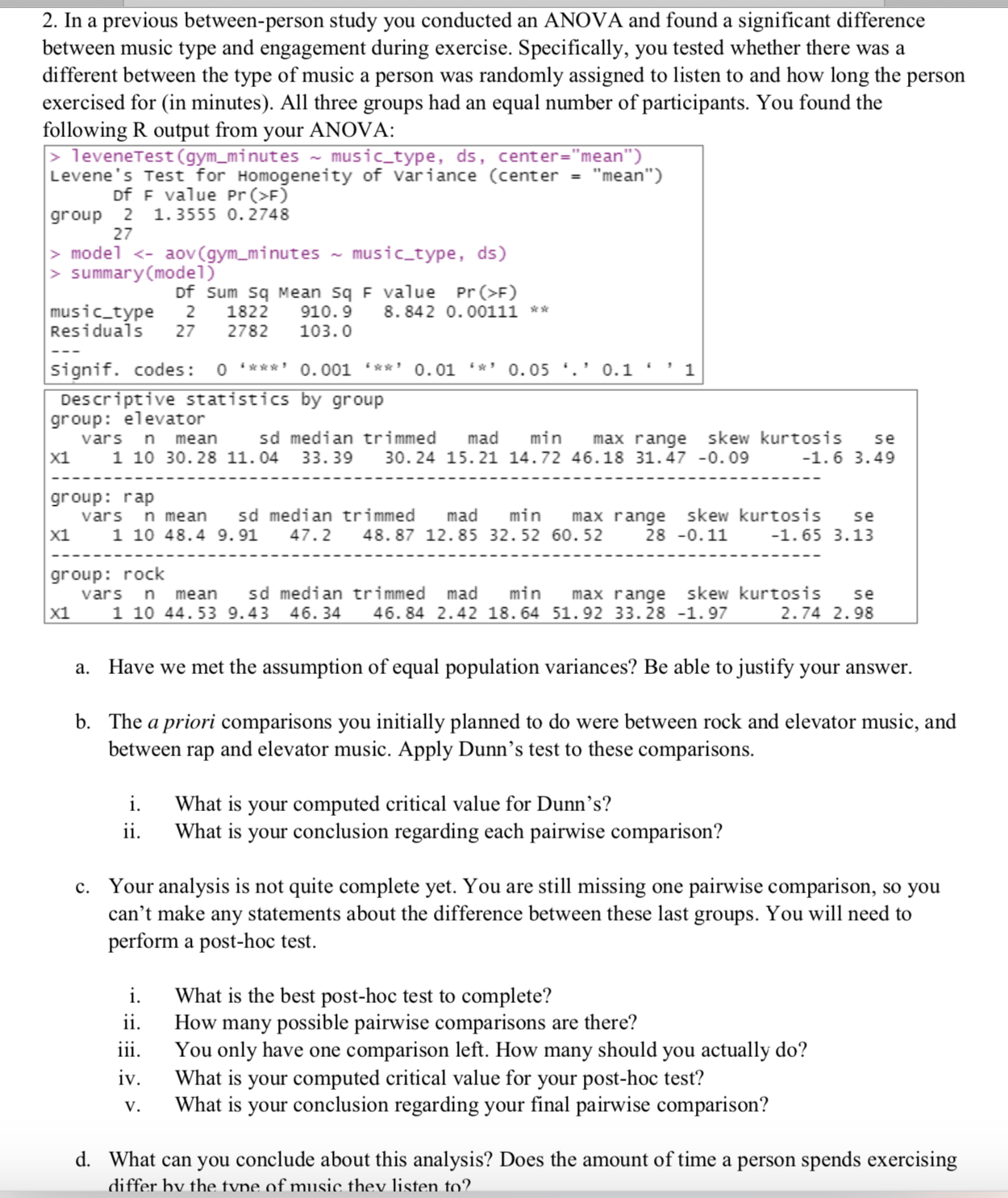
2. In a previous between-person study you conducted an ANOVA and found a signicant difference between music type and engagement during exercise. Specically, you tested whether there was a different between the type of music a person was randomly assigned to listen to and how long the person exercised for (in minutes). All three groups had an equal number of participants. You found the following R output 'om your ANOVA: > leveneTest(gym_minutes ~ music_type, d5, center-"mean\") Levene's Test for Homogeneity of variance (center - "mean") Df F value Pr(>F) group 2 1.3555 0.2743 2? > model summary(model) of sum sq Hean sq F value Pr(>F) music_type 2 1822 910.9 8.842 0.00111 ** Residuals 27 2782 103.0 Signif. codes: 0 '***' 0.001 '**' 0.01 '*' 0.05 '.' 0.1 ' ' 1 Descriptive statistics by group group: elevator vars n mean sd median trimmed mad min max range skew kurtosis se 1 10 30.28 11.04 33.39 30.24 15.21 14.72 46.18 31.4? 0.09 group: rap vars n mean sd median trimmed mad min max range skew kurtosis 1 10 48.4 9.91 47.2 48.87 12.85 32.52 60.52 28 0.11 group: rock vars n mean sd median trimmed mad min max range skew kurtosis x1 1 10 44.53 9.43 46.34 46.84 2.42 18.64 51.92 33.23 -1.97 2.74 a. Have we met the assumption of equal population variances? Be able to justify your answer. b. The a prior-i comparisons you initially planned to do were between rock and elevator music, and between rap and elevator music. Apply Dunn's test to these comparisons. i. What is your computed critical value for Dunn's? ii. What is your conclusion regarding each pairwise comparison? c. Your analysis is not quite complete yet. You are still missing one pairwise comparison, so you can't make any statements about the difference between these last groups. You will need to perform a post-hoc test. i. What is the best post-hoc test to complete? ii. How many possible pairwise comparisons are there? iii. You only have one comparison left. How many should you actually do? iv. What is your computed critical value for your post-hoc test? v. What is your conclusion regarding your nal pairwise comparison? d. What can you conclude about this analysis? Does the amount of time a person spends exercising I. E5 I l E . l 1' 2
Step by Step Solution
There are 3 Steps involved in it

Get step-by-step solutions from verified subject matter experts