







Question: Please help i dont get this FOR MORE INFOMATION PLEASE REFER TO PLREVIOUS QUESTIONS BELOW, I am not asking u to do all of them
Please help i dont get this


FOR MORE INFOMATION PLEASE REFER TO PLREVIOUS QUESTIONS BELOW, I am not asking u to do all of them
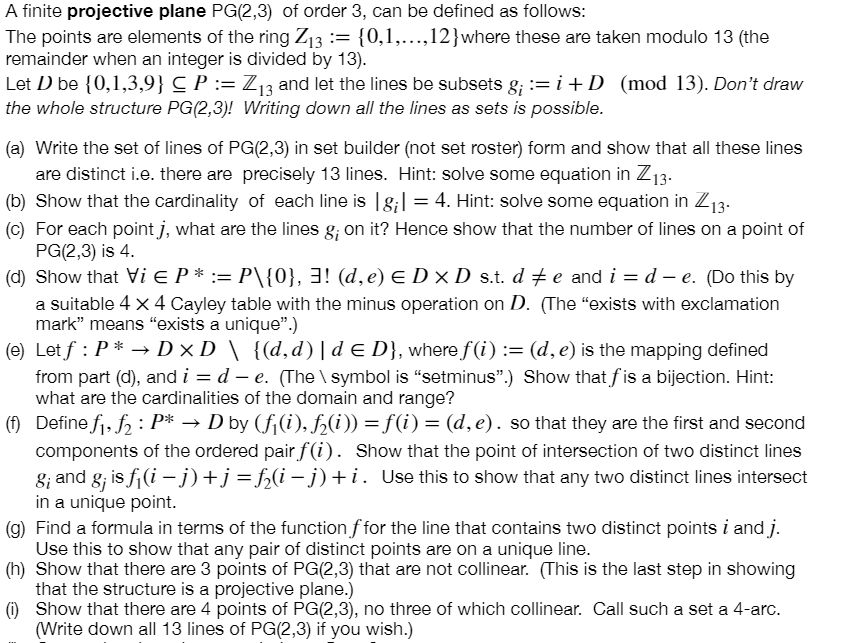
A finite projective plane PG(2,3) of order 3, can be defined as follows: The points are elements of the ring Z13:= {0,1,...,12}where these are taken modulo 13 (the remainder when an integer is divided by 13). Let D be {0,1,3,9} CP:=Z13 and let the lines be subsets gi=i+D (mod 13). Don't draw the whole structure PG(2,3)! Writing down all the lines as sets is possible. (1) Define fi, 52:P* D by (f;(i), fz(i)) =f(i) = (d,e). so that they are the first and second components of the ordered pair f(i). Show that the point of intersection of two distinct lines 8; and g; is f;(i j)+j = f(i j)+i. Use this to show that any two distinct lines intersect in a unique point. (9) Find a formula in terms of the function f for the line that contains two distinct points i and j. Use this to show that any pair of distinct points are on a unique line. A finite projective plane PG(2,3) of order 3, can be defined as follows: The points are elements of the ring Z13 := {0,1,...,12}where these are taken modulo 13 (the remainder when an integer is divided by 13). Let D be {0,1,3,9} CP:=Z13 and let the lines be subsets g;:=i+D (mod 13). Don't draw the whole structure PG(2,3)! Writing down all the lines as sets is possible. (a) Write the set of lines of PG(2,3) in set builder (not set roster) form and show that all these lines are distinct i.e. there are precisely 13 lines. Hint: solve some equation in Z13. (b) Show that the cardinality of each line is 18;) = 4. Hint: solve some equation in Z13. () For each point j, what are the lines g; on it? Hence show that the number of lines on a point of PG(2,3) is 4. (d) Show that Vi eP*:= P\{0}, 3! (d,e) EDxD s.t. d Ee and i = d-e. (Do this by a suitable 4 x 4 Cayley table with the minus operation on D. (The exists with exclamation mark" means "exists a unique".) (9) Letf :P* DxD \ {(d,d)|d D}, where f(i) := (d,e) is the mapping defined from part (d), and i= d - e. (The symbol is "setminus".) Show that f is a bijection. Hint: what are the cardinalities of the domain and range? (f) Define f1, 12:P* D by (f;(i), fz(i)) = f(i)=(d,e). so that they are the first and second components of the ordered pair f(i). Show that the point of intersection of two distinct lines &; and g; is f;(i j) +j =f(i j) +i. Use this to show that any two distinct lines intersect in a unique point. (9) Find a formula in terms of the function f for the line that contains two distinct points i and j. Use this to show that any pair of distinct points are on a unique line. (h) Show that there are 3 points of PG(2,3) that are not collinear. (This is the last step in showing that the structure is a projective plane.) Show that there are 4 points of PG(2,3), no three of which collinear. Call such a set a 4-arc. (Write down all 13 lines of PG(2,3) if you wish.) A finite projective plane PG(2,3) of order 3, can be defined as follows: The points are elements of the ring Z13:= {0,1,...,12}where these are taken modulo 13 (the remainder when an integer is divided by 13). Let D be {0,1,3,9} CP:=Z13 and let the lines be subsets gi=i+D (mod 13). Don't draw the whole structure PG(2,3)! Writing down all the lines as sets is possible. (1) Define fi, 52:P* D by (f;(i), fz(i)) =f(i) = (d,e). so that they are the first and second components of the ordered pair f(i). Show that the point of intersection of two distinct lines 8; and g; is f;(i j)+j = f(i j)+i. Use this to show that any two distinct lines intersect in a unique point. (9) Find a formula in terms of the function f for the line that contains two distinct points i and j. Use this to show that any pair of distinct points are on a unique line. A finite projective plane PG(2,3) of order 3, can be defined as follows: The points are elements of the ring Z13 := {0,1,...,12}where these are taken modulo 13 (the remainder when an integer is divided by 13). Let D be {0,1,3,9} CP:=Z13 and let the lines be subsets g;:=i+D (mod 13). Don't draw the whole structure PG(2,3)! Writing down all the lines as sets is possible. (a) Write the set of lines of PG(2,3) in set builder (not set roster) form and show that all these lines are distinct i.e. there are precisely 13 lines. Hint: solve some equation in Z13. (b) Show that the cardinality of each line is 18;) = 4. Hint: solve some equation in Z13. () For each point j, what are the lines g; on it? Hence show that the number of lines on a point of PG(2,3) is 4. (d) Show that Vi eP*:= P\{0}, 3! (d,e) EDxD s.t. d Ee and i = d-e. (Do this by a suitable 4 x 4 Cayley table with the minus operation on D. (The exists with exclamation mark" means "exists a unique".) (9) Letf :P* DxD \ {(d,d)|d D}, where f(i) := (d,e) is the mapping defined from part (d), and i= d - e. (The symbol is "setminus".) Show that f is a bijection. Hint: what are the cardinalities of the domain and range? (f) Define f1, 12:P* D by (f;(i), fz(i)) = f(i)=(d,e). so that they are the first and second components of the ordered pair f(i). Show that the point of intersection of two distinct lines &; and g; is f;(i j) +j =f(i j) +i. Use this to show that any two distinct lines intersect in a unique point. (9) Find a formula in terms of the function f for the line that contains two distinct points i and j. Use this to show that any pair of distinct points are on a unique line. (h) Show that there are 3 points of PG(2,3) that are not collinear. (This is the last step in showing that the structure is a projective plane.) Show that there are 4 points of PG(2,3), no three of which collinear. Call such a set a 4-arc. (Write down all 13 lines of PG(2,3) if you wish.)
Step by Step Solution
There are 3 Steps involved in it

Get step-by-step solutions from verified subject matter experts
 Study Help