







Question: please help i only have 30 min. Is it a word for word, or paraphrasing plagiarism, or this is not plagiarism Item 1 In the
please help i only have 30 min. Is it a word for word, or paraphrasing plagiarism, or this is not plagiarism 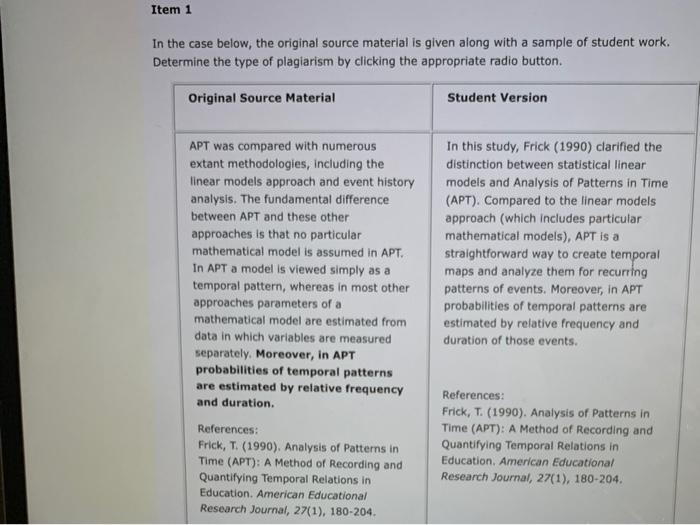
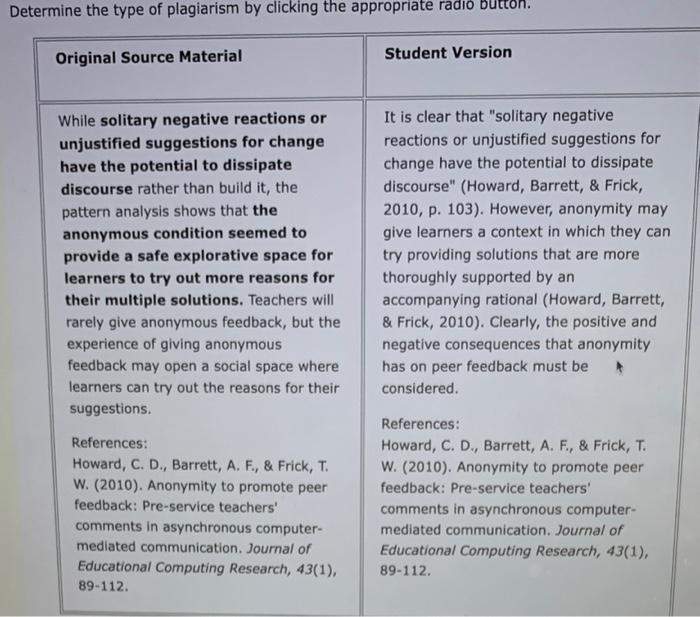
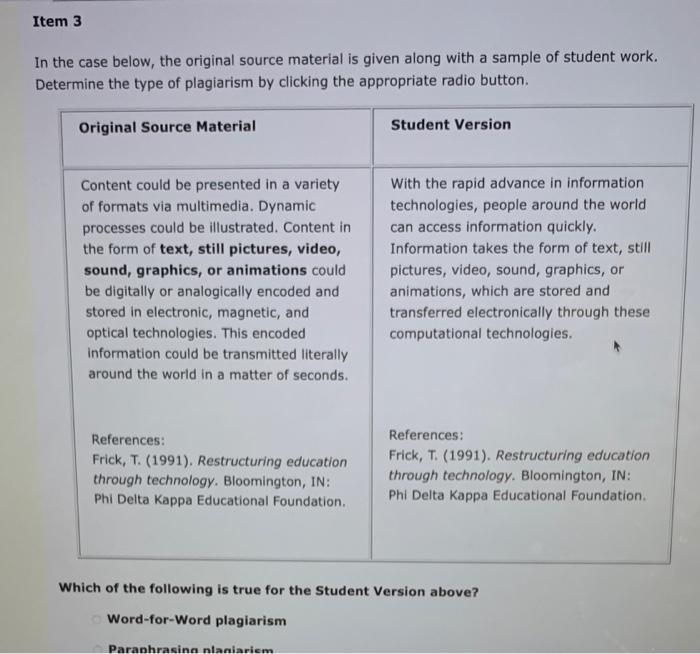
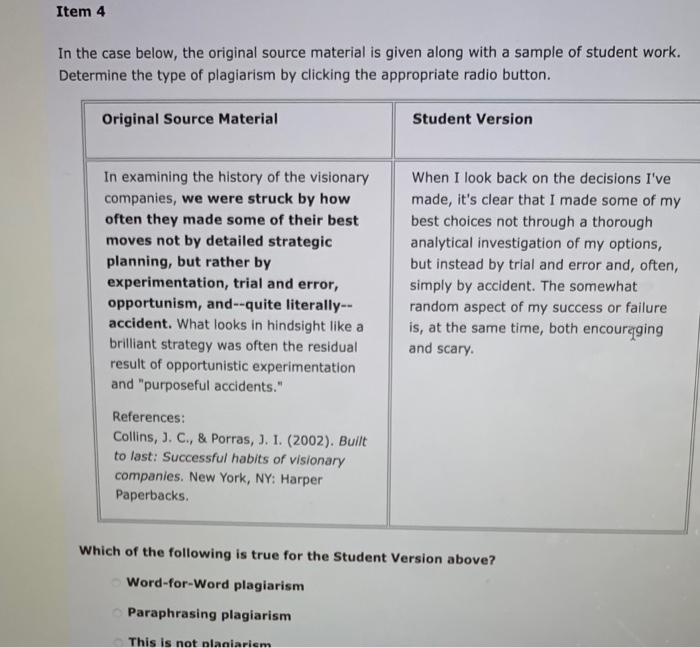
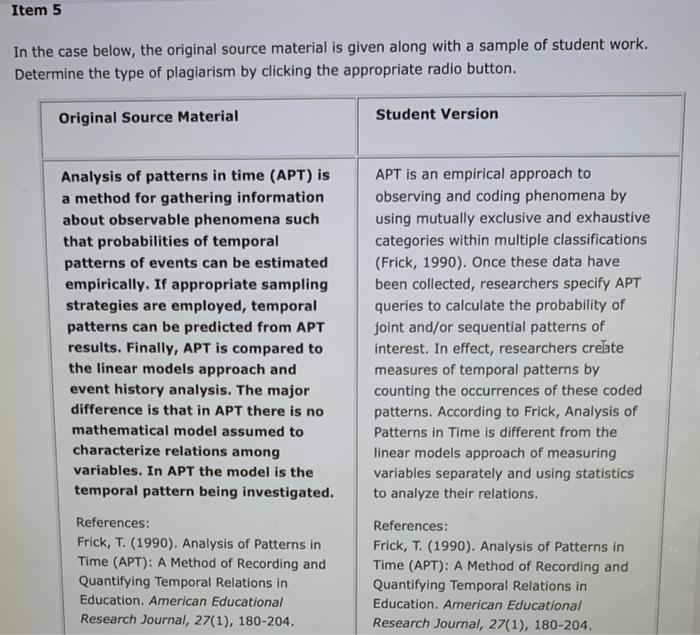
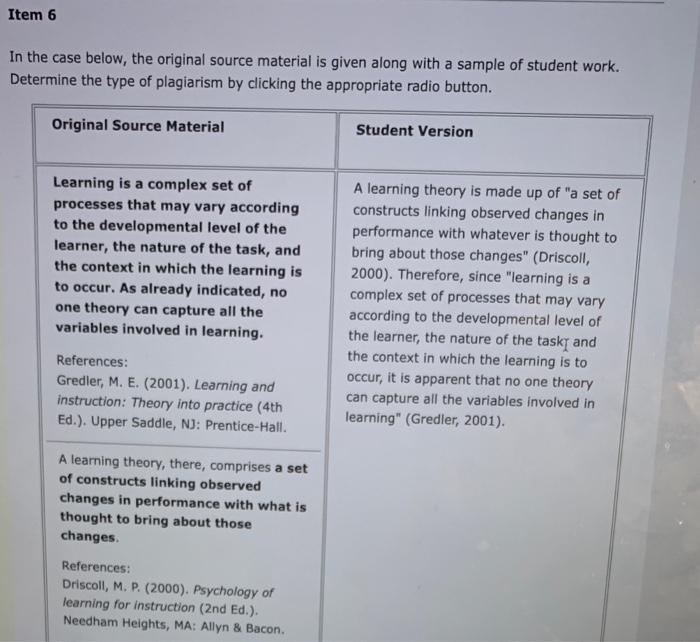
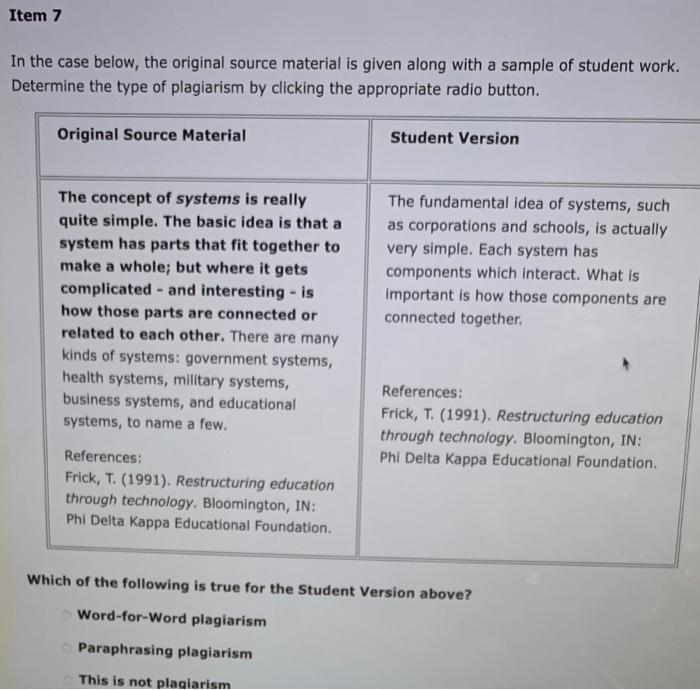
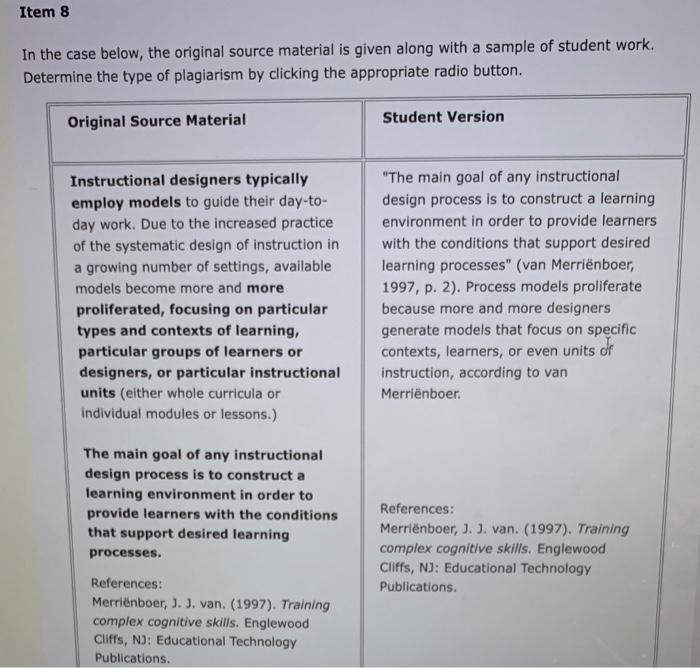
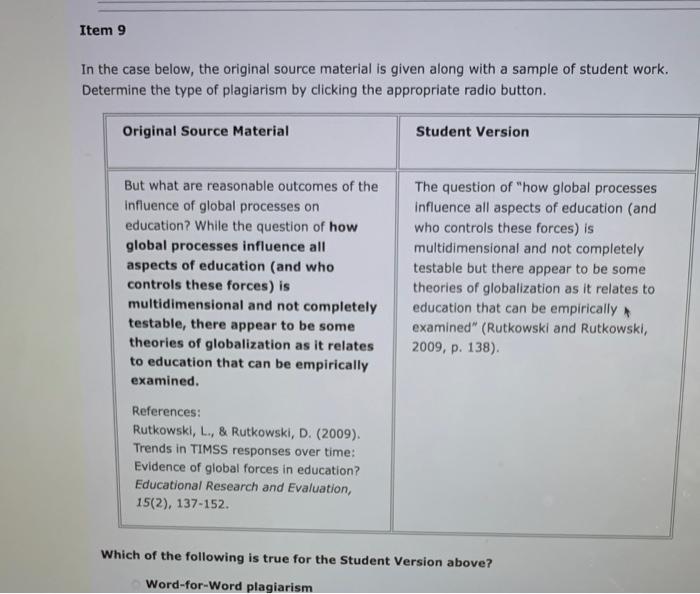
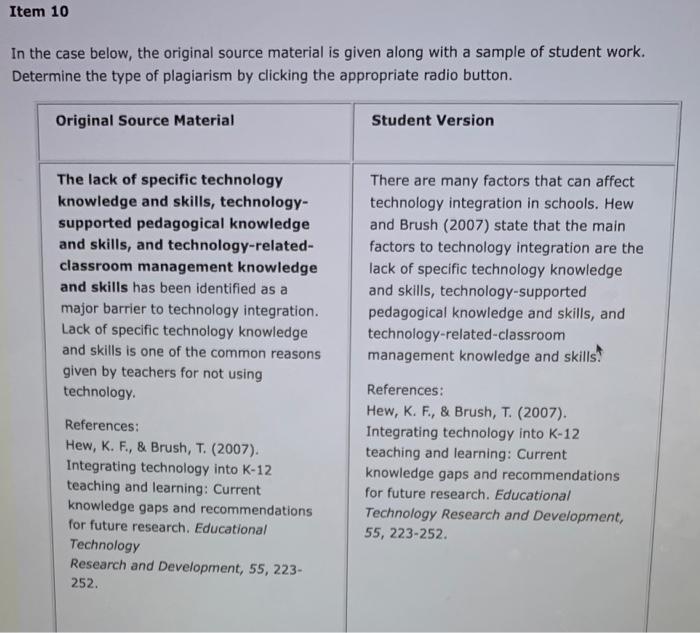
Item 1 In the case below, the original source material is given along with a sample of student work. Determine the type of plagiarism by clicking the appropriate radio button. Original Source Material Student Version APT was compared with numerous extant methodologies, including the linear models approach and event history analysis. The fundamental difference between APT and these other approaches is that no particular mathematical model is assumed in APT. In APT a model is viewed simply as a temporal pattern, whereas in most other approaches parameters of a mathematical model are estimated from data in which variables are measured separately. Moreover, in APT probabilities of temporal patterns are estimated by relative frequency and duration, In this study, Frick (1990) clarified the distinction between statistical linear models and Analysis of Patterns in Time (APT). Compared to the linear models approach (which includes particular mathematical models), APT is a straightforward way to create temporal maps and analyze them for recurring patterns of events. Moreover, in APT probabilities of temporal patterns are estimated by relative frequency and duration of those events. References: Frick, T. (1990). Analysis of Patterns in Time (APT): A Method of Recording and Quantifying Temporal Relations in Education. American Educational Research Journal, 27(1), 180-204 References: Frick, T. (1990). Analysis of Patterns in Time (APT): A Method of Recording and Quantifying Temporal Relations in Education. American Educational Research Journal, 27(1), 180-204. Determine the type of plagiarism by clicking the appropriate radio Bullon. Original Source Material Student Version While solitary negative reactions or unjustified suggestions for change have the potential to dissipate discourse rather than build it, the pattern analysis shows that the anonymous condition seemed to provide a safe explorative space for learners to try out more reasons for their multiple solutions. Teachers will rarely give anonymous feedback, but the experience of giving anonymous feedback may open a social space where learners can try out the reasons for their suggestions. It is clear that "solitary negative reactions or unjustified suggestions for change have the potential to dissipate discourse" (Howard, Barrett, & Frick, 2010, p. 103). However, anonymity may give learners a context in which they can try providing solutions that are more thoroughly supported by an accompanying rational (Howard, Barrett, & Frick, 2010). Clearly, the positive and negative consequences that anonymity has on peer feedback must be considered References: Howard, C. D., Barrett, A. F., & Frick, T. W. (2010). Anonymity to promote peer feedback: Pre-service teachers! comments in asynchronous computer- mediated communication. Journal of Educational Computing Research, 43(1), 89-112 References: Howard, C. D., Barrett, A. F., & Frick, T. W. (2010). Anonymity to promote peer feedback: Pre-service teachers' comments in asynchronous computer- mediated communication. Journal of Educational Computing Research, 43(1), 89-112. Item 3 In the case below, the original source material is given along with a sample of student work. Determine the type of plagiarism by clicking the appropriate radio button. Original Source Material Student Version Content could be presented in a variety of formats via multimedia. Dynamic processes could be illustrated. Content in the form of text, still pictures, video, sound, graphics, or animations could be digitally or analogically encoded and stored in electronic, magnetic, and optical technologies. This encoded information could be transmitted literally around the world in a matter of seconds. With the rapid advance in information technologies, people around the world can access information quickly. Information takes the form of text, still pictures, video, sound, graphics, or animations, which are stored and transferred electronically through these computational technologies. References: Frick, T. (1991). Restructuring education through technology. Bloomington, IN: Phi Delta Kappa Educational Foundation, References: Frick, T. (1991). Restructuring education through technology. Bloomington, IN: Phi Delta Kappa Educational Foundation, Which of the following is true for the Student Version above? Word-for-Word plagiarism Paraphrasina nlanlariem Item 4 In the case below, the original source material is given along with a sample of student work. Determine the type of plagiarism by clicking the appropriate radio button. Original Source Material Student Version In examining the history of the visionary companies, we were struck by how often they made some of their best moves not by detailed strategic planning, but rather by experimentation, trial and error, opportunism, and --quite literally accident. What looks in hindsight like a brilliant strategy was often the residual result of opportunistic experimentation and "purposeful accidents." When I look back on the decisions I've made, it's clear that I made some of my best choices not through a thorough analytical investigation of my options, but instead by trial and error and, often, simply by accident. The somewhat random aspect of my success or failure is, at the same time, both encouraging and scary References: Collins, J. C., & Porras, J. 1. (2002). Built to last: Successful habits of visionary companies. New York, NY: Harper Paperbacks. Which of the following is true for the Student Version above? Word-for-Word plagiarism Paraphrasing plagiarism This is not plagiariem Item 5 In the case below, the original source material is given along with a sample of student work. Determine the type of plagiarism by clicking the appropriate radio button. Original Source Material Student Version Analysis of patterns in time (APT) is a method for gathering information about observable phenomena such that probabilities of temporal patterns of events can be estimated empirically. If appropriate sampling strategies are employed, temporal patterns can be predicted from APT results. Finally, APT is compared to the linear models approach and event history analysis. The major difference is that in APT there is no mathematical model assumed to characterize relations among variables. In APT the model is the temporal pattern being investigated. APT is an empirical approach to observing and coding phenomena by using mutually exclusive and exhaustive categories within multiple classifications (Frick, 1990). Once these data have been collected, researchers specify APT queries to calculate the probability of joint and/or sequential patterns of interest. In effect, researchers create measures of temporal patterns by counting the occurrences of these coded patterns. According to Frick, Analysis of Patterns in Time is different from the linear models approach of measuring variables separately and using statistics to analyze their relations. References: Frick, T. (1990). Analysis of Patterns in Time (APT): A Method of Recording and Quantifying Temporal Relations in Education. American Educational Research Journal, 27(1), 180-204. References: Frick, T. (1990). Analysis of Patterns in Time (APT): A Method of Recording and Quantifying Temporal Relations in Education. American Educational Research Journal, 27(1), 180-204. Item 6 In the case below, the original source material is given along with a sample of student work. Determine the type of plagiarism by clicking the appropriate radio button. Original Source Material Student Version Learning is a complex set of processes that may vary according to the developmental level of the learner, the nature of the task, and the context in which the learning is to occur. As already indicated, no one theory can capture all the variables involved in learning. References: Gredler, M. E. (2001). Learning and instruction: Theory into practice (4th Ed.). Upper Saddle, NJ: Prentice-Hall. A learning theory is made up of "a set of constructs linking observed changes in performance with whatever is thought to bring about those changes" (Driscoll, 2000). Therefore, since "learning is a complex set of processes that may vary according to the developmental level of the learner, the nature of the tasks and the context in which the learning is to occur, it is apparent that no one theory can capture all the variables involved in learning" (Gredler, 2001). A learning theory, there, comprises a set of constructs linking observed changes in performance with what is thought to bring about those changes References: Driscoll, M. P. (2000). Psychology of learning for instruction (2nd Ed.). Needham Heights, MA: Allyn & Bacon. Item 7 In the case below, the original source material is given along with a sample of student work. Determine the type of plagiarism by clicking the appropriate radio button. Original Source Material Student Version The concept of systems is really quite simple. The basic idea is that a system has parts that fit together to make a whole; but where it gets complicated - and interesting - is how those parts are connected or related to each other. There are many kinds of systems: government systems, health systems, military systems, business systems, and educational systems, to name a few. The fundamental idea of systems, such as corporations and schools, is actually very simple. Each system has components which interact. What is important is how those components are connected together References: Frick, T. (1991). Restructuring education through technology. Bloomington, IN: Phi Delta Kappa Educational Foundation References: Frick, T. (1991). Restructuring education through technology. Bloomington, IN: Phi Delta Kappa Educational Foundation. Which of the following is true for the Student Version above? Word-for-Word plagiarism Paraphrasing plagiarism This is not plagiarism Item 8 In the case below, the original source material is given along with a sample of student work. Determine the type of plagiarism by clicking the appropriate radio button. Original Source Material Student Version Instructional designers typically employ models to guide their day-to- day work. Due to the increased practice of the systematic design of instruction in a growing number of settings, available models become more and more proliferated, focusing on particular types and contexts of learning, particular groups of learners or designers, or particular instructional units (either whole curricula or individual modules or lessons.) "The main goal of any instructional design process is to construct a learning environment in order to provide learners with the conditions that support desired learning processes" (van Merrienboer, 1997, p. 2). Process models proliferate because more and more designers generate models that focus on specific contexts, learners, or even units of instruction, according to van Merrinboer. The main goal of any instructional design process is to construct a learning environment in order to provide learners with the conditions that support desired learning processes. References: Merrienboer, J. J. van. (1997). Training complex cognitive skills. Englewood Cliffs, NJ: Educational Technology Publications References: Merrienboer, J. J. van. (1997). Training complex cognitive skills. Englewood Cliffs, NJ: Educational Technology Publications. Item 9 In the case below, the original source material is given along with a sample of student work. Determine the type of plagiarism by clicking the appropriate radio button. Original Source Material Student Version But what are reasonable outcomes of the Influence of global processes on education? While the question of how global processes influence all aspects of education (and who controls these forces) is multidimensional and not completely testable, there appear to be some theories of globalization as it relates to education that can be empirically examined. The question of "how global processes influence all aspects of education (and who controls these forces) is multidimensional and not completely testable but there appear to be some theories of globalization as it relates to education that can be empirically examined" (Rutkowski and Rutkowski, 2009, p. 138) References: Rutkowski, L., & Rutkowski, D. (2009). Trends in TIMSS responses over time: Evidence of global forces in education? Educational Research and Evaluation, 15(2), 137-152. Which of the following is true for the Student Version above? Word-for-Word plagiarism
Step by Step Solution
There are 3 Steps involved in it
1 Expert Approved Answer
Step: 1 Unlock

Question Has Been Solved by an Expert!
Get step-by-step solutions from verified subject matter experts
Step: 2 Unlock
Step: 3 Unlock
 Study Help