







Question: Please help!! If you could include the excel formula needed it would be very helpful! Scoops is a local business that produces homemade ice cream.
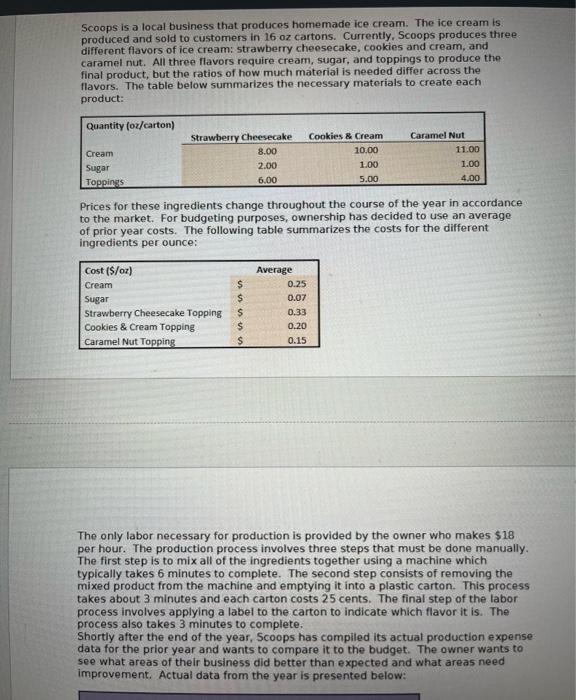
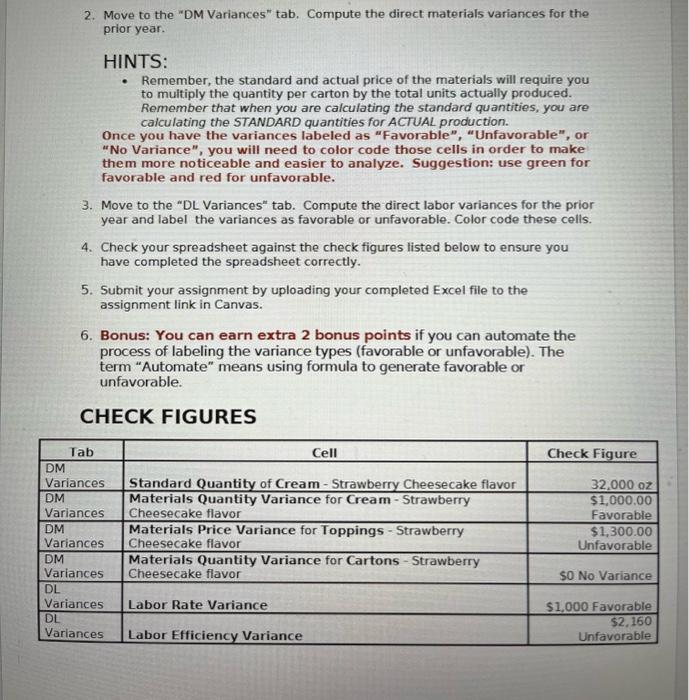
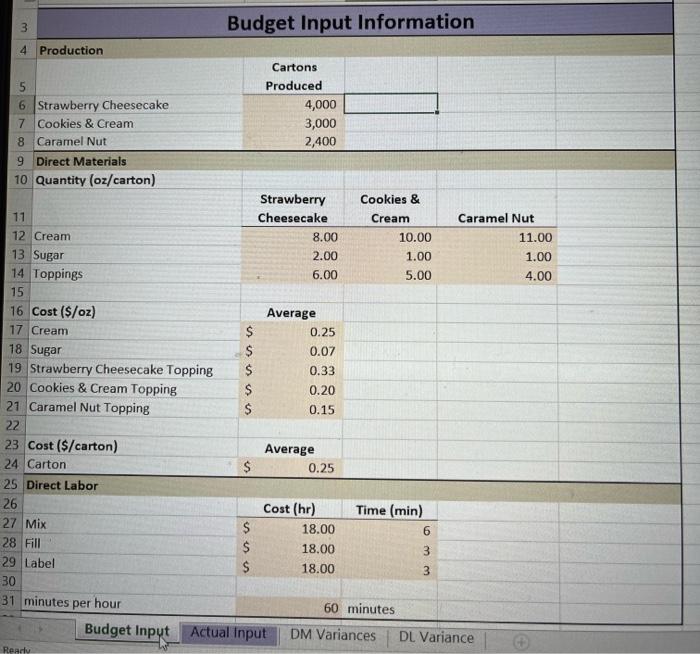
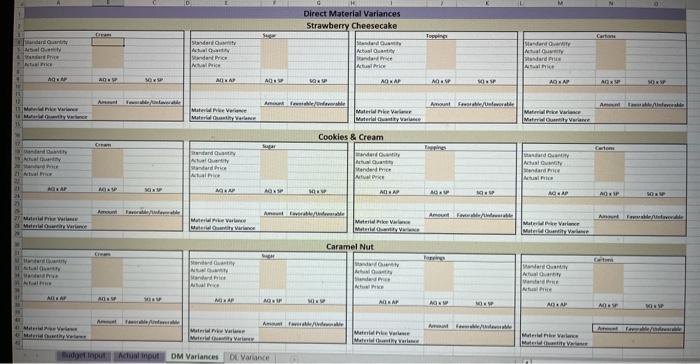
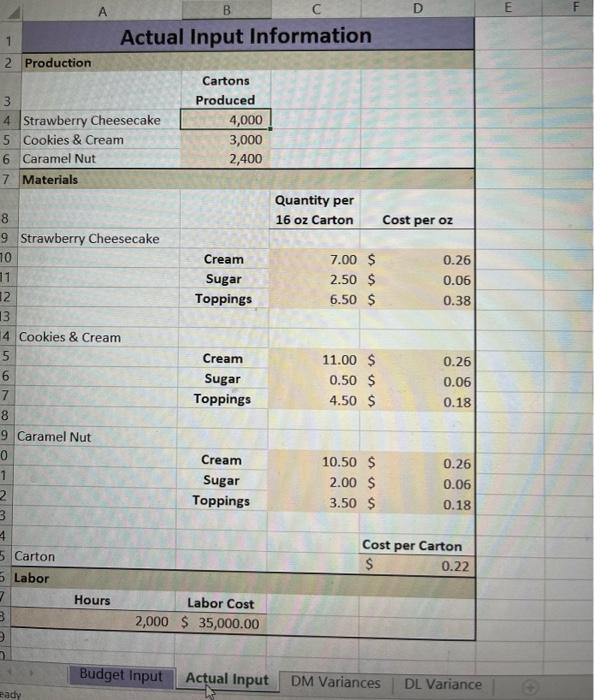
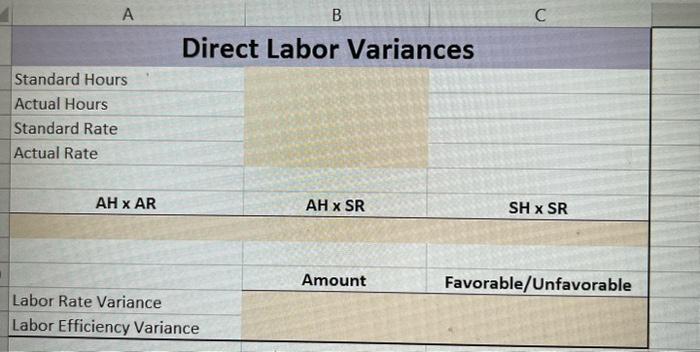
Scoops is a local business that produces homemade ice cream. The ice cream is produced and sold to customers in 16 oz cartons. Currently. Scoops produces three different flavors of ice cream: strawberry cheosecake, cookies and cream, and caramel nut. All three flavors require cream, sugar, and toppings to produce the final product, but the ratios of how much material is needed differ across the flavors. The table below summarizes the necessary materials to create each product: Prices for these ingredients change throughout the course of the year in accordance to the market. For budgeting purposes, ownership has decided to use an average of prior year costs. The following table summarizes the costs for the different ingredients per ounce: The only labor necessary for production is provided by the owner who makes $18 per hour. The production process involves three steps that must be done manually. The first step is to mix all of the ingredients together using a machine which typically takes 6 minutes to complete. The second step consists of removing the mixed product from the machine and emptying it into a plastic carton. This process takes about 3 minutes and each carton costs 25 cents. The final step of the labor process involves applying a label to the carton to indicate which flavor it is. The process also takes 3 minutes to complete. Shortly after the end of the year, Scoops has compiled its actual production expense data for the prior year and wants to compare it to the budget. The owner wants to see what areas of their business did better than expected and what areas need improvement. Actual data from the year is presented below: 2. Move to the "DM Variances" tab. Compute the direct materials variances for the prior year. HINTS: - Remember, the standard and actual price of the materials will require you to muitiply the quantity per carton by the total units actually produced. Remember that when you are calculating the standard quantities, you are calculating the STANDARD quantities for ACTUAL production. Once you have the variances labeled as "Favorable", "Unfavorable", or "No Variance", you will need to color code those cells in order to make them more noticeable and easier to analyze. Suggestion: use green for favorable and red for unfavorable. 3. Move to the "DL Variances" tab. Compute the direct labor variances for the prior year and label the variances as favorable or unfavorable. Color code these cells. 4. Check your spreadsheet against the check figures listed below to ensure you have completed the spreadsheet correctly. 5. Submit your assignment by uploading your completed Excel file to the assignment link in Canvas. 6. Bonus: You can earn extra 2 bonus points if you can automate the process of labeling the variance types (favorable or unfavorable). The term "Automate" means using formula to generate favorable or unfavorable. CHECK FIGURES Budget Input Information A Actual Input Information A B C Direct Labor Variances Standard Hours Actual Hours Standard Rate Actual Rate AHAR AHSR SHSR Favorable/Unfavorable Labor Rate Variance Labor Efficiency Variance Scoops is a local business that produces homemade ice cream. The ice cream is produced and sold to customers in 16 oz cartons. Currently. Scoops produces three different flavors of ice cream: strawberry cheosecake, cookies and cream, and caramel nut. All three flavors require cream, sugar, and toppings to produce the final product, but the ratios of how much material is needed differ across the flavors. The table below summarizes the necessary materials to create each product: Prices for these ingredients change throughout the course of the year in accordance to the market. For budgeting purposes, ownership has decided to use an average of prior year costs. The following table summarizes the costs for the different ingredients per ounce: The only labor necessary for production is provided by the owner who makes $18 per hour. The production process involves three steps that must be done manually. The first step is to mix all of the ingredients together using a machine which typically takes 6 minutes to complete. The second step consists of removing the mixed product from the machine and emptying it into a plastic carton. This process takes about 3 minutes and each carton costs 25 cents. The final step of the labor process involves applying a label to the carton to indicate which flavor it is. The process also takes 3 minutes to complete. Shortly after the end of the year, Scoops has compiled its actual production expense data for the prior year and wants to compare it to the budget. The owner wants to see what areas of their business did better than expected and what areas need improvement. Actual data from the year is presented below: 2. Move to the "DM Variances" tab. Compute the direct materials variances for the prior year. HINTS: - Remember, the standard and actual price of the materials will require you to muitiply the quantity per carton by the total units actually produced. Remember that when you are calculating the standard quantities, you are calculating the STANDARD quantities for ACTUAL production. Once you have the variances labeled as "Favorable", "Unfavorable", or "No Variance", you will need to color code those cells in order to make them more noticeable and easier to analyze. Suggestion: use green for favorable and red for unfavorable. 3. Move to the "DL Variances" tab. Compute the direct labor variances for the prior year and label the variances as favorable or unfavorable. Color code these cells. 4. Check your spreadsheet against the check figures listed below to ensure you have completed the spreadsheet correctly. 5. Submit your assignment by uploading your completed Excel file to the assignment link in Canvas. 6. Bonus: You can earn extra 2 bonus points if you can automate the process of labeling the variance types (favorable or unfavorable). The term "Automate" means using formula to generate favorable or unfavorable. CHECK FIGURES Budget Input Information A Actual Input Information A B C Direct Labor Variances Standard Hours Actual Hours Standard Rate Actual Rate AHAR AHSR SHSR Favorable/Unfavorable Labor Rate Variance Labor Efficiency Variance
Step by Step Solution
There are 3 Steps involved in it

Get step-by-step solutions from verified subject matter experts
 Study Help