



Question: please help im struggling, solve a,b,c,d,e,f,g,h,i,j,k, and l Your first assignment in your new position as assistant financial analyst at Caledonia Products is to evaluate

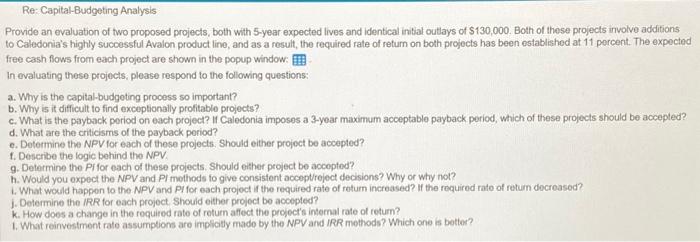
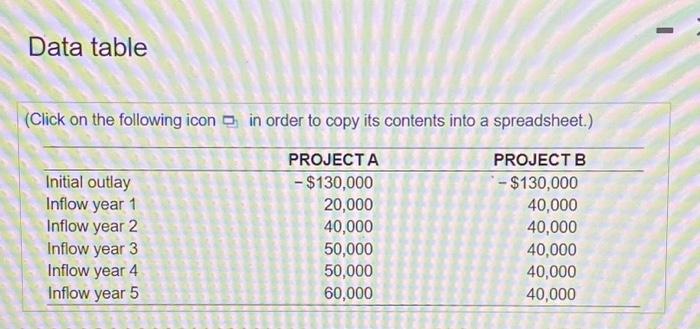
Your first assignment in your new position as assistant financial analyst at Caledonia Products is to evaluate two new capital-budgeting proposals. Because this is your first assignment, you have been asked not only to provide a recommendation but also to respond to a number of questions aimed at assessing your understanding of the capital-budgeting process. This is a standard procedure for all new financial analysts at Caledonia, and it will serve to determine whether you are moved directly into the capital-budgeting analysis department or are provided with remedial training. The memorandum you received outlining your assignent follows: To: New Financial Analysts From: Mr: V. Morrison, CEO, Caledonia Products Re: Capital-Budgeting Analysis Provide an evaluation of two proposed projects, both with 5 -year expected lives and identical initial outiays of $130,000. Both of these projects involve additions to Caledonia's highly successful Avalon product line, and as a retuit, the roquired rate of return on both projects has been ostablished at 11 percent. The expected free cash fiows from each project are shown in the popup window. In evaluating these projects, please respond to the following questions: a. Why is the capital-budgeting process so important? b. Why is it difficult to find exceptionally profitable projects? c. What is the payback period on each project? If Caledonia imposes a 3-yoar maximum acceptable payback period, which of these projects should be accepted? d. What are the criticisms of the payback period? Provide an evaluation of two proposed projects, both with 5 -year expected lives and identical initial outlays of $130,000. Both of these projects involve additions to Caledonia's highly successful Avalon product line, and as a result, the required rate of return on both projects has been established at 11 percent. The expected free cash fows from each project are shown in the popup window: In evaluating these projects, please respond to the following questions: a. Why is the capital-budgeting process so important? b. Why is it difficult to find exceptionally profitable projects? c. What is the payback period on each project? If Caledonia imposes a 3-yoar maximum acceptable payback period, which of these projects should be accepted? d. What are the criticisms of the payback period? e. Determine the NPV for each of these prejects, Should either project be accepted? f. Describe the logic behind the NPV. 9. Determine the Pf for each of these projects. Should ether project be accepted? h. Would you expect the NPV and PI methods fo give consistent aoceptreject decisions? Why or why not? 1. What would happon to the NPV and Pl for each projoct if the required rate of raturn increased? If the required rate of return decreasod? j. Determine the IRR for each project. Shouid either project be accepted? k. How does a change in the required rate of return affect the project's internal rate of retum? 1. What reirvestment rate assumptions are implictly made by the NPV and IRR methods? Which one is better? Data table (Click on the following icon in order to copy its contents into a spreadsheet.) Your first assignment in your new position as assistant financial analyst at Caledonia Products is to evaluate two new capital-budgeting proposals. Because this is your first assignment, you have been asked not only to provide a recommendation but also to respond to a number of questions aimed at assessing your understanding of the capital-budgeting process. This is a standard procedure for all new financial analysts at Caledonia, and it will serve to determine whether you are moved directly into the capital-budgeting analysis department or are provided with remedial training. The memorandum you received outlining your assignent follows: To: New Financial Analysts From: Mr: V. Morrison, CEO, Caledonia Products Re: Capital-Budgeting Analysis Provide an evaluation of two proposed projects, both with 5 -year expected lives and identical initial outiays of $130,000. Both of these projects involve additions to Caledonia's highly successful Avalon product line, and as a retuit, the roquired rate of return on both projects has been ostablished at 11 percent. The expected free cash fiows from each project are shown in the popup window. In evaluating these projects, please respond to the following questions: a. Why is the capital-budgeting process so important? b. Why is it difficult to find exceptionally profitable projects? c. What is the payback period on each project? If Caledonia imposes a 3-yoar maximum acceptable payback period, which of these projects should be accepted? d. What are the criticisms of the payback period? Provide an evaluation of two proposed projects, both with 5 -year expected lives and identical initial outlays of $130,000. Both of these projects involve additions to Caledonia's highly successful Avalon product line, and as a result, the required rate of return on both projects has been established at 11 percent. The expected free cash fows from each project are shown in the popup window: In evaluating these projects, please respond to the following questions: a. Why is the capital-budgeting process so important? b. Why is it difficult to find exceptionally profitable projects? c. What is the payback period on each project? If Caledonia imposes a 3-yoar maximum acceptable payback period, which of these projects should be accepted? d. What are the criticisms of the payback period? e. Determine the NPV for each of these prejects, Should either project be accepted? f. Describe the logic behind the NPV. 9. Determine the Pf for each of these projects. Should ether project be accepted? h. Would you expect the NPV and PI methods fo give consistent aoceptreject decisions? Why or why not? 1. What would happon to the NPV and Pl for each projoct if the required rate of raturn increased? If the required rate of return decreasod? j. Determine the IRR for each project. Shouid either project be accepted? k. How does a change in the required rate of return affect the project's internal rate of retum? 1. What reirvestment rate assumptions are implictly made by the NPV and IRR methods? Which one is better? Data table (Click on the following icon in order to copy its contents into a spreadsheet.)
Step by Step Solution
There are 3 Steps involved in it

Get step-by-step solutions from verified subject matter experts