







Question: Please help implement the following Lisp function, following the specification below: Function 1(5 p) Write and run a recursive Lisp function, called linearp, that tests
Please help implement the following Lisp function, following the specification below:
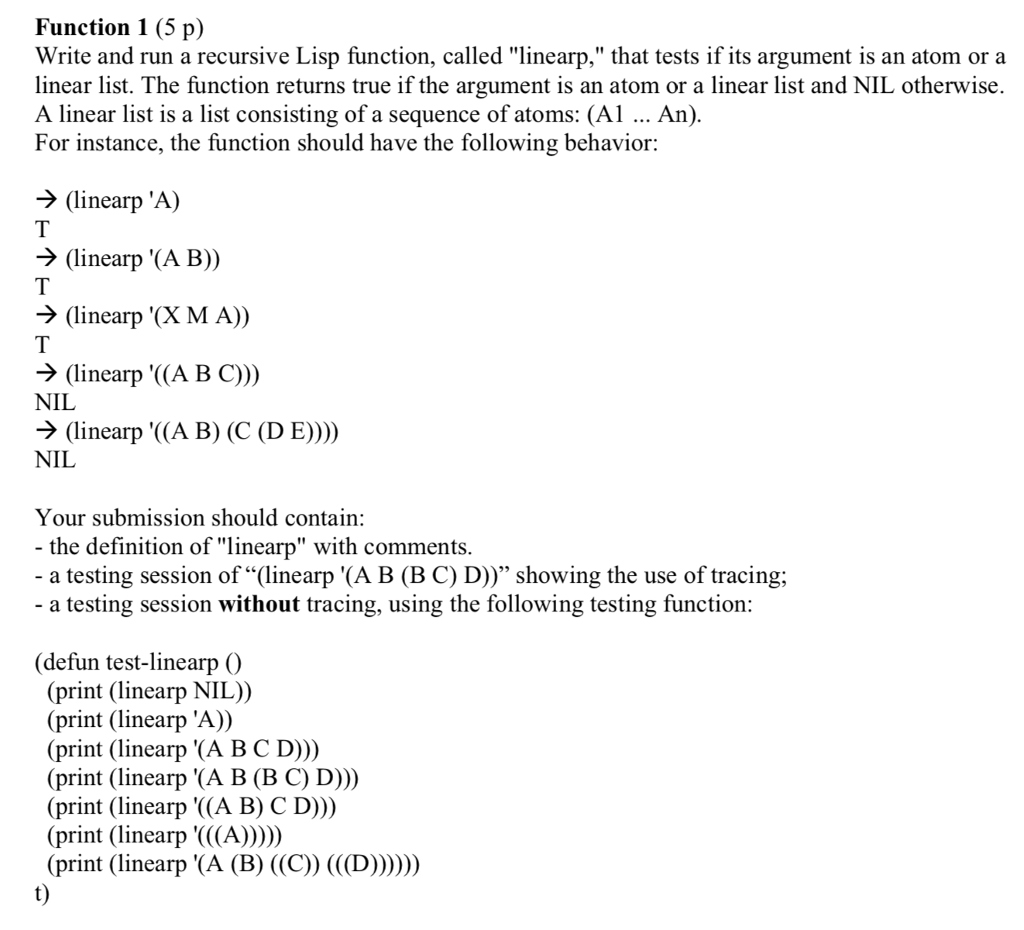
Function 1(5 p) Write and run a recursive Lisp function, called "linearp," that tests if its argument is an atom or a linear list. The function returns true if the argument is an atom or a linear list and NIL otherwise. A linear list is a list consisting of a sequence of atoms: (Al An) For instance, the function should have the following behavior: >(linearp '(A B)) (linearp '(X M A)) > (linearp '((A B C))) NIL -) (linear-p '((A B) (C (D E)))) NIL Your submission should contain: the definition of "linearp" with comments. a testing session of "(linearp '(A B (BC) D))" showing the use of tracing; - a testing session without tracing, using the following testing function: (defun test-linearp ( (print (linearp NIL)) (print (linearp 'A)) (print (linearp (A BC D)) (print (linearp (A B (B C) D)) (print (linearp ((A B) C D) Function 1(5 p) Write and run a recursive Lisp function, called "linearp," that tests if its argument is an atom or a linear list. The function returns true if the argument is an atom or a linear list and NIL otherwise. A linear list is a list consisting of a sequence of atoms: (Al An) For instance, the function should have the following behavior: >(linearp '(A B)) (linearp '(X M A)) > (linearp '((A B C))) NIL -) (linear-p '((A B) (C (D E)))) NIL Your submission should contain: the definition of "linearp" with comments. a testing session of "(linearp '(A B (BC) D))" showing the use of tracing; - a testing session without tracing, using the following testing function: (defun test-linearp ( (print (linearp NIL)) (print (linearp 'A)) (print (linearp (A BC D)) (print (linearp (A B (B C) D)) (print (linearp ((A B) C D)
Step by Step Solution
There are 3 Steps involved in it

Get step-by-step solutions from verified subject matter experts
 Study Help