







Question: Please help:( in python. Number 3. This is all the information I have, this is the entire problem. Please help 1 0 3 2 S
Please help:( in python. Number 3. This is all the information I have, this is the entire problem. Please help
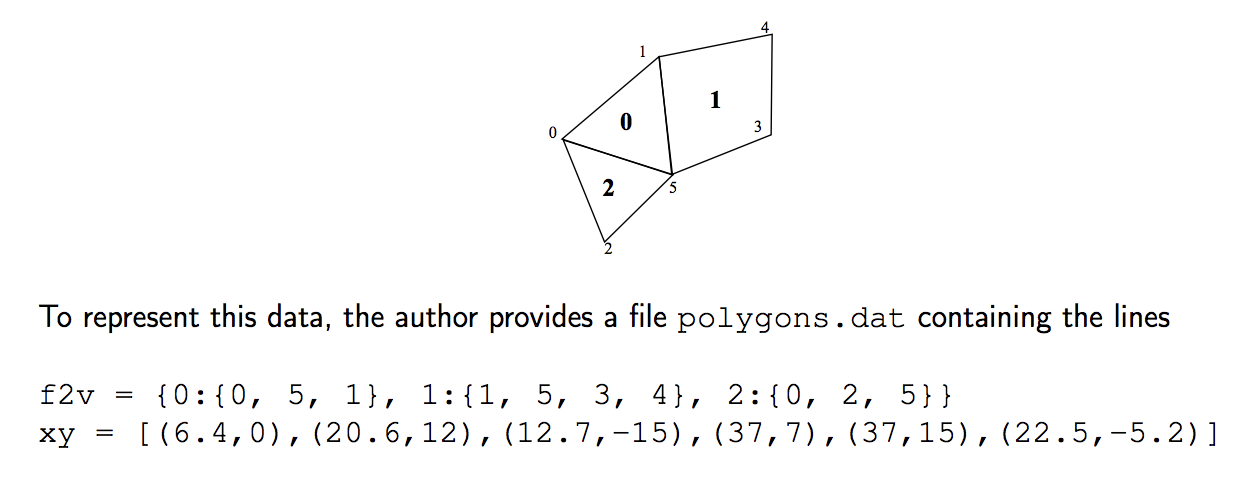
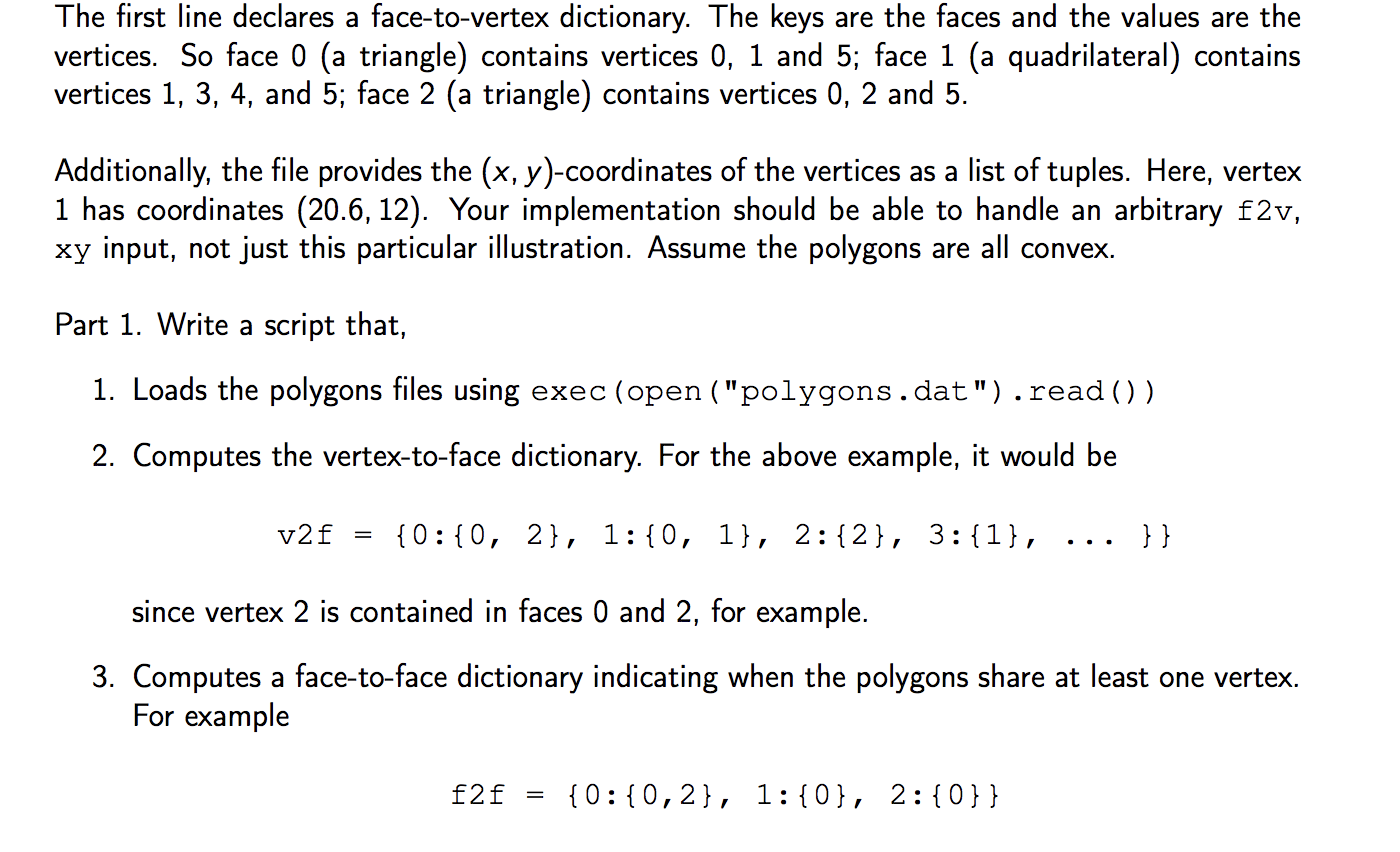
1 0 3 2 S To represent this data, the author provides a file polygons.dat containing the lines f2v = {0:{0, 5, 1}, 1:{1, 5, 3, 4}, 2:{0, 2, 5}} [(6.4,0), (20.6,12), (12.7,-15), (37,7), (37,15), (22.5, -5.2)] = The first line declares a face-to-vertex dictionary. The keys are the faces and the values are the vertices. So face 0 (a triangle) contains vertices 0, 1 and 5; face 1 (a quadrilateral) contains vertices 1, 3, 4, and 5; face 2 (a triangle) contains vertices 0, 2 and 5. Additionally, the file provides the (x, y)-coordinates of the vertices as a list of tuples. Here, vertex 1 has coordinates (20.6, 12). Your implementation should be able to handle an arbitrary f2v, xy input, not just this particular illustration. Assume the polygons are all convex. Part 1. Write a script that, 1. Loads the polygons files using exec (open ("polygons.dat").read() ) 2. Computes the vertex-to-face dictionary. For the above example, it would be v2f = {0:{0, 2}, 1:{0, 1}, 2:{2}, 3:{1}, }} since vertex 2 is contained in faces 0 and 2, for example. 3. Computes a face-to-face dictionary indicating when the polygons share at least one vertex. For example f2f {0:{0,2}, 1:{0}, 2:{0}} 1 0 3 2 S To represent this data, the author provides a file polygons.dat containing the lines f2v = {0:{0, 5, 1}, 1:{1, 5, 3, 4}, 2:{0, 2, 5}} [(6.4,0), (20.6,12), (12.7,-15), (37,7), (37,15), (22.5, -5.2)] = The first line declares a face-to-vertex dictionary. The keys are the faces and the values are the vertices. So face 0 (a triangle) contains vertices 0, 1 and 5; face 1 (a quadrilateral) contains vertices 1, 3, 4, and 5; face 2 (a triangle) contains vertices 0, 2 and 5. Additionally, the file provides the (x, y)-coordinates of the vertices as a list of tuples. Here, vertex 1 has coordinates (20.6, 12). Your implementation should be able to handle an arbitrary f2v, xy input, not just this particular illustration. Assume the polygons are all convex. Part 1. Write a script that, 1. Loads the polygons files using exec (open ("polygons.dat").read() ) 2. Computes the vertex-to-face dictionary. For the above example, it would be v2f = {0:{0, 2}, 1:{0, 1}, 2:{2}, 3:{1}, }} since vertex 2 is contained in faces 0 and 2, for example. 3. Computes a face-to-face dictionary indicating when the polygons share at least one vertex. For example f2f {0:{0,2}, 1:{0}, 2:{0}}
Step by Step Solution
There are 3 Steps involved in it

Get step-by-step solutions from verified subject matter experts
 Study Help