







Question: please help in solving this economic question.......its a complete question * Exercise 5 A housewife buys 2 kilo of meat a week. Assume that the
please help in solving this economic question.......its a complete question
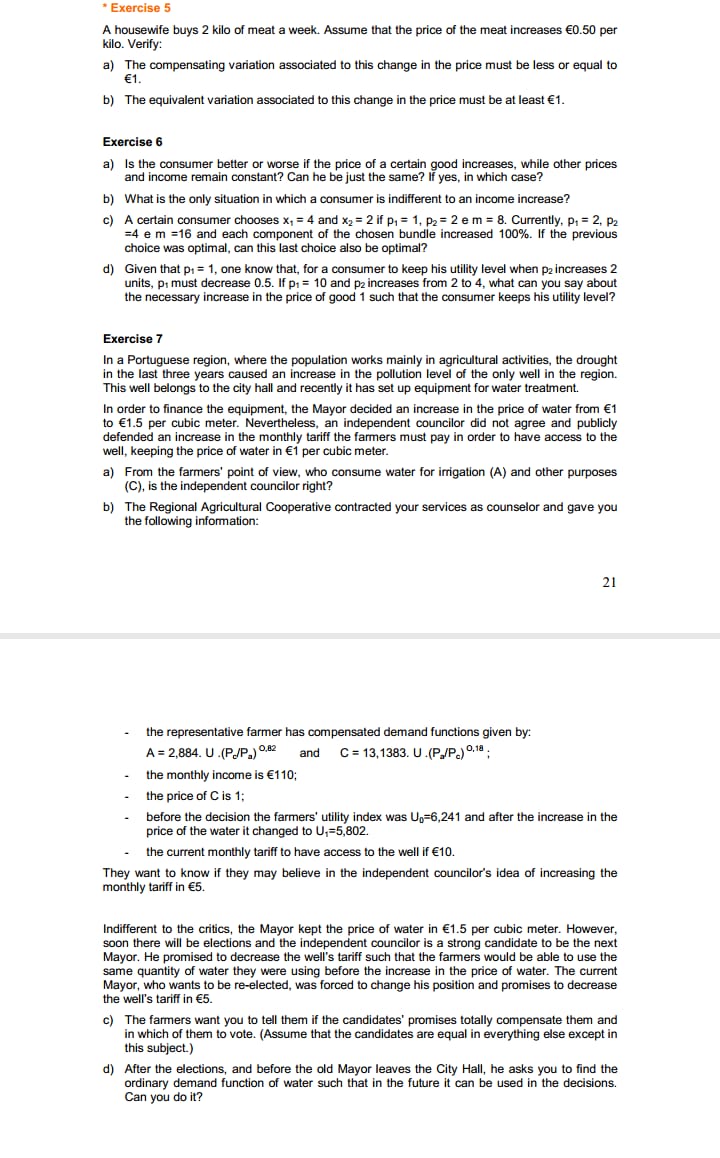
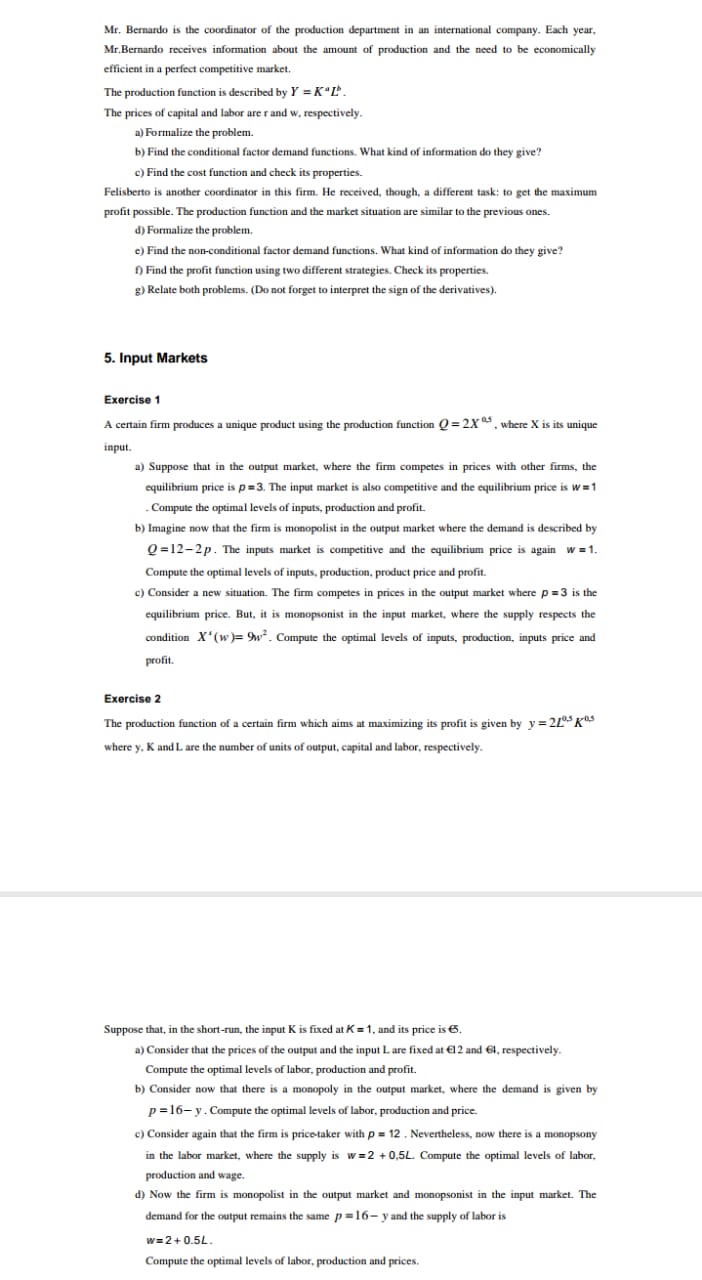
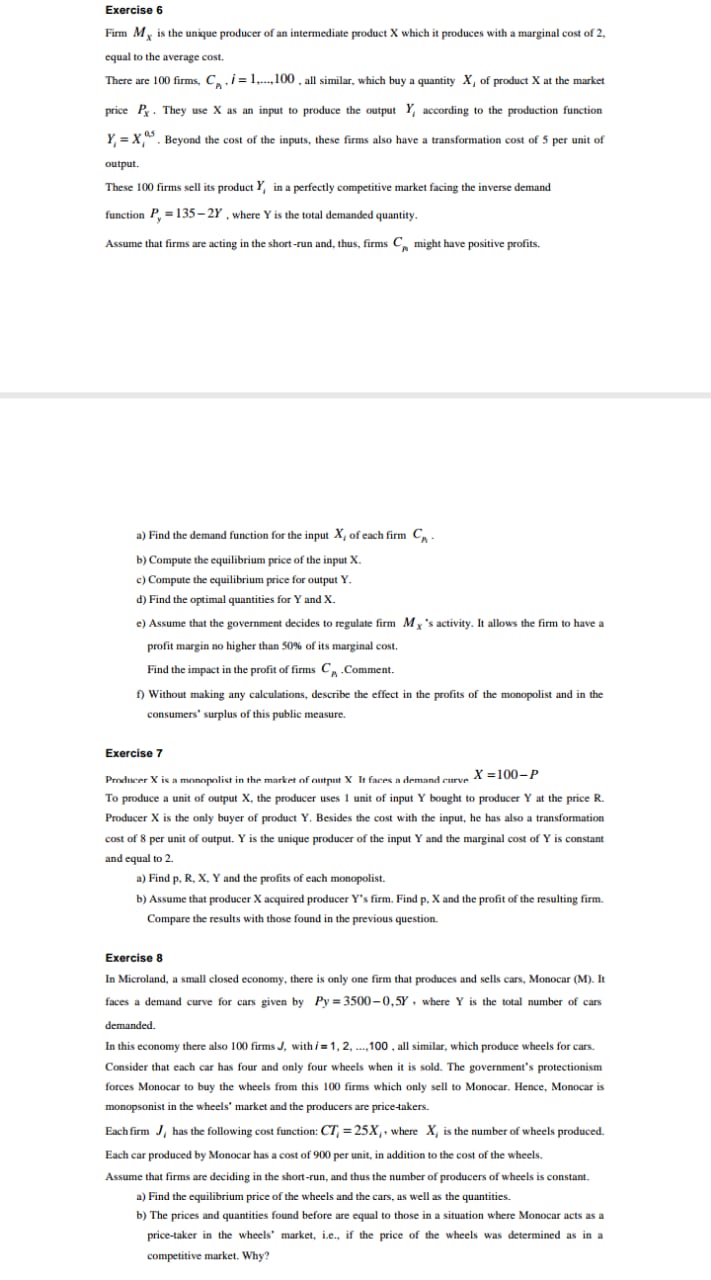
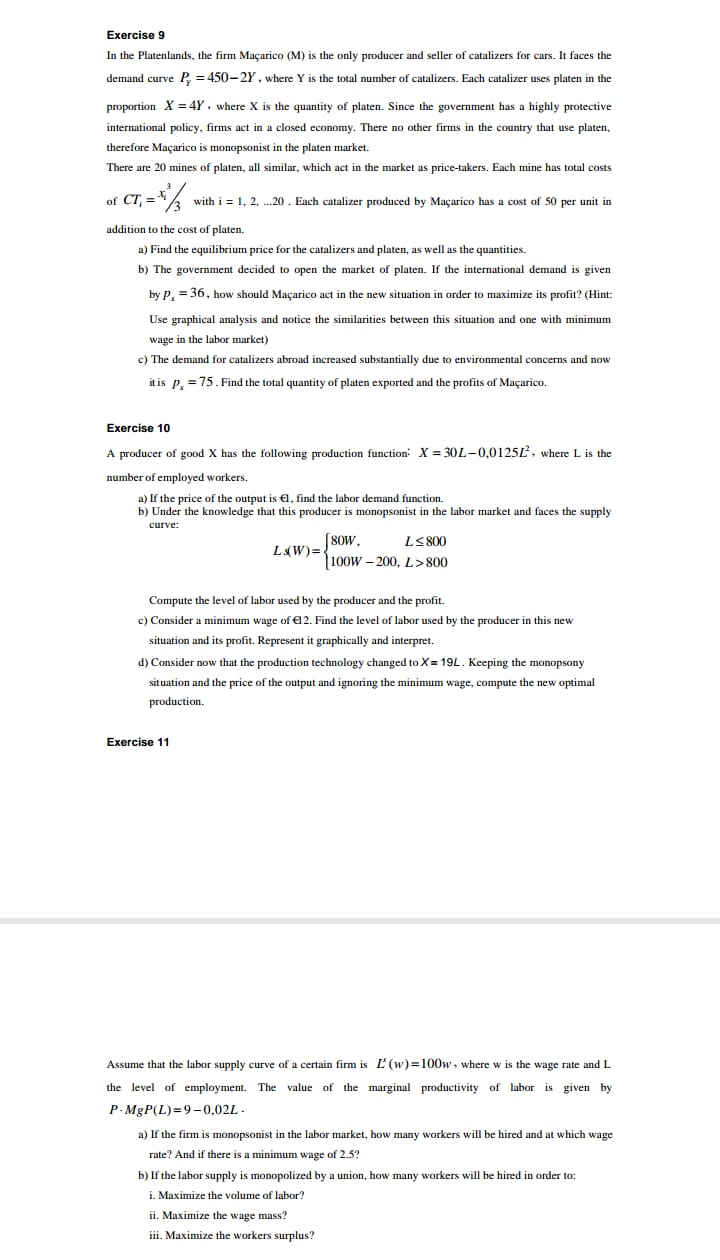
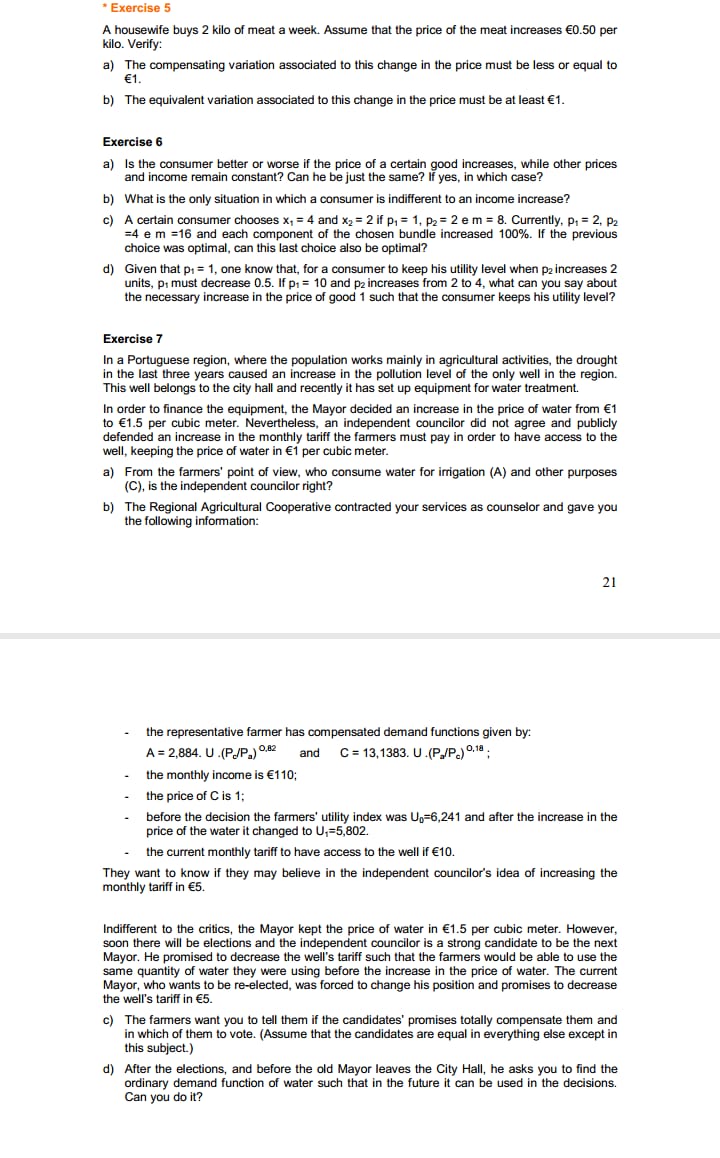
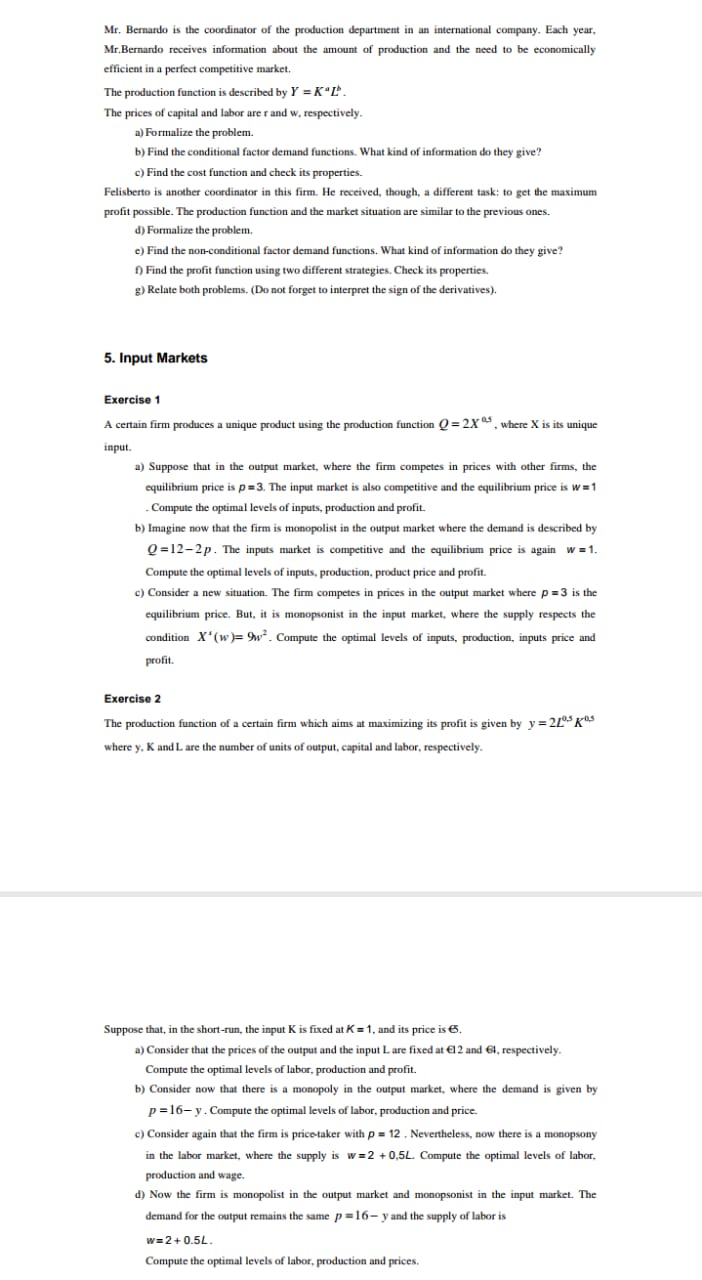
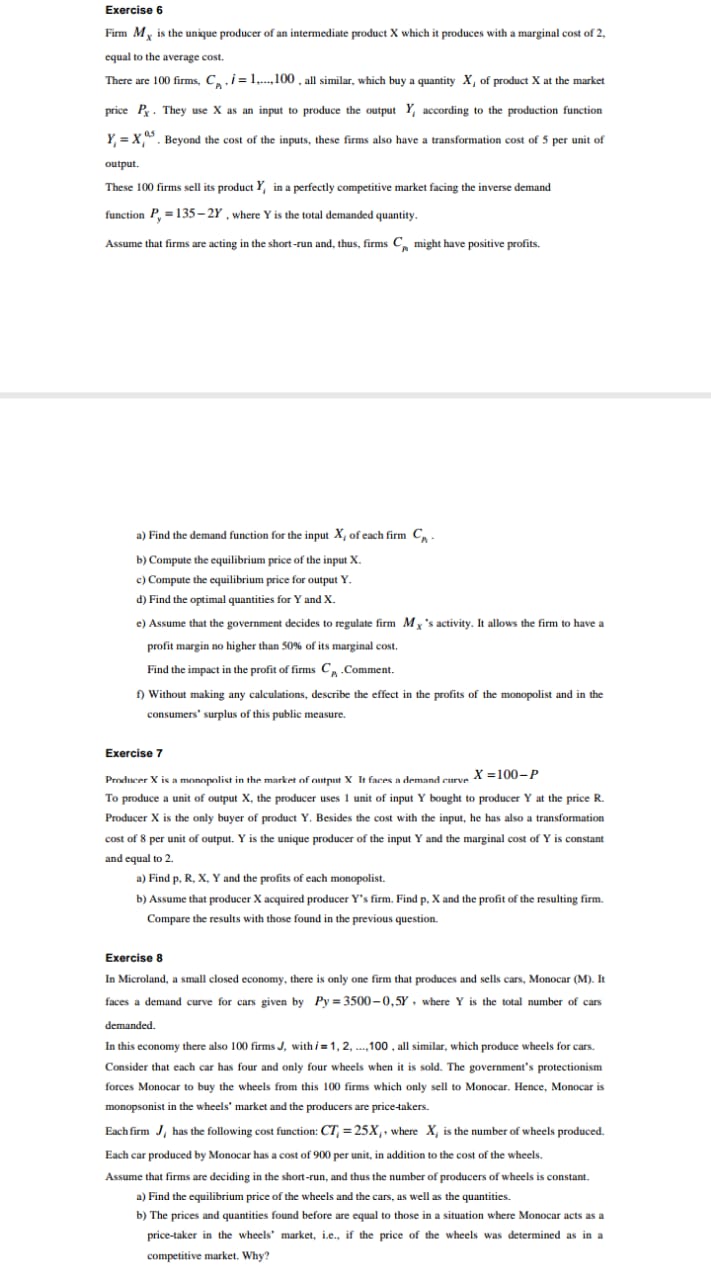
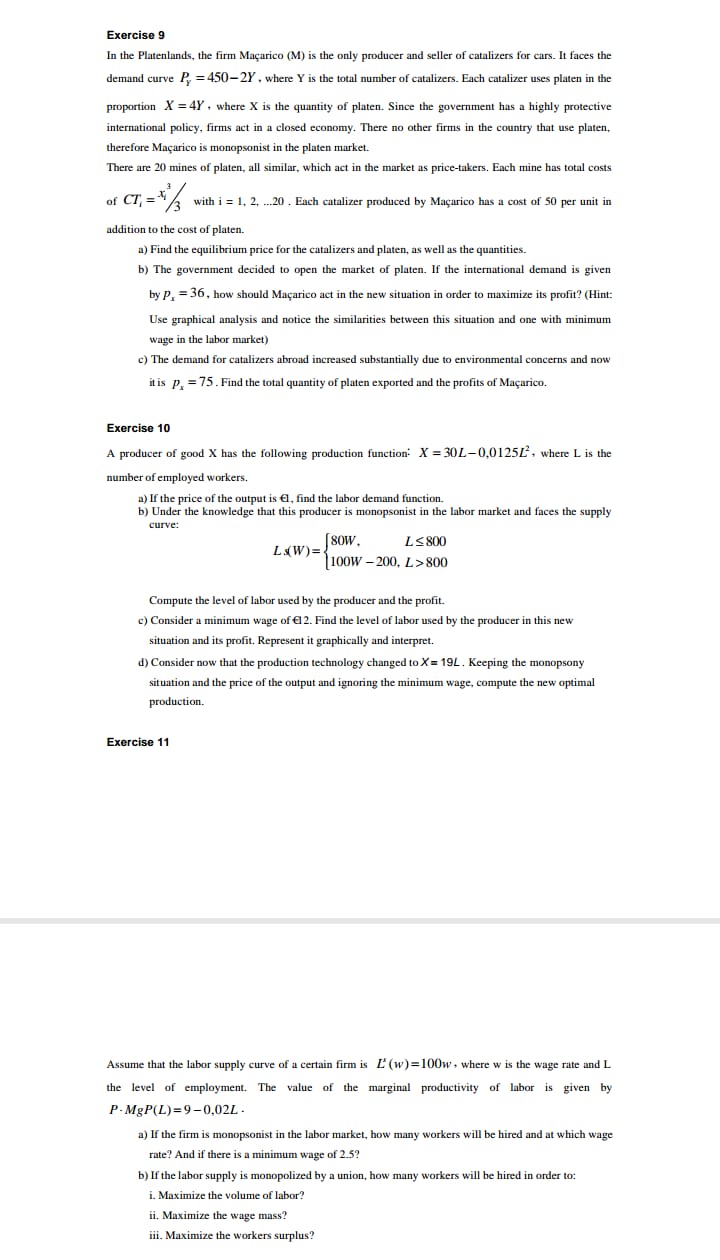
* Exercise 5 A housewife buys 2 kilo of meat a week. Assume that the price of the meat increases 60.50 per kilo. Verify: a) The compensating variation associated to this change in the price must be less or equal to E1. b) The equivalent variation associated to this change in the price must be at least (1. Exercise 6 a) Is the consumer better or worse if the price of a certain good increases, while other prices and income remain constant? Can he be just the same? If yes, in which case? b) What is the only situation in which a consumer is indifferent to an income increase? c) A certain consumer chooses x, = 4 and *2 = 2 if p, = 1, p2 = 2 em = 8. Currently, p, = 2, p2 =4 e m =16 and each component of the chosen bundle increased 100%. If the previous choice was optimal, can this last choice also be optimal? d) Given that p: = 1, one know that, for a consumer to keep his utility level when p2 increases 2 units, p: must decrease 0.5. If p: = 10 and p2 increases from 2 to 4, what can you say about the necessary increase in the price of good 1 such that the consumer keeps his utility level? Exercise 7 In a Portuguese region, where the population works mainly in agricultural activities, the drought in the last three years caused an increase in the pollution level of the only well in the region. This well belongs to the city hall and recently it has set up equipment for water treatment. In order to finance the equipment, the Mayor decided an increase in the price of water from E1 to (1.5 per cubic meter. Nevertheless, an independent councilor did not agree and publicly defended an increase in the monthly tariff the farmers must pay in order to have access to the well, keeping the price of water in (1 per cubic meter. a) From the farmers' point of view, who consume water for irrigation (A) and other purposes (C), is the independent councilor right? b) The Regional Agricultural Cooperative contracted your services as counselor and gave you the following information: 21 the representative farmer has compensated demand functions given by: A = 2,884. U .(P/P.) . and C = 13,1383. U .(P_/P.) 0.12; the monthly income is E110; the price of C is 1; before the decision the farmers' utility index was Up=6,241 and after the increase in the price of the water it changed to U,=5,802. the current monthly tariff to have access to the well if E10. They want to know if they may believe in the independent councilor's idea of increasing the monthly tariff in E5. Indifferent to the critics, the Mayor kept the price of water in E1.5 per cubic meter. However, soon there will be elections and the independent councilor is a strong candidate to be the next Mayor. He promised to decrease the well's tariff such that the farmers would be able to use the same quantity of water they were using before the increase in the price of water. The current Mayor, who wants to be re-elected, was forced to change his position and promises to decrease the well's tariff in 65. c) The farmers want you to tell them if the candidates' promises totally compensate them and in which of them to vote. (Assume that the candidates are equal in everything else except in this subject.) d) After the elections, and before the old Mayor leaves the City Hall, he asks you to find the ordinary demand function of water such that in the future it can be used in the decisions. Can you do it?Mr. Bernardo is the coordinator of the production department in an international company. Each year, Mr. Bernardo receives information about the amount of production and the need to be economically efficient in a perfect competitive market, The production function is described by Y = K-L The prices of capital and labor are r and w, respectively. a) Formalize the problem. b) Find the conditional factor demand functions. What kind of information do they give? c) Find the cost function and check its properties. Felisberto is another coordinator in this firm. He received, though, a different task: to get the maximum profit possible. The production function and the market situation are similar to the previous ones. d) Formalize the problem. e) Find the non-conditional factor demand functions, What kind of information do they give? () Find the profit function using two different strategies. Check its properties. g) Relate both problems. (Do not forget to interpret the sign of the derivatives). 5. Input Markets Exercise 1 A certain firm produces a unique product using the production function O= 2X, where X is its unique input. a) Suppose that in the output market, where the firm competes in prices with other firms, the equilibrium price is p =3. The input market is also competitive and the equilibrium price is w = 1 Compute the optimal levels of inputs, production and profit. b) Imagine now that the firm is monopolist in the output market where the demand is described by Q=12-2p. The inputs market is competitive and the equilibrium price is again w = 1. Compute the optimal levels of inputs, production, product price and profit. c) Consider a new situation. The firm competes in prices in the output market where p = 3 is the equilibrium price. But, it is monopsonist in the input market. where the supply respects the condition X' (w)= 9w . Compute the optimal levels of inputs, production, inputs price and profit. Exercise 2 The production function of a certain firm which aims at maximizing its profit is given by y = 2105 gas where y. K and L are the number of units of output, capital and labor, respectively. Suppose that, in the short-run, the input K is fixed at K = 1, and its price is (5. a) Consider that the prices of the output and the input L are fixed at (1 2 and 6, respectively. Compute the optimal levels of labor, production and profit. b) Consider now that there is a monopoly in the output market, where the demand is given by p =16- y . Compute the optimal levels of labor, production and price. c) Consider again that the firm is price-taker with p = 12 . Nevertheless, now there is a monopsony in the labor market, where the supply is w= 2 +0,5L. Compute the optimal levels of labor. production and wage. d) Now the firm is monopolist in the output market and monopsonist in the input market. The demand for the output remains the same p =16- y and the supply of labor is w=2+0.5L. Compute the optimal levels of labor, production and prices.Exercise 6 Firm My is the unique producer of an intermediate product X which it produces with a marginal cost of 2, equal to the average cost. There are 100 firms, C. . /= 1.....100 . all similar, which buy a quantity X, of product X at the market price Pr . They use X as an input to produce the output , according to the production function Y, = X,". Beyond the cost of the inputs, these firms also have a transformation cost of 5 per unit of output. These 100 firms sell its product ), in a perfectly competitive market facing the inverse demand function P, = 135-2Y , where Y is the total demanded quantity. Assume that firms are acting in the short-run and, thus, firms C, might have positive profits. a) Find the demand function for the input X, of each firm Co . b) Compute the equilibrium price of the input X. c) Compute the equilibrium price for output Y. d) Find the optimal quantities for Y and X. e) Assume that the government decides to regulate firm My 's activity. It allows the firm to have a profit margin no higher than 50% of its marginal cost. Find the impact in the profit of firms Co . Comment. () Without making any calculations, describe the effect in the profits of the monopolist and in the consumers' surplus of this public measure. Exercise 7 Producer X is a monopolist in the market of output X It faces a demand curve X =100-P To produce a unit of output X. the producer uses I unit of input Y bought to producer Y at the price R. Producer X is the only buyer of product Y. Besides the cost with the input, he has also a transformation cost of 8 per unit of output. Y is the unique producer of the input Y and the marginal cost of Y is constant and equal to 2. a) Find p. R. X. Y and the profits of each monopolist. b) Assume that producer X acquired producer Y's firm. Find p. X and the profit of the resulting firm. Compare the results with those found in the previous question. Exercise 8 In Microland, a small closed economy, there is only one firm that produces and sells cars, Monocar (M). It faces a demand curve for cars given by Py = 3500-0.5Y . where Y is the total number of cars demanded. In this economy there also 100 firms J, with / = 1, 2, ...,100 , all similar, which produce wheels for cars. Consider that each car has four and only four wheels when it is sold. The government's protectionism forces Monocar to buy the wheels from this 100 firms which only sell to Monocar. Hence, Monocar is monopsonist in the wheels' market and the producers are price-takers. Each firm J, has the following cost function: C7, = 25X, . where X, is the number of wheels produced. Each car produced by Monocar has a cost of 900 per unit, in addition to the cost of the wheels. Assume that firms are deciding in the short-run, and thus the number of producers of wheels is constant. a) Find the equilibrium price of the wheels and the cars, as well as the quantities. b) The prices and quantities found before are equal to those in a situation where Monocar acts as a price-taker in the wheels' market, i.e., if the price of the wheels was determined as in a competitive market. Why?Exercise 9 In the Platenlands, the firm Macarico (M) is the only producer and seller of catalizers for cars. It faces the demand curve P =450-21 . where Y is the total number of catalizers. Each catalizer uses platen in the proportion X =4Y . where X is the quantity of platen. Since the government has a highly protective international policy, firms act in a closed economy. There no other firms in the country that use platen, therefore Macarico is monopsonist in the platen market. There are 20 mines of platen, all similar, which act in the market as price-takers. Each mine has total costs of CT, =1 / 3 with i = 1, 2, ...20 . Each catalizer produced by Macarico has a cost of 50 per unit in addition to the cost of platen. a) Find the equilibrium price for the catalizers and platen, as well as the quantities. b) The government decided to open the market of platen. If the international demand is given by p. = 36, how should Macarico act in the new situation in order to maximize its profit? (Hint: Use graphical analysis and notice the similarities between this situation and one with minimum wage in the labor market) c) The demand for catalizers abroad increased substantially due to environmental concerns and now it is p, =75 . Find the total quantity of platen exported and the profits of Macarico. Exercise 10 A producer of good X has the following production function: X =304-0,01254 , where L is the number of employed workers. a) If the price of the output is El, find the labor demand function. b) Under the knowledge that this producer is monopsonist in the labor market and faces the supply curve: LAW)= SOW. LS800 100W -200, L >800 Compute the level of labor used by the producer and the profit. c) Consider a minimum wage of (1 2. Find the level of labor used by the producer in this new situation and its profit. Represent it graphically and interpret. d) Consider now that the production technology changed to X= 194 . Keeping the monopsony situation and the price of the output and ignoring the minimum wage, compute the new optimal production. Exercise 11 Assume that the labor supply curve of a certain firm is A (w)=100w , where w is the wage rate and L the level of employment. The value of the marginal productivity of labor is given by P- MgP(L)=9-0,02L - a) If the firm is monopsonist in the labor market, how many workers will be hired and at which wage rate? And if there is a minimum wage of 2.5? b) If the labor supply is monopolized by a union, how many workers will be hired in order to: i. Maximize the volume of labor? ii, Maximize the wage mass? ifi. Maximize the workers surplus
Step by Step Solution
There are 3 Steps involved in it

Get step-by-step solutions from verified subject matter experts
 Study Help