







Question: Please help In this problem, we explore the effect on the standard deviation of multiplying each data value in a data set by the same
Please help
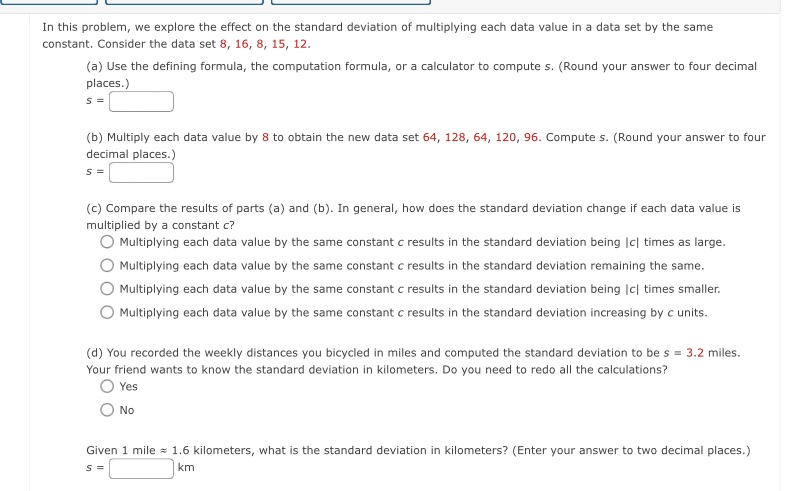
In this problem, we explore the effect on the standard deviation of multiplying each data value in a data set by the same constant. Consider the data set 8, 16, 8, 15, 12. (a) Use the defining formula, the computation formula, or a calculator to compute s. (Round your answer to four decimal places.) S = (b) Multiply each data value by 8 to obtain the new data set 64, 128, 64, 120, 96. Compute s. (Round your answer to four decimal places.) S = (c) Compare the results of parts (a) and (b). In general, how does the standard deviation change if each data value is multiplied by a constant c? O Multiplying each data value by the same constant c results in the standard deviation being |cl times as large. O Multiplying each data value by the same constant c results in the standard deviation remaining the same. O Multiplying each data value by the same constant c results in the standard deviation being |cl times smaller. O Multiplying each data value by the same constant c results in the standard deviation increasing by c units. (d) You recorded the weekly distances you bicycled in miles and computed the standard deviation to be s = 3.2 miles. Your friend wants to know the standard deviation in kilometers. Do you need to redo all the calculations? O Yes O No Given 1 mile = 1.6 kilometers, what is the standard deviation in kilometers? (Enter your answer to two decimal places.) S = km
Step by Step Solution
There are 3 Steps involved in it

Get step-by-step solutions from verified subject matter experts
 Study Help