Question: PLEASE HELP!!!! Instructions: Below is a description of a study that focuses on having (versus not having) plants inside participants' workplaces. Read over the study
PLEASE HELP!!!!
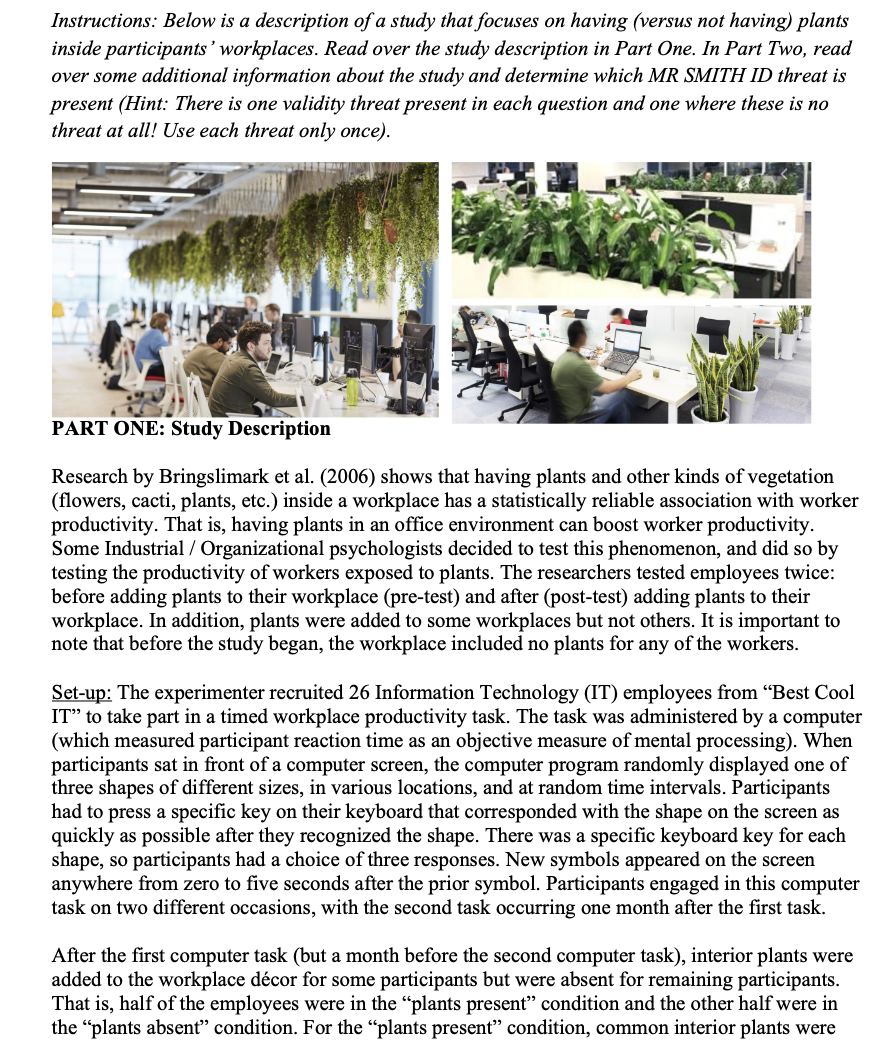
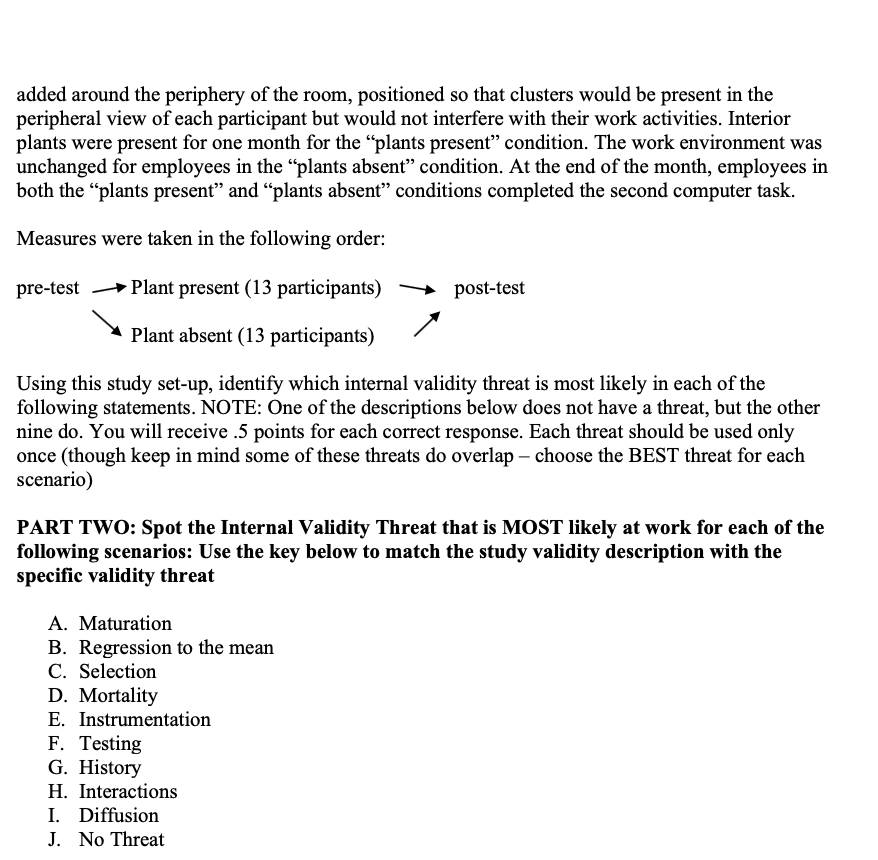
Instructions: Below is a description of a study that focuses on having (versus not having) plants inside participants' workplaces. Read over the study description in Part One. In Part Two, read over some additional information about the study and determine which MR SMITH ID threat is present (Hint: There is one validity threat present in each question and one where these is no threat at all! Use each threat only once). PART ONE: Study Description Research by Bringslimark et al. (2006) shows that having plants and other kinds of vegetation (flowers, cacti, plants, etc.) inside a workplace has a statistically reliable association with worker productivity. That is, having plants in an office environment can boost worker productivity. Some Industrial / Organizational psychologists decided to test this phenomenon, and did so by testing the productivity of workers exposed to plants. The researchers tested employees twice: before adding plants to their workplace (pre-test) and after (post-test) adding plants to their workplace. In addition, plants were added to some workplaces but not others. It is important to note that before the study began, the workplace included no plants for any of the workers. Set-up: The experimenter recruited 26 Information Technology (IT) employees from Best Cool IT to take part in a timed workplace productivity task. The task was administered by a computer (which measured participant reaction time as an objective measure of mental processing). When participants sat in front of a computer screen, the computer program randomly displayed one of three shapes of different sizes, in various locations, and at random time intervals. Participants had to press a specific key on their keyboard that corresponded with the shape on the screen as quickly as possible after they recognized the shape. There was a specific keyboard key for each shape, so participants had a choice of three responses. New symbols appeared on the screen anywhere from zero to five seconds after the prior symbol. Participants engaged in this computer task on two different occasions, with the second task occurring one month after the first task. After the first computer task (but a month before the second computer task), interior plants were added to the workplace dcor for some participants but were absent for remaining participants. That is, half of the employees were in the plants present condition and the other half were in the plants absent condition. For the plants present condition, common interior plants were added around the periphery of the room, positioned so that clusters would be present in the peripheral view of each participant but would not interfere with their work activities. Interior plants were present for one month for the plants present condition. The work environment was unchanged for employees in the plants absent condition. At the end of the month, employees in both the plants present and plants absent" conditions completed the second computer task. Measures were taken in the following order: pre-test Plant present (13 participants) post-test Plant absent (13 participants) Using this study set-up, identify which internal validity threat is most likely in each of the following statements. NOTE: One of the descriptions below does not have a threat, but the other nine do. You will receive .5 points for each correct response. Each threat should be used only once (though keep in mind some of these threats do overlap - choose the BEST threat for each scenario) PART TWO: Spot the Internal Validity Threat that is MOST likely at work for each of the following scenarios: Use the key below to match the study validity description with the specific validity threat A. Maturation B. Regression to the mean C. Selection D. Mortality E. Instrumentation F. Testing G. History H. Interactions I. Diffusion J. No Threat c. Selection d. Mortality e. Instrumentation f. Testing g. History h. Interactions i. Diffusion j. No Threat 10. The study ran for 10 days after adding interior plants when three employees in plant- absent group tested COVID-19 positive. They asked for sick leave and were unable to take the post-test. The researchers found that those in the plant-present group did better in their post work productivity test compared to those in the plant-absent condition. a. Maturation b. Regression to the mean c. Selection d. Mortality e. Instrumentation f. Testing g. History h. Interactions i. Diffusion j. No Threat









 Study Help