







Question: please help it's due in the next 30munites 3. It leverages its prowess in battery technology to minimize the total cost of ownership over the
please help it's due in the next 30munites
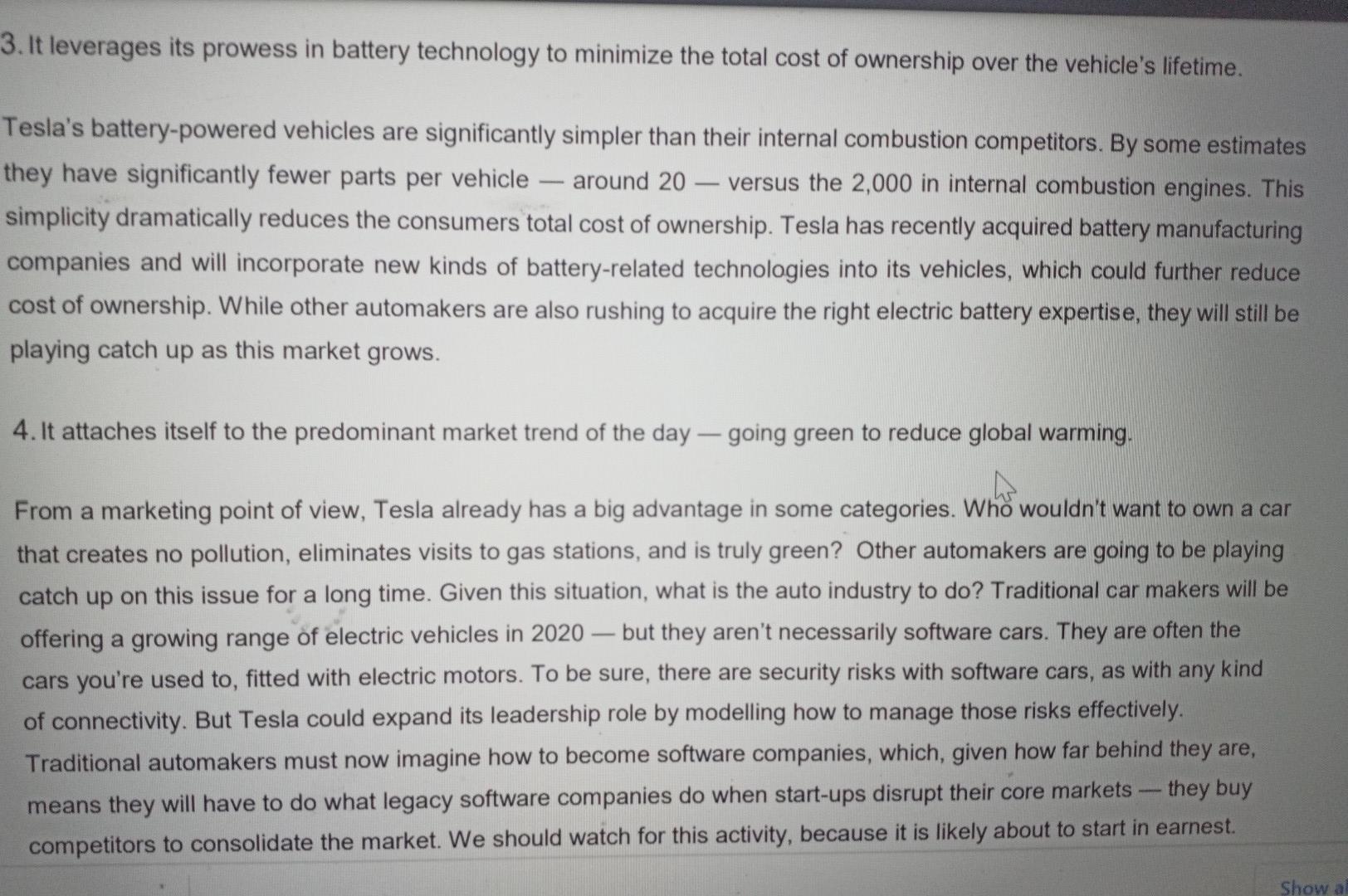
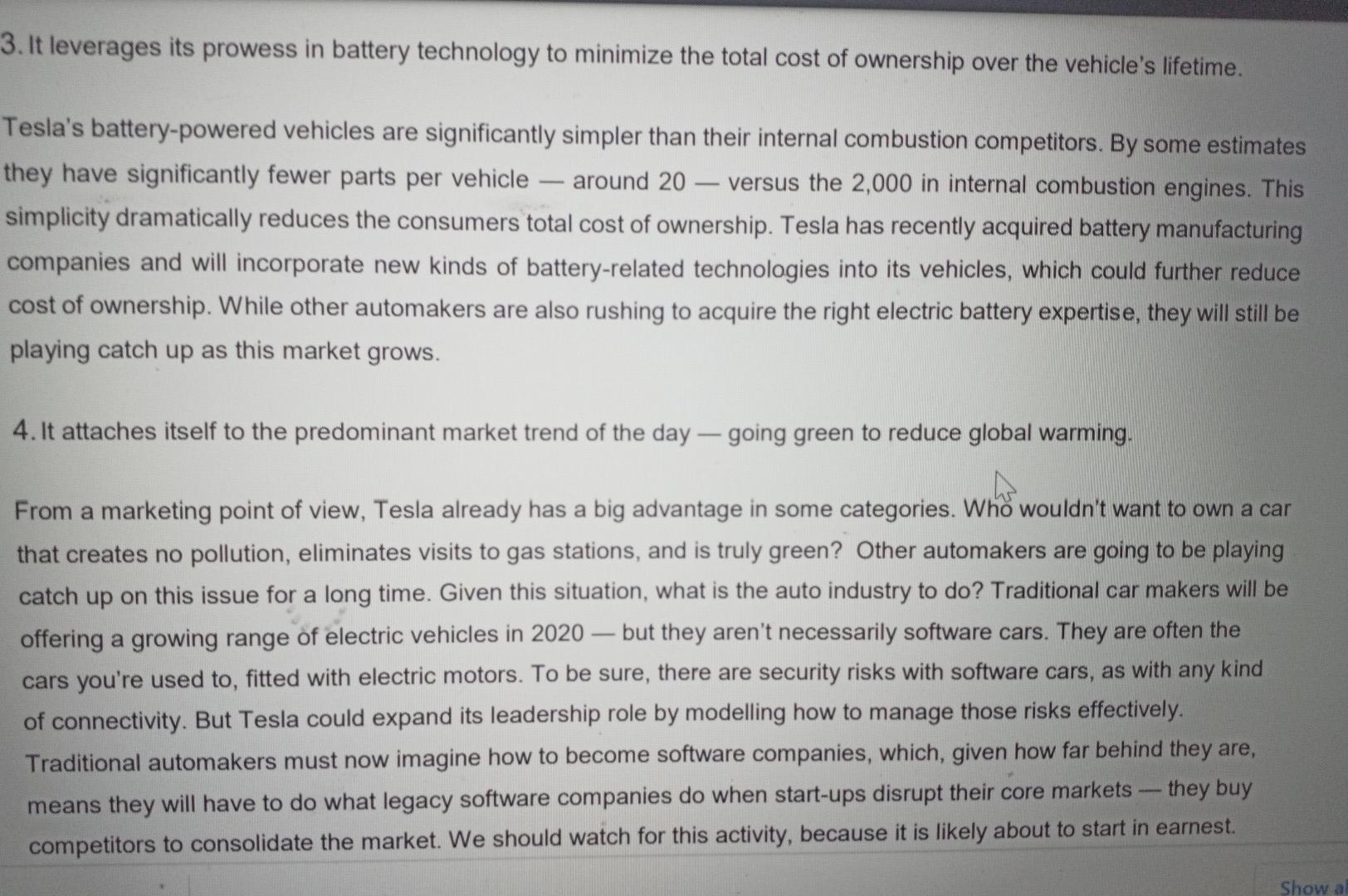
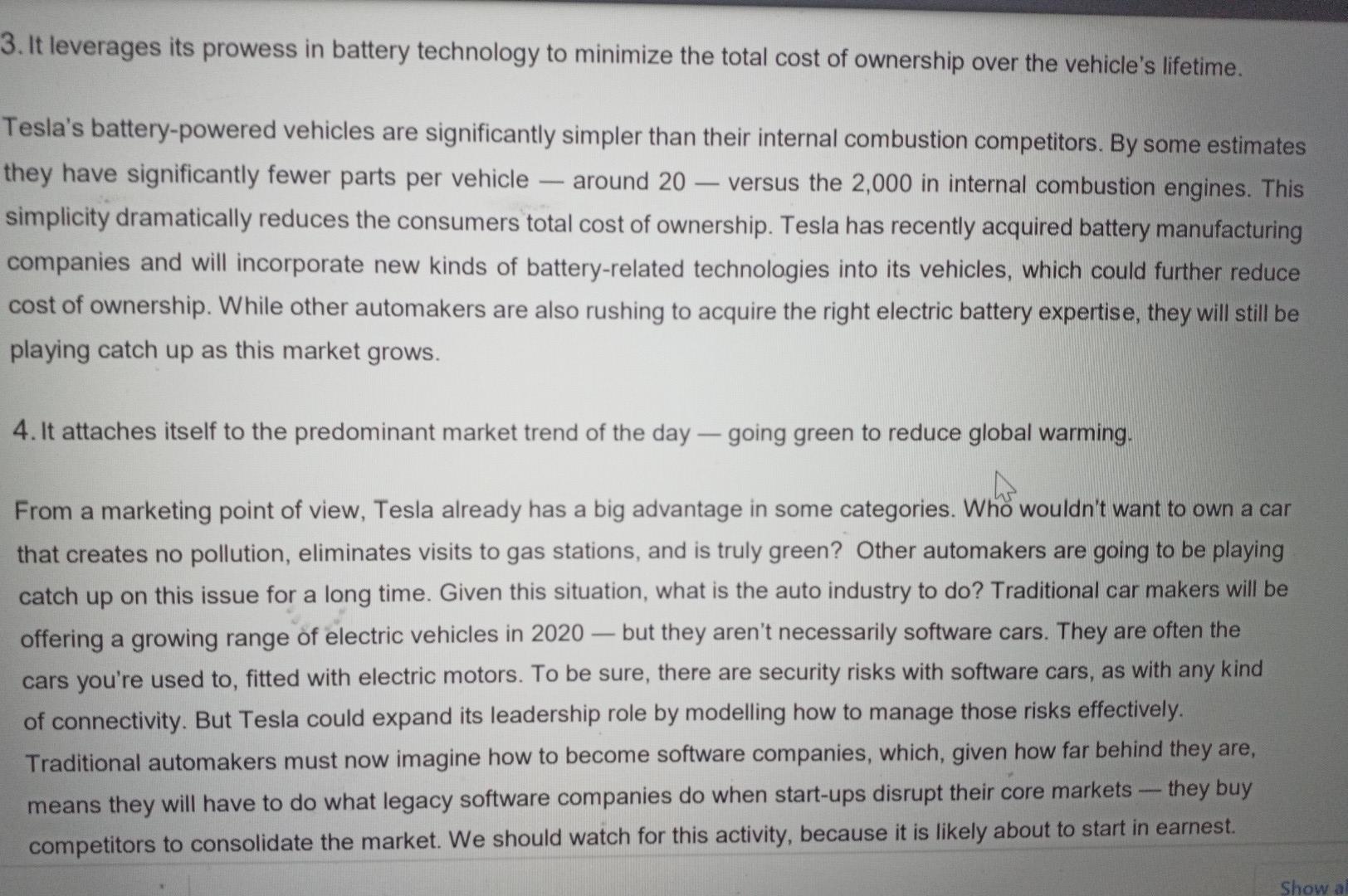
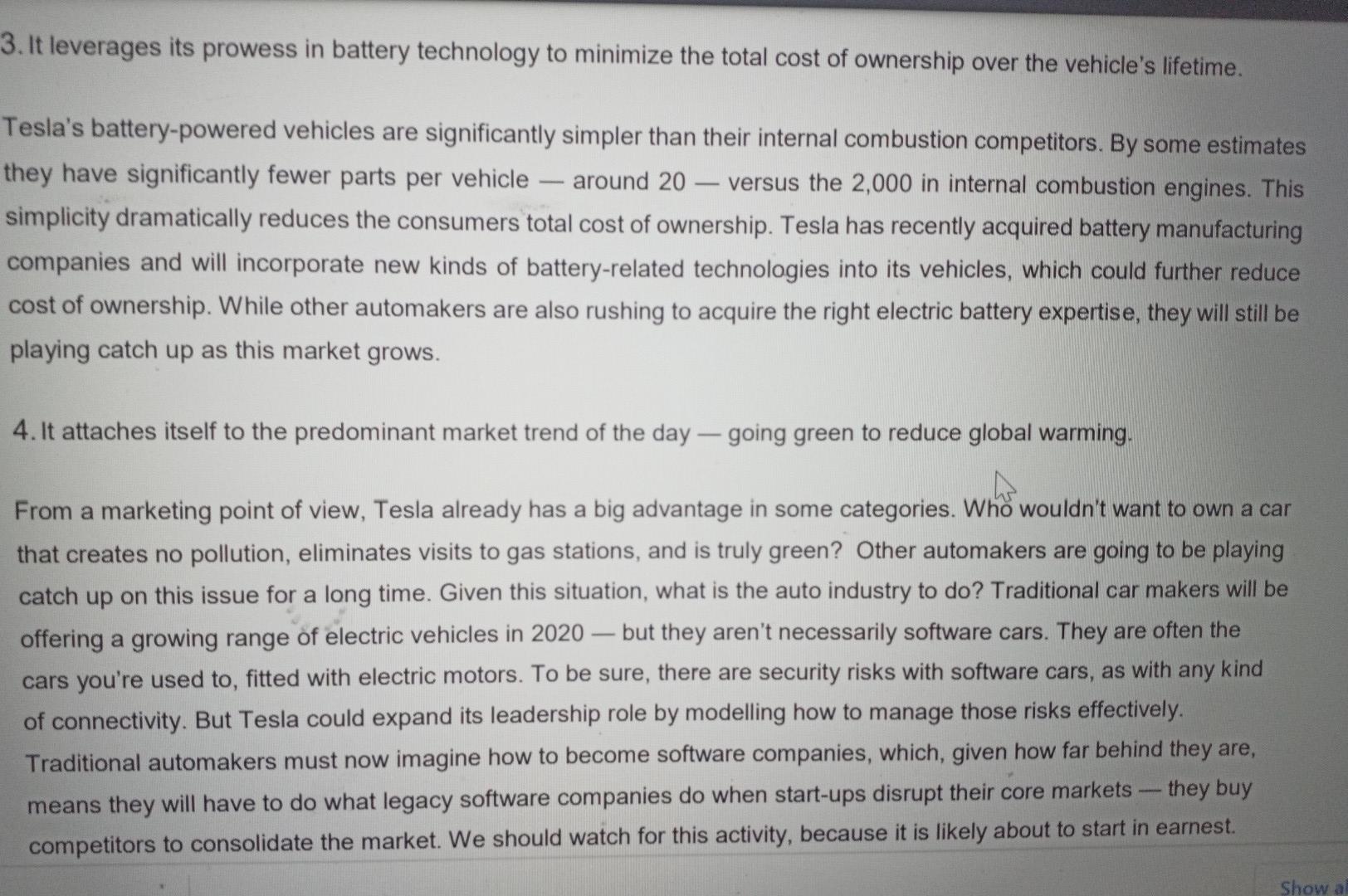
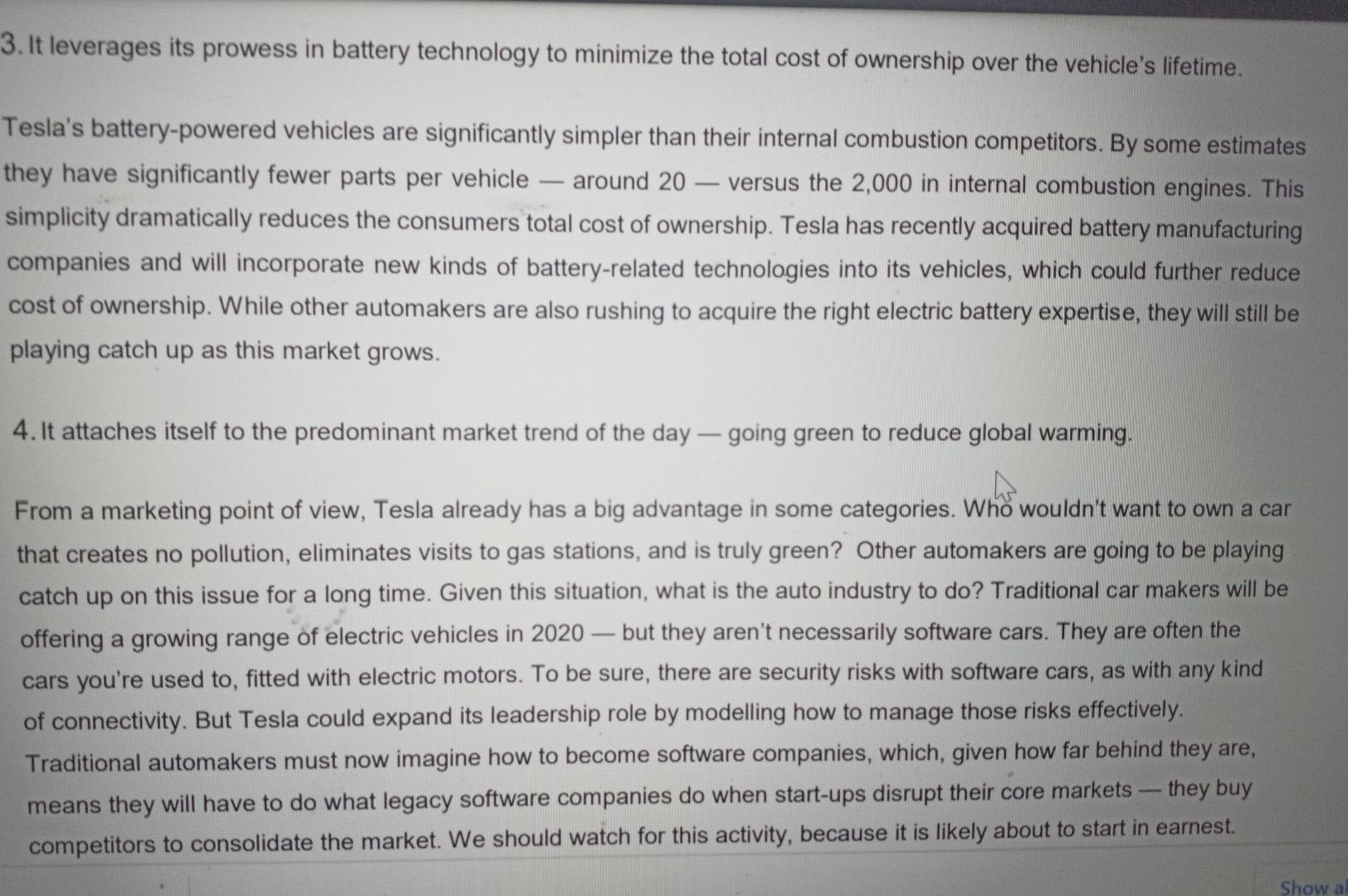
3. It leverages its prowess in battery technology to minimize the total cost of ownership over the vehicle's lifetime. - Tesla's battery-powered vehicles are significantly simpler than their internal combustion competitors. By some estimates they have significantly fewer parts per vehicle - around 20 versus the 2,000 in internal combustion engines. This simplicity dramatically reduces the consumers total cost of ownership. Tesla has recently acquired battery manufacturing companies and will incorporate new kinds of battery-related technologies into its vehicles, which could further reduce cost of ownership. While other automakers are also rushing to acquire the right electric battery expertise, they will still be playing catch up as this market grows. 4. It attaches itself to the predominant market trend of the day going green to reduce global warming. From a marketing point of view, Tesla already has a big advantage in some categories. Who wouldn't want to own a car that creates no pollution, eliminates visits to gas stations, and is truly green? Other automakers are going to be playing catch up on this issue for a long time. Given this situation, what is the auto industry to do? Traditional car makers will be offering a growing range of electric vehicles in 2020 but they aren't necessarily software cars. They are often the cars you're used to, fitted with electric motors. To be sure, there are security risks with software cars, as with any kind of connectivity. But Tesla could expand its leadership role by modelling how to manage those risks effectively. Traditional automakers must now imagine how to become software companies, which, given how far behind they are, means they will have to do what legacy software companies do when start-ups disrupt their core markets they buy competitors to consolidate the market. We should watch for this activity, because it is likely about to start in earnest. - Show a 3. It leverages its prowess in battery technology to minimize the total cost of ownership over the vehicle's lifetime. - Tesla's battery-powered vehicles are significantly simpler than their internal combustion competitors. By some estimates they have significantly fewer parts per vehicle - around 20 versus the 2,000 in internal combustion engines. This simplicity dramatically reduces the consumers total cost of ownership. Tesla has recently acquired battery manufacturing companies and will incorporate new kinds of battery-related technologies into its vehicles, which could further reduce cost of ownership. While other automakers are also rushing to acquire the right electric battery expertise, they will still be playing catch up as this market grows. 4. It attaches itself to the predominant market trend of the day going green to reduce global warming. From a marketing point of view, Tesla already has a big advantage in some categories. Who wouldn't want to own a car that creates no pollution, eliminates visits to gas stations, and is truly green? Other automakers are going to be playing catch up on this issue for a long time. Given this situation, what is the auto industry to do? Traditional car makers will be offering a growing range of electric vehicles in 2020 but they aren't necessarily software cars. They are often the cars you're used to, fitted with electric motors. To be sure, there are security risks with software cars, as with any kind of connectivity. But Tesla could expand its leadership role by modelling how to manage those risks effectively. Traditional automakers must now imagine how to become software companies, which, given how far behind they are, means they will have to do what legacy software companies do when start-ups disrupt their core markets they buy competitors to consolidate the market. We should watch for this activity, because it is likely about to start in earnest. - Show a 3. It leverages its prowess in battery technology to minimize the total cost of ownership over the vehicle's lifetime. - Tesla's battery-powered vehicles are significantly simpler than their internal combustion competitors. By some estimates they have significantly fewer parts per vehicle - around 20 versus the 2,000 in internal combustion engines. This simplicity dramatically reduces the consumers total cost of ownership. Tesla has recently acquired battery manufacturing companies and will incorporate new kinds of battery-related technologies into its vehicles, which could further reduce cost of ownership. While other automakers are also rushing to acquire the right electric battery expertise, they will still be playing catch up as this market grows. 4. It attaches itself to the predominant market trend of the day going green to reduce global warming. From a marketing point of view, Tesla already has a big advantage in some categories. Who wouldn't want to own a car that creates no pollution, eliminates visits to gas stations, and is truly green? Other automakers are going to be playing catch up on this issue for a long time. Given this situation, what is the auto industry to do? Traditional car makers will be offering a growing range of electric vehicles in 2020 but they aren't necessarily software cars. They are often the cars you're used to, fitted with electric motors. To be sure, there are security risks with software cars, as with any kind of connectivity. But Tesla could expand its leadership role by modelling how to manage those risks effectively. Traditional automakers must now imagine how to become software companies, which, given how far behind they are, means they will have to do what legacy software companies do when start-ups disrupt their core markets they buy competitors to consolidate the market. We should watch for this activity, because it is likely about to start in earnest. - Show a 3. It leverages its prowess in battery technology to minimize the total cost of ownership over the vehicle's lifetime. - Tesla's battery-powered vehicles are significantly simpler than their internal combustion competitors. By some estimates they have significantly fewer parts per vehicle - around 20 versus the 2,000 in internal combustion engines. This simplicity dramatically reduces the consumers total cost of ownership. Tesla has recently acquired battery manufacturing companies and will incorporate new kinds of battery-related technologies into its vehicles, which could further reduce cost of ownership. While other automakers are also rushing to acquire the right electric battery expertise, they will still be playing catch up as this market grows. 4. It attaches itself to the predominant market trend of the day going green to reduce global warming. From a marketing point of view, Tesla already has a big advantage in some categories. Who wouldn't want to own a car that creates no pollution, eliminates visits to gas stations, and is truly green? Other automakers are going to be playing catch up on this issue for a long time. Given this situation, what is the auto industry to do? Traditional car makers will be offering a growing range of electric vehicles in 2020 but they aren't necessarily software cars. They are often the cars you're used to, fitted with electric motors. To be sure, there are security risks with software cars, as with any kind of connectivity. But Tesla could expand its leadership role by modelling how to manage those risks effectively. Traditional automakers must now imagine how to become software companies, which, given how far behind they are, means they will have to do what legacy software companies do when start-ups disrupt their core markets they buy competitors to consolidate the market. We should watch for this activity, because it is likely about to start in earnest. - Show a 3. It leverages its prowess in battery technology to minimize the total cost of ownership over the vehicle's lifetime. - Tesla's battery-powered vehicles are significantly simpler than their internal combustion competitors. By some estimates they have significantly fewer parts per vehicle - around 20 versus the 2,000 in internal combustion engines. This simplicity dramatically reduces the consumers total cost of ownership. Tesla has recently acquired battery manufacturing companies and will incorporate new kinds of battery-related technologies into its vehicles, which could further reduce cost of ownership. While other automakers are also rushing to acquire the right electric battery expertise, they will still be playing catch up as this market grows. 4. It attaches itself to the predominant market trend of the day going green to reduce global warming. From a marketing point of view, Tesla already has a big advantage in some categories. Who wouldn't want to own a car that creates no pollution, eliminates visits to gas stations, and is truly green? Other automakers are going to be playing catch up on this issue for a long time. Given this situation, what is the auto industry to do? Traditional car makers will be offering a growing range of electric vehicles in 2020 but they aren't necessarily software cars. They are often the cars you're used to, fitted with electric motors. To be sure, there are security risks with software cars, as with any kind of connectivity. But Tesla could expand its leadership role by modelling how to manage those risks effectively. Traditional automakers must now imagine how to become software companies, which, given how far behind they are, means they will have to do what legacy software companies do when start-ups disrupt their core markets they buy competitors to consolidate the market. We should watch for this activity, because it is likely about to start in earnest. - Show a 3. It leverages its prowess in battery technology to minimize the total cost of ownership over the vehicle's lifetime. - Tesla's battery-powered vehicles are significantly simpler than their internal combustion competitors. By some estimates they have significantly fewer parts per vehicle - around 20 versus the 2,000 in internal combustion engines. This simplicity dramatically reduces the consumers total cost of ownership. Tesla has recently acquired battery manufacturing companies and will incorporate new kinds of battery-related technologies into its vehicles, which could further reduce cost of ownership. While other automakers are also rushing to acquire the right electric battery expertise, they will still be playing catch up as this market grows. 4. It attaches itself to the predominant market trend of the day going green to reduce global warming. From a marketing point of view, Tesla already has a big advantage in some categories. Who wouldn't want to own a car that creates no pollution, eliminates visits to gas stations, and is truly green? Other automakers are going to be playing catch up on this issue for a long time. Given this situation, what is the auto industry to do? Traditional car makers will be offering a growing range of electric vehicles in 2020 but they aren't necessarily software cars. They are often the cars you're used to, fitted with electric motors. To be sure, there are security risks with software cars, as with any kind of connectivity. But Tesla could expand its leadership role by modelling how to manage those risks effectively. Traditional automakers must now imagine how to become software companies, which, given how far behind they are, means they will have to do what legacy software companies do when start-ups disrupt their core markets they buy competitors to consolidate the market. We should watch for this activity, because it is likely about to start in earnest. - Show aStep by Step Solution
There are 3 Steps involved in it
1 Expert Approved Answer
Step: 1 Unlock

Question Has Been Solved by an Expert!
Get step-by-step solutions from verified subject matter experts
Step: 2 Unlock
Step: 3 Unlock
 Study Help