







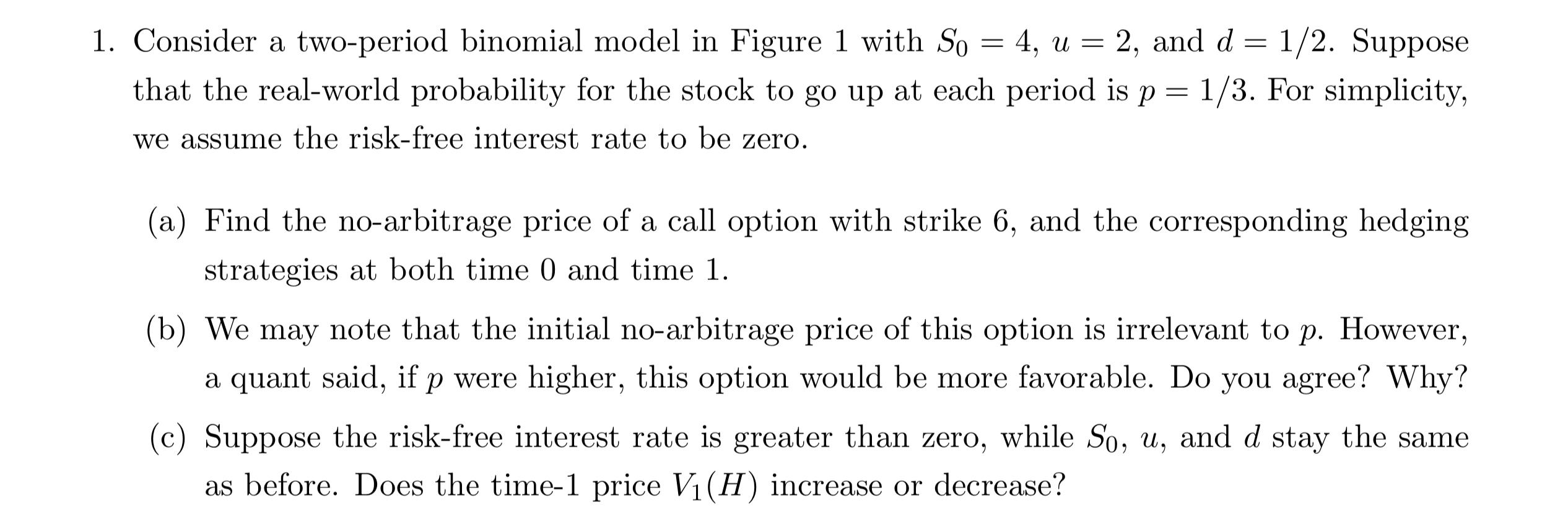
Question: please help me 1. Consider a two-period binomial model in Figure 1 with S0=4,u=2, and d=1/2. Suppose that the real-world probability for the stock to
 please help me
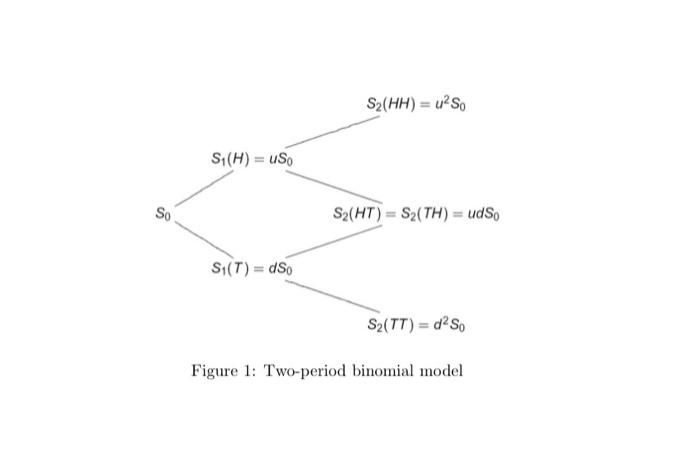
1. Consider a two-period binomial model in Figure 1 with S0=4,u=2, and d=1/2. Suppose that the real-world probability for the stock to go up at each period is p=1/3. For simplicity, we assume the risk-free interest rate to be zero. (a) Find the no-arbitrage price of a call option with strike 6, and the corresponding hedging strategies at both time 0 and time 1 . (b) We may note that the initial no-arbitrage price of this option is irrelevant to p. However, a quant said, if p were higher, this option would be more favorable. Do you agree? Why? (c) Suppose the risk-free interest rate is greater than zero, while S0,u, and d stay the same as before. Does the time-1 price V1(H) increase or decrease? Figure 1: Two-period binomial model 1. Consider a two-period binomial model in Figure 1 with S0=4,u=2, and d=1/2. Suppose that the real-world probability for the stock to go up at each period is p=1/3. For simplicity, we assume the risk-free interest rate to be zero. (a) Find the no-arbitrage price of a call option with strike 6, and the corresponding hedging strategies at both time 0 and time 1 . (b) We may note that the initial no-arbitrage price of this option is irrelevant to p. However, a quant said, if p were higher, this option would be more favorable. Do you agree? Why? (c) Suppose the risk-free interest rate is greater than zero, while S0,u, and d stay the same as before. Does the time-1 price V1(H) increase or decrease? Figure 1: Two-period binomial model
Step by Step Solution
There are 3 Steps involved in it

Get step-by-step solutions from verified subject matter experts
 Study Help