







Question: Please help me answer for these four questions. I also attached a screenshot of the excel sheet. Please use excel to solve it and provide
Please help me answer for these four questions. I also attached a screenshot of the excel sheet. Please use excel to solve it and provide an exact number, thank you so much!!
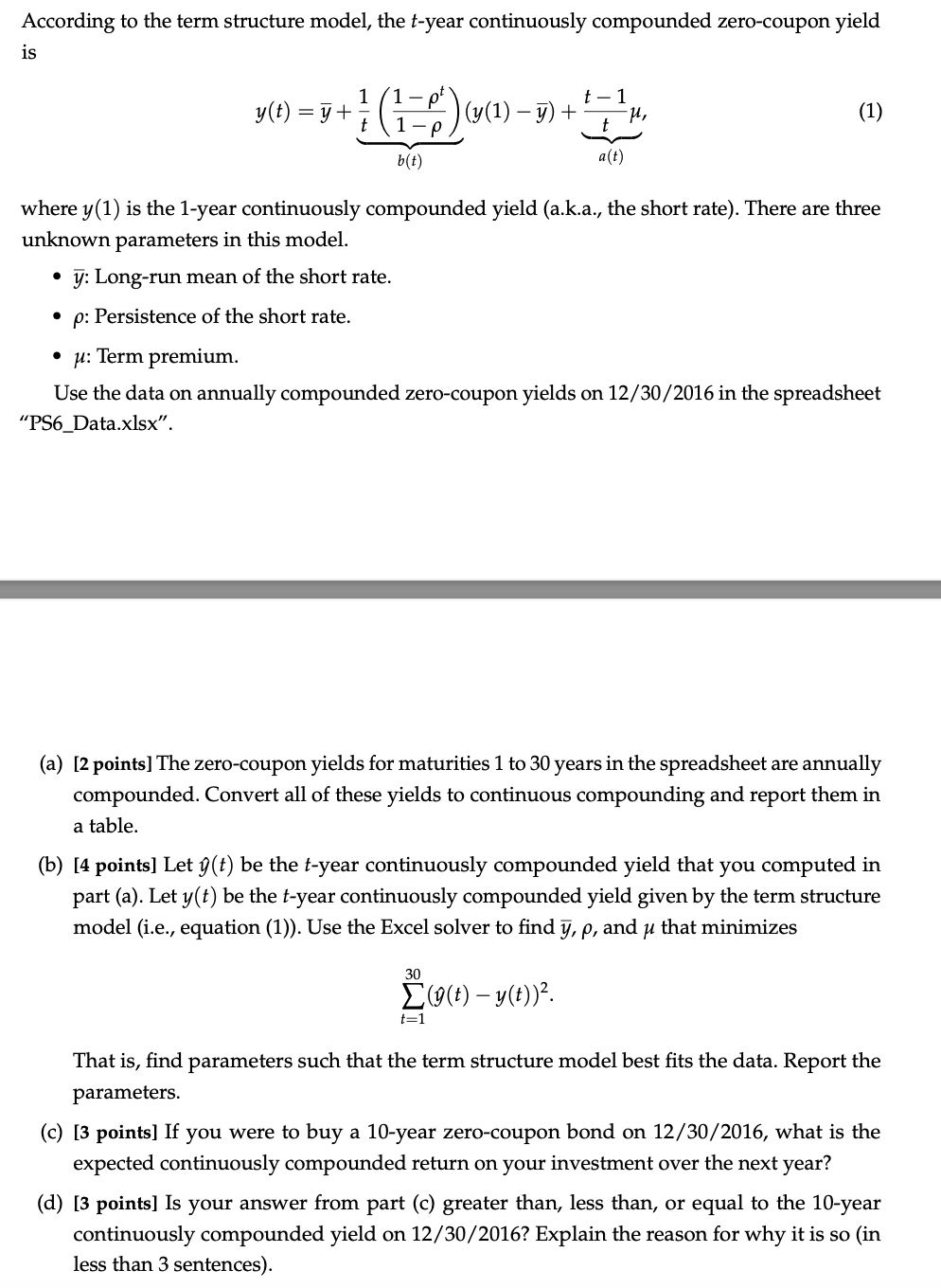
According to the term structure model, the year continuously compounded zerocoupon yield
is
ubraceubrace
where is the year continuously compounded yield aka the short rate There are three
unknown parameters in this model.
: Longrun mean of the short rate.
: Persistence of the short rate.
: Term premium.
Use the data on annually compounded zerocoupon yields on in the spreadsheet
PSData.xlsx
a points The zerocoupon yields for maturities to years in the spreadsheet are annually
compounded. Convert all of these yields to continuous compounding and report them in
a table.
b points Let hat be the year continuously compounded yield that you computed in
part a Let be the year continuously compounded yield given by the term structure
model ie equation Use the Excel solver to find and that minimizes
That is find parameters such that the term structure model best fits the data. Report the
parameters.
c points If you were to buy a year zerocoupon bond on what is the
expected continuously compounded return on your investment over the next year?
d points Is your answer from part c greater than, less than, or equal to the year
continuously compounded yield on Explain the reason for why it is so in
less than sentences
Step by Step Solution
There are 3 Steps involved in it
1 Expert Approved Answer
Step: 1 Unlock

Question Has Been Solved by an Expert!
Get step-by-step solutions from verified subject matter experts
Step: 2 Unlock
Step: 3 Unlock
 Study Help