







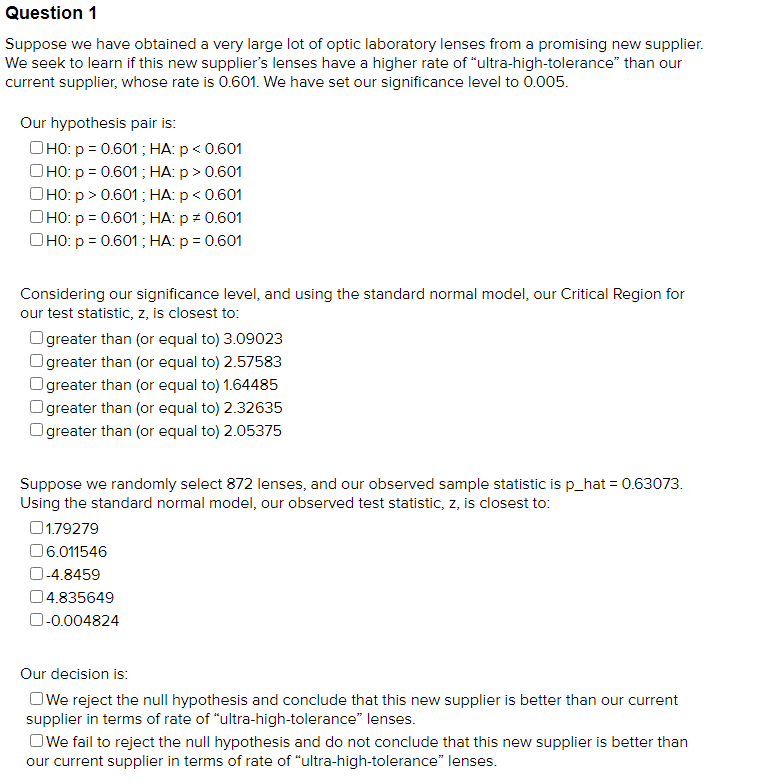
Question: Please help me answer the following: Question 1 Suppose we have obtained a very large lot of optic laboratory lenses from a promising new supplier.
Please help me answer the following:
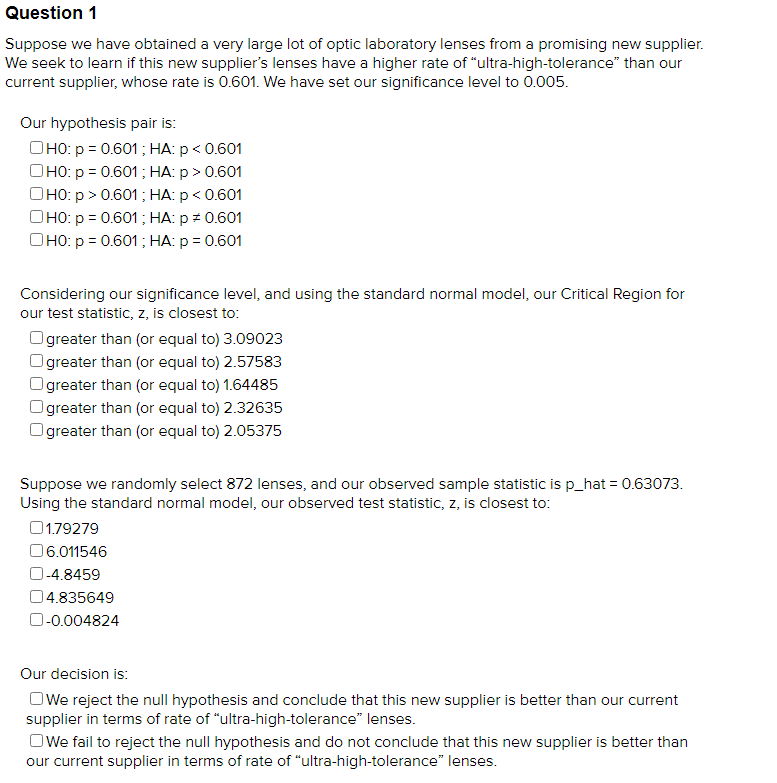
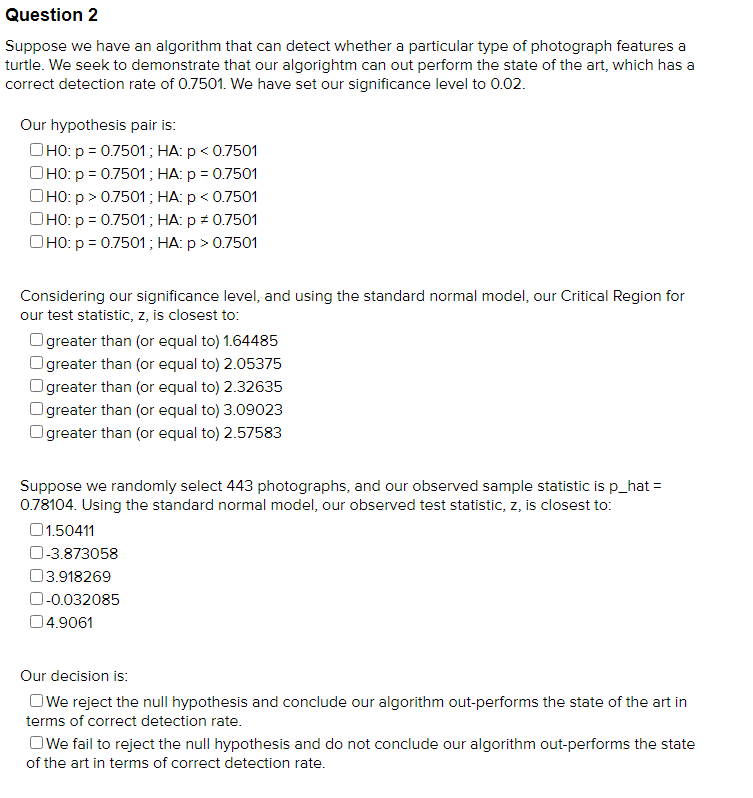
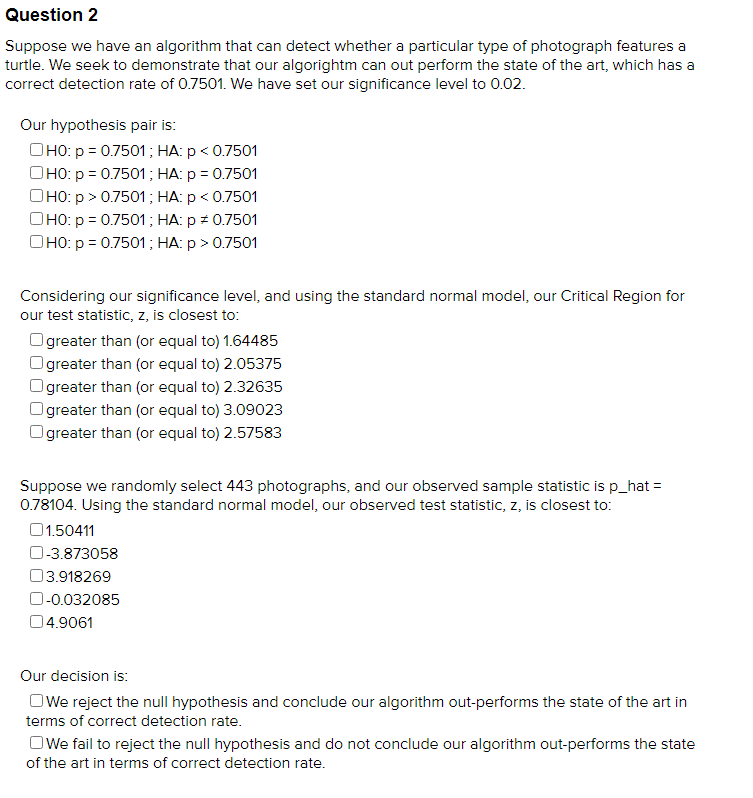
Question 1 Suppose we have obtained a very large lot of optic laboratory lenses from a promising new supplier. We seek to learn if this new supplier's lenses have a higher rate of "ultra-high-tolerance" than our current supplier, whose rate is 0.601. We have set our significance level to 0.005. Our hypothesis pair is: OHO: p = 0.601 ; HA: p 0.601 OHO: p > 0.601 ; HA: p 0.7501; HA: p 0.7501 Considering our significance level, and using the standard normal model, our Critical Region for our test statistic, z, is closest to: O greater than (or equal to) 1.64485 greater than (or equal to) 2.05375 O greater than (or equal to) 2.32635 greater than (or equal to) 3.09023 greater than (or equal to) 2.57583 Suppose we randomly select 443 photographs, and our observed sample statistic is p_hat = 0.78104. Using the standard normal model, our observed test statistic, z, is closest to: 01.50411 0-3.873058 03.918269 0-0.032085 04.9061 Our decision is: We reject the null hypothesis and conclude our algorithm out-performs the state of the art in terms of correct detection rate. We fail to reject the null hypothesis and do not conclude our algorithm out-performs the state of the art in terms of correct detection rate
Step by Step Solution
There are 3 Steps involved in it

Get step-by-step solutions from verified subject matter experts
 Study Help