







Question: please help me answer the question in your words Don't copy the original questions to avoid plagiarism. Picture this scenario. You're the CEO of one
please help me answer the question in your words
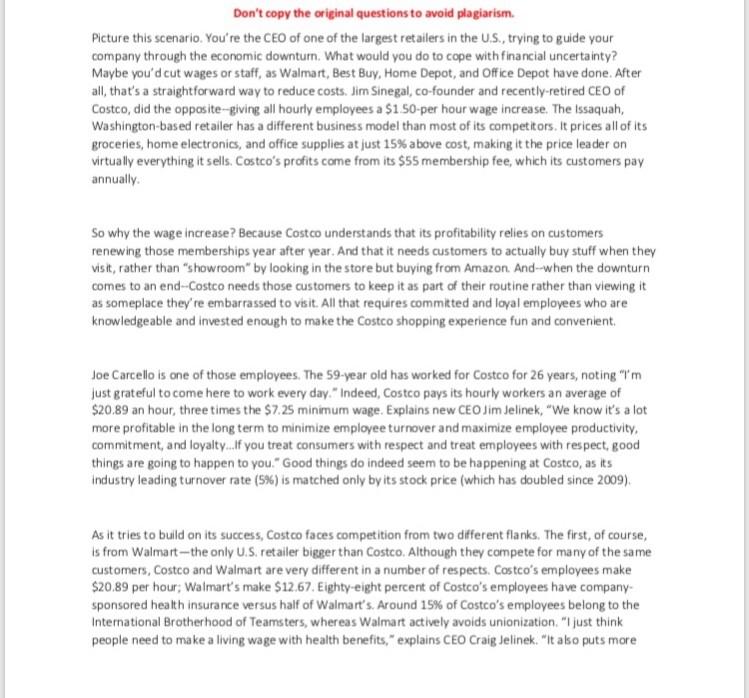
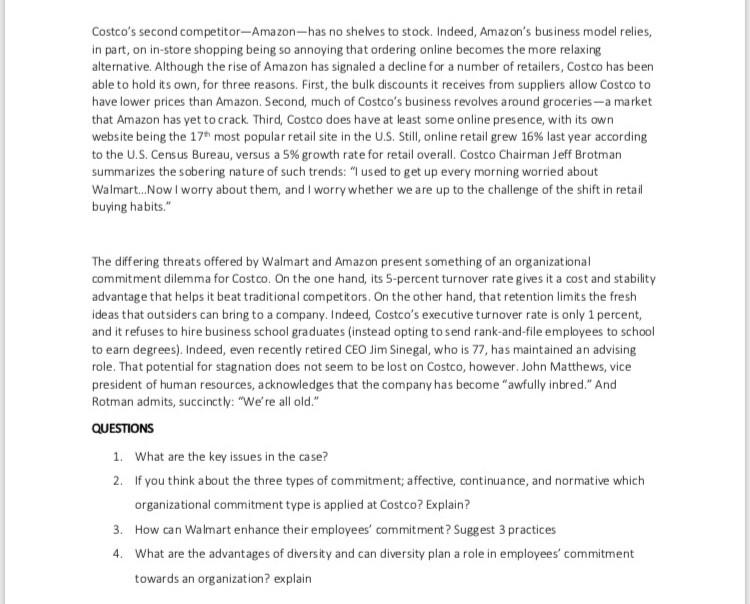
Don't copy the original questions to avoid plagiarism. Picture this scenario. You're the CEO of one of the largest retailers in the U.S., trying to guide your company through the economic downturn. What would you do to cope with financial uncertainty? Maybe you'd cut wages or staff, as Walmart, Best Buy, Home Depot, and Office Depot have done. After all, that's a straightforward way to reduce costs Jim Sinegal, co-founder and recently-retired CEO of Costco, did the opposite-giving all hourly employees a $1.50 per hour wage increase. The Issaquah, Washington-based retailer has a different business model than most of its competitors. It prices all of its groceries, home electronics, and office supplies at just 15% above cost, making it the price leader on virtually everything it sells. Costco's profits come from its $55 membership fee, which its customers pay annually. So why the wage increase? Because Costco understands that its profitability relies on customers renewing those memberships year after year. And that it needs customers to actually buy stuff when they visit, rather than "showroom" by looking in the store but buying from Amazon And--when the downturn comes to an end-Costco needs those customers to keep it as part of their routine rather than viewing it as someplace they're embarrassed to o visit. All that requires committed and loyal employees who are knowledgeable and invested enough to make the Costco shopping experience fun and convenient Joe Carcello is one of those employees. The 59-year old has worked for Costco for 26 years, noting em just grateful to come here to work every day." Indeed, Costco pays its hourly workers an average of $20.89 an hour three times the $7.25 minimum wage. Explains new CEO Jim Jelinek, "We know it's a lot more profitable in the long term to minimize employee turnover and maximize employee productivity, commitment, and loyalty.If you treat consumers with respect and treat employees with respect, good things are going to happen to you." Good things do indeed seem to be happening at Costco, as its industry leading turnover rate (596) is matched only by its stock price (which has doubled since 2009) As it tries to build on its success, Costco faces competition from two different flanks. The first, of course, is from Walmart-the only U.S. retailer bigger than Costco. Although they compete for many of the same customers, Costco and Walmart are very different in a number of respects. Costco's employees make $20.89 per hour; Walmart's make $12.67. Eighty-eight percent of Costco's employees have company sponsored health insurance versus half of Walmart's. Around 15% of Costco's employees belong to the International Brotherhood of Teamsters, whereas Walmart actively avoids unionization. "I just think people need to make a living wage with health benefits," explains CEO Craig Jelinek. It also puts more Costco's second competitor-Amazon-has no shelves to stock. Indeed, Amazon's business model relles, in part, on in-store shopping being so annoying that ordering online becomes the more relaxing alternative. Although the rise of Amazon has signaled a decline for a number of retailers, Costco has been able to hold its own, for three reasons. First, the bulk discounts it receives from suppliers allow Costco to have lower prices than Amazon. Second, much of Costco's business revolves around groceries -a market that Amazon has yet to crack. Third, Costco does have at least some online presence, with its own website being the 17* most popular retail site in the U.S. Still, online retail grew 16% last year according to the U.S. Census Bureau, versus a 5% growth rate for retail overall. Costco Chairman Jeff Brotman summarizes the sobering nature of such trends: "I used to get up every morning worried about Walmart...Now I worry about them, and I worry whether we are up to the challenge of the shift in retail buying habits." The differing threats offered by Walmart and Amazon present something of an organizational commitment dilemma for Costco. On the one hand, its 5-percent turnover rate gives it a cost and stability advantage that helps it beat traditional competitors. On the other hand, that retention limits the fresh ideas that outsiders can bring to a company. Indeed, Costco's executive turnover rate is only 1 percent and it refuses to hire business school graduates (instead opting to send rank-and-file employees to school to earn degrees). Indeed, even recently retired CEO Jim Sinegal, who is 77, has maintained an advising role. That potential for stagnation does not seem to be lost on Costco, however. John Matthews, vice president of human resources, acknowledges that the company has become "awfully inbred." And Rotman admits, succinctly: "We're all old." QUESTIONS 1. What are the key issues in the case? 2. If you think about the three types of commitment; affective, continuance, and normative which organizational commitment type is applied at Costco? Explain? 3. How can Walmart enhance their employees' commitment? Suggest 3 practices 4. What are the advantages of diversity and can diversity plan a role in employees' commitment towards an organization? explainStep by Step Solution
There are 3 Steps involved in it
1 Expert Approved Answer
Step: 1 Unlock

Question Has Been Solved by an Expert!
Get step-by-step solutions from verified subject matter experts
Step: 2 Unlock
Step: 3 Unlock
 Study Help