Question: Please help me answer these question will rate your answer right away! Requirements: IVEy |Publishing W27514 HARRY ROSEN: DIGITIZING CUSTOMER RELATIONSHIPS Vania Sakelaris and Professor
Please help me answer these question will rate your answer right away!
Requirements:
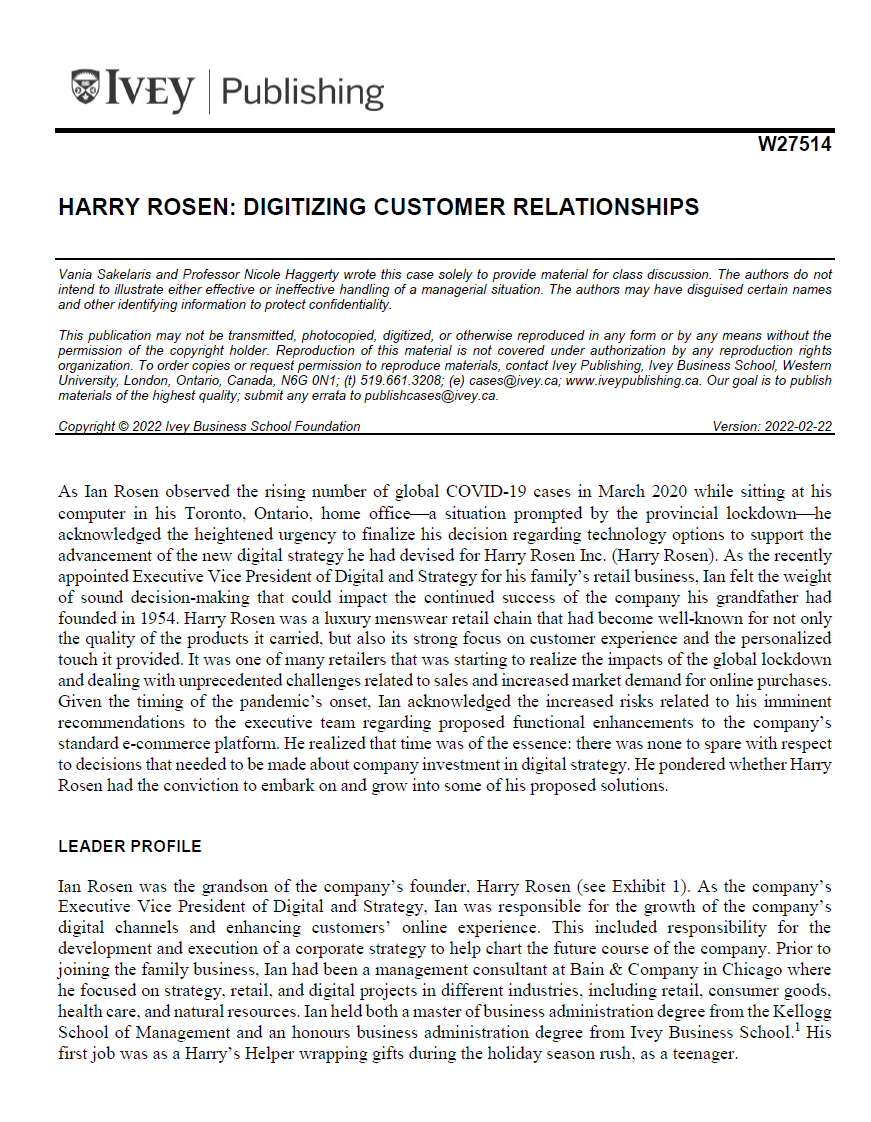
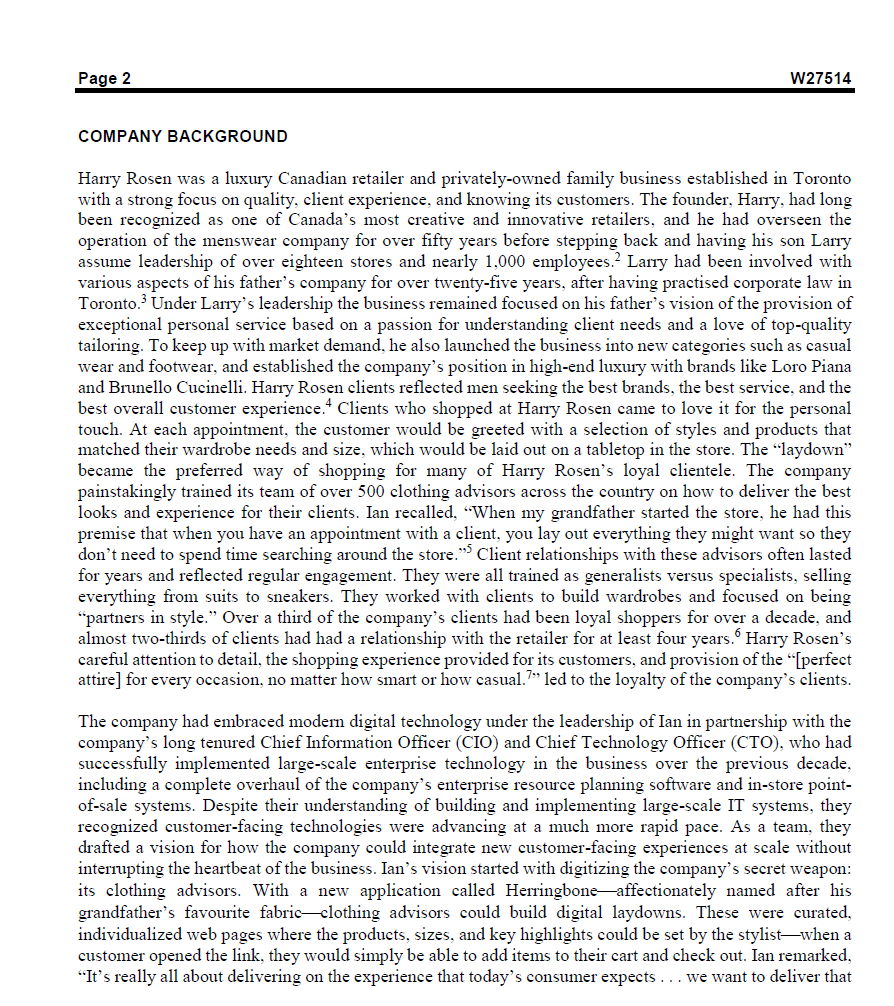
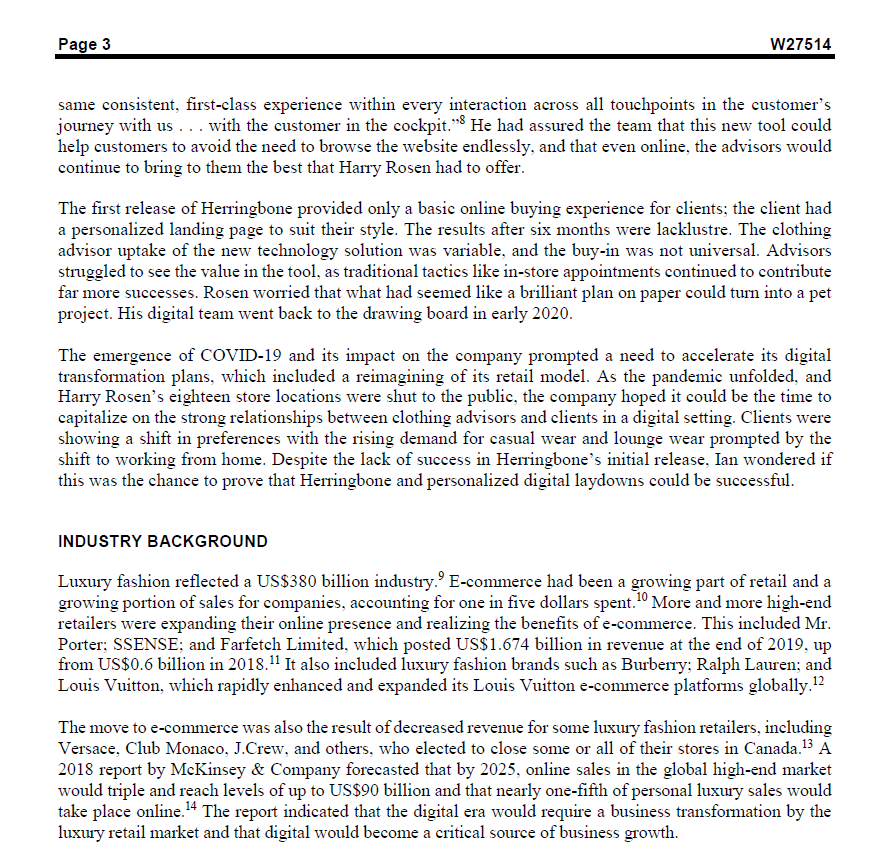
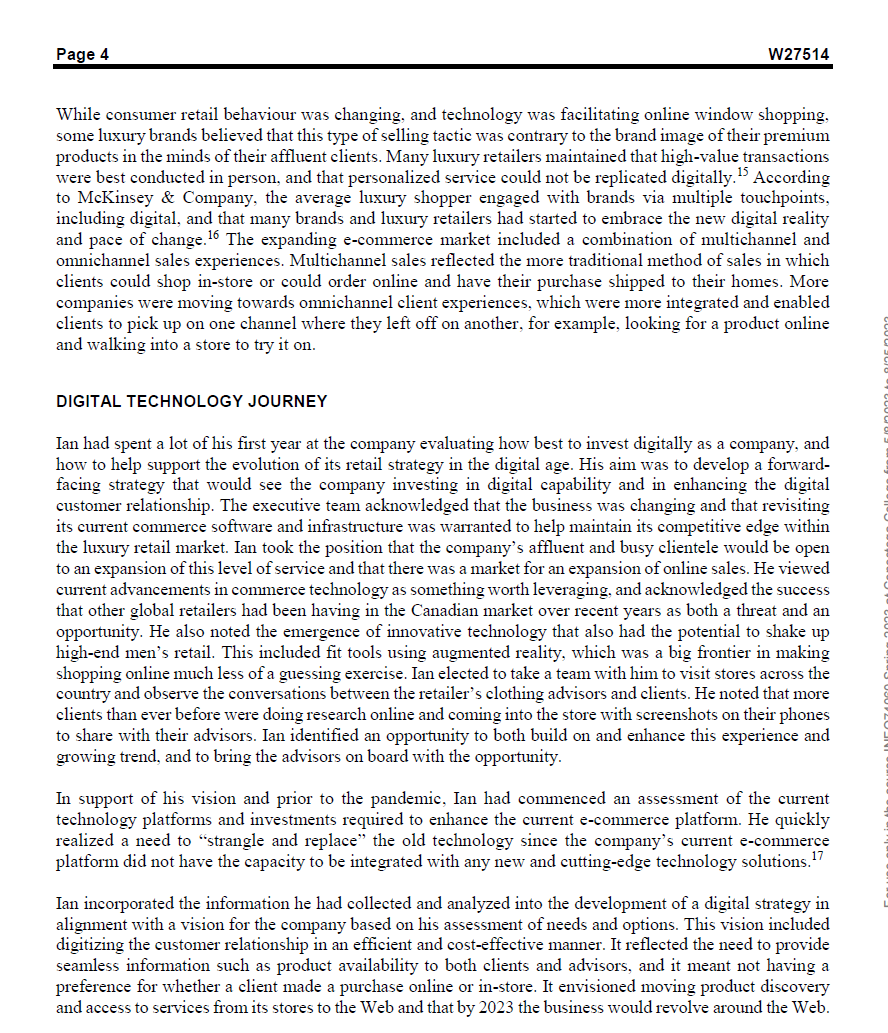
IVEy |Publishing W27514 HARRY ROSEN: DIGITIZING CUSTOMER RELATIONSHIPS Vania Sakelaris and Professor Nicole Haggerty wrote this case solely to provide material for class discussion. The authors do not intend to illustrate either effective or ineffective handling of a managerial situation. The authors may have disguised certain names and other identifying information to protect confidentiality. This publication may not be transmitted, photocopied, digitized, or otherwise reproduced in any form or by any means without the permission of the copyright holder. Reproduction of this material is not covered under authorization by any reproduction rights organization. To order copies or request permission to reproduce materials, contact Ivey Publishing, Ivey Business School, Western University, London, Ontario, Canada, N6G ON1; (t) 519.661.3208; (e) cases@ivey.ca; www.iveypublishing.ca. Our goal is to publish materials of the highest quality; submit any errata to publishcases@ivey.ca. Copyright @ 2022 Ivey Business School Foundation Version: 2022-02-22 As Ian Rosen observed the rising number of global COVID-19 cases in March 2020 while sitting at his computer in his Toronto, Ontario, home office-a situation prompted by the provincial lockdown he acknowledged the heightened urgency to finalize his decision regarding technology options to support the advancement of the new digital strategy he had devised for Harry Rosen Inc. (Harry Rosen). As the recently appointed Executive Vice President of Digital and Strategy for his family's retail business, Ian felt the weight of sound decision-making that could impact the continued success of the company his grandfather had founded in 1954. Harry Rosen was a luxury menswear retail chain that had become well-known for not only the quality of the products it carried, but also its strong focus on customer experience and the personalized touch it provided. It was one of many retailers that was starting to realize the impacts of the global lockdown and dealing with unprecedented challenges related to sales and increased market demand for online purchases. Given the timing of the pandemic's onset, Ian acknowledged the increased risks related to his imminent recommendations to the executive team regarding proposed functional enhancements to the company's standard e-commerce platform. He realized that time was of the essence: there was none to spare with respect to decisions that needed to be made about company investment in digital strategy. He pondered whether Harry Rosen had the conviction to embark on and grow into some of his proposed solutions. LEADER PROFILE Ian Rosen was the grandson of the company's founder, Harry Rosen (see Exhibit 1). As the company's Executive Vice President of Digital and Strategy, Ian was responsible for the growth of the company's digital channels and enhancing customers' online experience. This included responsibility for the development and execution of a corporate strategy to help chart the future course of the company. Prior to joining the family business, Ian had been a management consultant at Bain & Company in Chicago where he focused on strategy, retail, and digital projects in different industries, including retail, consumer goods, health care, and natural resources. Ian held both a master of business administration degree from the Kellogg School of Management and an honours business administration degree from Ivey Business School. His first job was as a Harry's Helper wrapping gifts during the holiday season rush, as a teenager.Page 2 W27514 COM PANY BAC KG R0 UN D Harry Rosen was a luxury Canadian retailer and privately-owned family business established in Toronto with a strong focus on quality. client experience. and knowing its customers. The founder. Harry. had long been recognized as one of C anada"s most creative and innovative retailers. and he had overseen the operation of the menswear company for over fifty years before stepping back and having his son Larry assume leadership of over eighteen stores and nearly 1.000 employees.2 Larry had been involved with various aspects of his father's company for over twenty-five years. after having practised corporate law in Toronto.5 Under Lany's leadership the business remained focused 011 his father" s vision of the provision of exceptional personal service based on a passion for understanding client needs and a love of top-quality tailoring. To keep up with market demand. he also launched the business into new categories such as casual wear and footwear. and established the company's position in high-end luxury with brands like Loro Piana and Brunello C ucinelli. Harry Rosen clients reflected men seeking the best brands. the best service. and the best overall customer experience.4 Clients who shopped at Harry Rosen came to love it for the personal touch. At each appointment. the customer would be greeted with a selection of styles and products that matched their wardrobe needs and size. which would be laid out on a tabletop in the store. The "laydown" became the preferred way of shopping for many of Harry Rosen's loyal clientele. The company painstakingly trained its team of over 500 clothing advisors across the country on how to deliver the best looks and experience for their c ients. Ian recalled. "When my grandfather started the store. he had this premise that when you have an appointment with a client. you lay out everything they might want so they don't need to spend time searching around the store."5 Client relationships with these advisors often lasted for years and reected regular e1 gageinent. They were all trained as generalists versus specialists. selling everything from suits to sneakers. They worked with clients to build wardrobes and focused 011 being "partners in style.\" Over a third of the company's clients had been loyal shoppers for over a decade. and almost two-thirds of clients had .1ad a relationship with the retailer for at least four years.'i Harry Rosen's careful attention to detail. the shopping experience provided for its customers. and provision of the "Lperfect attire] for every occasion. no mat er how smart or how casual?" led to the loyalty of the company's clients. The company had embraced modern digital technology under the leadership of Ian in partnership with the company's long tenured Chief It formation Ofcer (CIO) and Chief Technology Ofcer (CTO). who had successfully implemented large-scale enterprise technology in the business over the previous decade. including a complete overhaul of the company's enterprise resource planning software and in-store point- of-sale systems. Despite their understanding of building and implementing large-scale IT systems. they recognized customer-facing technologies were advancing at a much more rapid pace. As a team. they drafted a vision for how the company could integrate new customer-facing experiences at scale without interrupting the heartbeat of the business. Ian's vision started with digitizing the company"s secret weapon: its clothing advisors. \\Vith a new application called Herringboneaffectionately named after his grandfather's favourite fabricclothing advisors could build digital laydowns. These were curated. individualized web pages where the products. sizes. and key highlights could be set by the stylistwhen a customer opened the link. they would simply be able to add items to their cart and check out. Ian remarked. "It's really all about delivering on the experience that today's consumer expects . . . we want to deliver that Page 3 W27514 same consistent. first-class experience within every interaction across all touchpoints in the customer's journey with us . . . with the customer in the cockpit.\"8 He had assured the team that this new tool could help customers to avoid the need to browse the website endlessly. and that even online. the advisors would continue to bring to them the best that Hairy Rosen had to offer. The first release of Herringbone provided only a basic online buying experience for clients: the client had a personalized landing page to suit their style. The results after six months were lacklustre. The clothing advisor uptake of the new technology solution was variable. and the buy-in was not universal. Advisors struggled to see the value in the tool. as traditional tactics like in-store appointments continued to contribute far more successes. Rosen worried that what had seemed like a brilliant plan on paper could turn into a pet project. His digital team went back to the drawing board in early 3020. The emergence of C OV'ID-19 and its impact on the company prompted a need to accelerate its digital transformation plans. which included a reimagining of its retail model. As the pandemic unfolded. and Harry Rosen's eighteen store locations were shut to the public. the company hoped it could be the time to capitalize on the strong relationships between clothing advisors and clients in a digital setting. Clients were showing a shift in preferences with the rising demand for casual wear and lounge wear prompted by the shift to working from home. Despite the lack of success in Herringbone's initial release. Ian wondered if this was the chance to prove that Herringbone and personalized digital laydowns could be successful. INDUSTRY BACKGROUND Luxury fashion reected a US$380 billion industry? E-conmlerce had been. a growing part of retail and a growing portion of sales for companies. accounting for one in five dollars spent.10 More and more high-end retailers were expanding their online presence and realizing the benefits of e-comnlerce. This included Mr. Porter: SS \"XS -: and Farfetch Limited. which posted US$1.67'4 billion in revenue at the end of 2019. up from US$06 billion in 2018.11 It also included luxury fashion brands such as Burberry'. Ralph Lauren: and Louis Vuitton. which rapidly enhanced and expanded its Louis Vuitton e-comnlerce platforms globally.11 The move to e-cominerce was also the result of decreased revenue for some luxuiy fashion retailers. including Versace. Club Monaco. .T.Crew. and others. who elected to close some or all of their stores in Canada.13 A 2018 report by McKinsey 8: Company forecasted that by 3025. online sales in the global high-end market would triple and reach levels of up to US$90 billion and that nearly one-fifth of personal luxury sales would take place online.14 The report indicated that the digital era would require a business transformation by the luxury retail market and that digital would become a critical source of business growth. Page 4 W27514 \\Vhile consumer retail behaviour was changing. and technology was facilitating online window shopping. some luxury brands believed that this type of selling tactic was contrary to the brand image of their premium products in the minds of their affluent clients. Many luxury retailers maintained that high-value transactions were best conducted in person. and that personalized service could not be replicated digitally.\" According to McKinsey & Company. the average luxury shopper engaged with brands via multiple touchpoints. including digital. and that many brands and luxuiy retailers had started to embrace the new digital reality and pace of change.\" The expanding e-conimerce market included a combination of multichannel and omnichannel sales experiences. Multichatmel sales reected the more traditional method of sales in which clients could shop in-store or could order online and have their purchase shipped to their homes. More companies were moving towards omnichannel client experiences. which were more integrated and enabled clients to pick up on one channel where they left off on another. for example. looking for a product online and walking into a store to t1y it on. DIGITAL TECHNOLOGY JOURNEY Ian had spent a lot of his first year at the company evaluating how best to invest digitally as a company. and how to help support the evolution of its retail strategy in the digital age. His aim was to develop a forward- facing strategy that would see the company investing in digital capability and in enhancing the digital customer relationship. The executive team acknowledged that the business was changing and that revisiting its current commerce software and infrastructure was warranted to help maintain its competitive edge within the luxury retail market. Ian took the position that the company's affluent and busy clientele would be open to an expansion of this level of service and that there was a market for an expansion of online sales. He viewed current advancements in commerce technology as something worth leveraging. and acknowledged the success that other global retailers had been having in the Canadian market over recent years as both a threat and an oppommity. He also noted the emergence of innovative technology that also had the potential to shake up high-end men's retail. This included fit tools using augmented reality. which was a big frontier in making shopping online much less of a guessing exercise. Ian elected to take a team with him to visit stores across the country and ob serve the conversations between the retailer" s clothing advisors and clients. He noted that more clients than ever before were doing research online and coming into the store with screenshots on their phones to share with their advisors. Ian identified an opportunity to both build on and enhance this experience and growing trend. and to bring the advis ors on board with the opportunity. In support of his vision and prior to the pandemic. Ian had commenced an assessment of the current technology platforms and investments required to enhance the current e-commerce platform. He quickly realized a need to "strangle and replace\" the old technology since the company's current e-commerce platform did not have the capacity to be integrated with any new and cutting-edge technology solutions.\" Ian incorporated the information he had collected and analyzed into the development of a digital strategy in alignment with a vision for the company based 011 his assessment of needs and options. This vision included digitizing the customer relationship in an efcient and cost-effective manner. It reflected the need to provide seamless information such as product availability to both clients and advisors. and it meant not having a preference for whether a client made a purchase online or in-store. It envisioned moving product discovery and access to services from its stores to the \\Veb and that by 2023 the business would revolve around the 'Neb. n ..-..- ..-. r..-.z. .- .r. ..-.(..-.,. 1.. .__i.... ...u...... r...__ .-. (. .-. ,. .. lulln. H mm n__:_.. u... ._ Page 5 W27514 The organization treated its clothing advisor team like entreprenelu's and gave them the training. tools. and products they needed to help them build their business. According to Ian. the business chose clothing advisors \"who were entrepreneurs at heart" and "gave them access to the best menswear merchandise. tried. tested. and true ways of connecting with and building clients. and leading selling tools to help them build a business.\" He explained. "\\Ve rely on our staff to always play the long game. which helps us ensure the same attention to detail is given to a first -time client buying a sale sweater and our best client buying [luxury brand] Kiton made-to-mea sure sports jackets.'1 Ian's aim was to provide the team with something new that would allow them to embrace digital selling at the core. using an updated version of Herringbone as a complementaly means of serving clients. His goal was to have the clothing advisors trained to help build curated personalized web pages as both an additional passive revenue stream and a means of eanling commission. He viewed this as an opportunity to fully compensate store-based advisors for online purchases that were attributable to their reconunendations as part of the shopping journey. His intention was to track this closely to help support commission calculations. and to build on the lessons he had learned through the adoption challenges encountered when launching Herringbone. In support of this objective. Ian had originally set a target of selecting and launching a new customer-facing e- commerce solution by November 2020 as part of a multi-year plan. His philosophy was that the digital offering had to be as good as the service Harry Rosen provided to clients in its stores. He acknowledged that building such an experience would require a strategic investment and believed that failure to make such a financial commitment could result in reactive and avoidable costs downstream. The global pandemic prompted an acceleration of the proposed launch date in an effort to both maintain and expand client relationships. Two factors were on Ian' s mind as he approached his ta sk: 110w to accelerate the selection and incorporation of a new system and new approach to business. and how to get other executives on board. First. in the past. developing information systems to support inventoly and other internal systems had been undertaken by the IT group at Hariy Rosen. Traditional waterfall approaches to systems development had served the organization well. But the situation it faced now was urgent. For the envisioned strategy. it would ideally take ten to twelve months to put in place the new technology and business practices. There were over fty features that were part of the strategy. and Ian wondered how to approach getting something in place as quickly as possible that would be a solid foundation for future activity. Agile methods and iterative work could help. but how would the team decide when to quit iterating and launch? Second. Ian further acknowledged that the proposed investment would require the support and buy-in of other key internal stakeholders who could be impacted by the strategy. including senior executives such as the CTO and the CIO. It would also require appointing a director of Digital Experience and Product and a new Director of e-Connnerce (see Exhibit 2). In support of his vison of a reimagined and enhanced retail experience. which included moving seamlessly from web-based searches and conversations to in-person settings. Ian and his team reviewed various technology options that could enable the advancement of his strategic aims. These included the following: 1. Traditional Commerce Ian acknowledged that this option helped organizations to manage cost of ownership through the provision of "commerce in a box" solutions including Shopify Inc. (Shopify). which provided a world class e-commerce experience for small to large businesses for a fraction of the cost and a low risk of failure. This commerce- driven software was designed to provide the benefit of a low-risk and turn-key solution as a well-esta blished e-commerce solution. which other Canadian national retailers. including Staples. had embraced.18 Shopify Page 6 W27514 also supported large-scale businesses such as PepsiCo. Inc. It would provide a short tinleline from purchase to implementation of such a digital strategy enabler and was known to work well for its intended use. This out-of-the-box solution would provide lower upfront costs and access to a generally large support system (including other Shopify users) to leverage for answers to questions and issues that might arise once implemented. This option would have low development costs and ongoing fees in the range of US$3.000- 4.000 per month plus a percentage of revenue. for an estimated overall cost of US$15. million. It was noted however that Shopify was not truly focused on entelprise grade commerce. Rosen pondered whether there might be a risk that they would outgrow Shopify in three years and nd itself back at the drawing table. Or would Shopify be able to keep pace with its own innovation? Ian and his team further acknowledged that this solution included a list of technical service options or solutions. as well as a list of technical limitations given its "one size fits all" design element. He recognized that it was not intended to serve as a customized solution but rather be an enabler of the advancement of various components of organizational digital sales strategies based on current needs. While there would be ease of implementation. ease of scalability would be low. This architecture reected tethered front- and back-end systems. which hindered customization and the integration of third-party platforms given their interconnectedness within the architecture (see Exhibit 3). Ian appreciated that this option could linlit the extent of the marrying of the online and ofine digital experience he envisioned for clients. and might not seamlessly embed with current advisor workows. which could impact its adoption. 2. Composable CommercetHeadless Commerce This content-drivenversus commerce-drivenoption would involve acquiring and putting in place a strategy that would be underpinned by technology and dependent on external vendors. This option could be pursued using C'ommercetools.1g a company headquartered in Mlmich. This would reect the use of an application programming interface (APB-based platform that would facilitate the stitching together of custom solutions. bringing to life the reimagined customer experience. This headless commerce solution would enable the linking of a curated set of vendors and services based on the research and assessment of market trends and consumer preferences by Ian's team. It would include a variety of different services and software solutions on the front end (e.g.. client-facing processes such as search and checkout) and on the back end (e.g.. internal processes such as inventoly manage ment). This option would provide the untethering of the e-storefront from the back end and would facilitate greater exibility in customizing the user experience. The API solution architecture would not require back-end processes to change as the result of front-end enhancements that would evolve with business needs to help tailor client experiences (see Exhibit 4). Ian acknowledged that a headless commerce solution had more risks since it would be more complex and require a larger investment of time. as well as fmancial and human resources to design and implement the architecture. It would also necessitate the integration of current workows to help support adoption. and would require skills. experience. and internal capabilities that exceeded the company's current capacity. The associated benefits. however. in comparison to traditional out-of-the-box solutions. would include the provision of more control and exibility with respect to functionality and the addressing of emerging needs and required changes to the system. The solution would also support refinement and scalability in alignment with the company's broader growth plan and with emerging and changing client needs. It could prove to be a future proofed technology to build on. It had the ability to produce valuable insights through the enhanced data collection features. which could help support retention of current clients and enhance efforts to appeal to a broader audience. The costs for this option largely encompassed the cost of the necessary software Page 7 W27514 licences. which would total nearly US$SDD.OOO. and one-time development costs of approximately US$15 million. reflecting the list of fifty-five features identified in alignment with the vision (see Exhibit 5). 3. ln-HousetHomeg rown Solution This option would involve the development of a customized "made to order'" platform. building 011 the foundational elements of the current technology platform and digital in'astructlu'e. It would leverage internal IT team resources and would incorporate the costs associated with ensuring integration with other systems to help facilitate the transfer of information. This option would reduce the risk of investing in a solution that did not closely align with the organization's digital strategy ainls and the future direction of the business. and would limit the dependency on external IT resources. Ian acknowledged that it could. however. require higher labour-related costs associated with the development and maintenance of customized coding. Aside from costs. it was understood that this option could possibly result in longer timelines from design and development to launch of the customized solution and would likely exceed the IT expertise currently available internally. The associated budget would not reflect licensing fees but was anticipated to reect the cost of onboarding external experts including software developers to both help develop and maintain the new system. This capital investment would be amortized over three years and was anticipated to cost US$25 million. The Harry Rosen IT team had historically focused on traditional back-ofce functions including inventory and order management. customer relationship management. enterprise resource planning. and internal reporting applications. The team did not have experience building any customer-facing technology. Ian developed a framework to help assess these technology investment options. with a view to evaluating alignment with the priorities of his proposed digital strategy. He was condent that populating the amework with the information his team had collected would help determine the optimal investment decision (see Exhibit 6). He was focused on building for the future he envisioned moving towards. versus replicating the past. His aim was to ensure the advancement of the proposed strategic aims using a viable approach and technology solution. The desired outcomes included enhanced client engagement and customer experience with digital strategy at the core. facilitating personalization and data collection and analysis. CONCLUSION 1With the executive team meeting date quickly approaching. and with the continued impacts of the spread of COVE-19 on the retail industry and on organizations. including his renowned family-owned business. Ian acknowledged that business decisions regarding technology investments in support of his proposed digital strategy had to quickly be finalized. He further acknowledged that this included the buy-in and support of the company's C 10 and CTO together with other directly impacted members of the leadership team. \\Vhile the pandemic brought with it a wave of unanticipated risks. Ian was aware that the timing of his proposed changes could help to mitigate some of these. \\Vhile 2020 budget forecasts became a moving target given the rapid and unprecedented changes within the industry. he believed that an investment in digital transformation was becoming increasingly imperative and would help keep the company at the forefront. \\Vith a number of options on the table. ranging from low-risk to high-risk modern technology. Ian pondered whether the company had the conviction to embark on and grow into some of the solutions he was strongly considering. The time for critical decision-making about strategic investments to help the sixty-seven-year-old family business deliver against his proposed business objectives had arrived. . A summary of the key issues and your thoughts about important aspects of an analysis or recommendation. . A contextually grounded inquiry into aspects of the case that you would like to know more about. For example, your reflection could articulate questions you have about the technologies involved, the organizational response to the problem, or the industry context in which the case is set
Step by Step Solution
There are 3 Steps involved in it
1 Expert Approved Answer
Step: 1 Unlock
Question Has Been Solved by an Expert!
Get step-by-step solutions from verified subject matter experts
Step: 2 Unlock
Step: 3 Unlock
Students Have Also Explored These Related Accounting Questions!










 Study Help