Question: PLEASE HELP ME ANSWER THESE QUESTIONS AND I DONT NEED ANY EXPLANATION. 1. Use strong induction to show that every positive integer n can be
PLEASE HELP ME ANSWER THESE QUESTIONS AND I DONT NEED ANY EXPLANATION.
1.
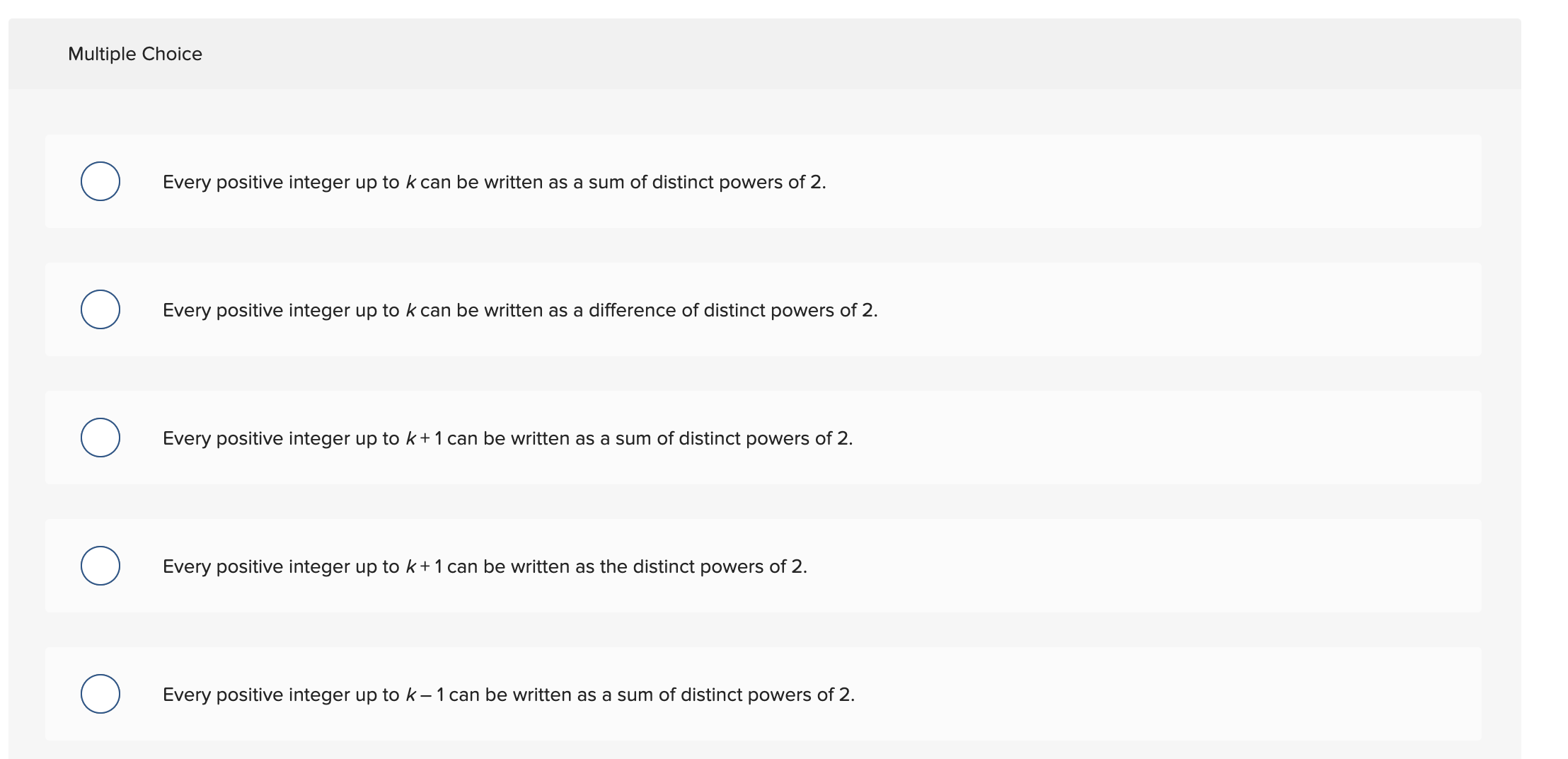
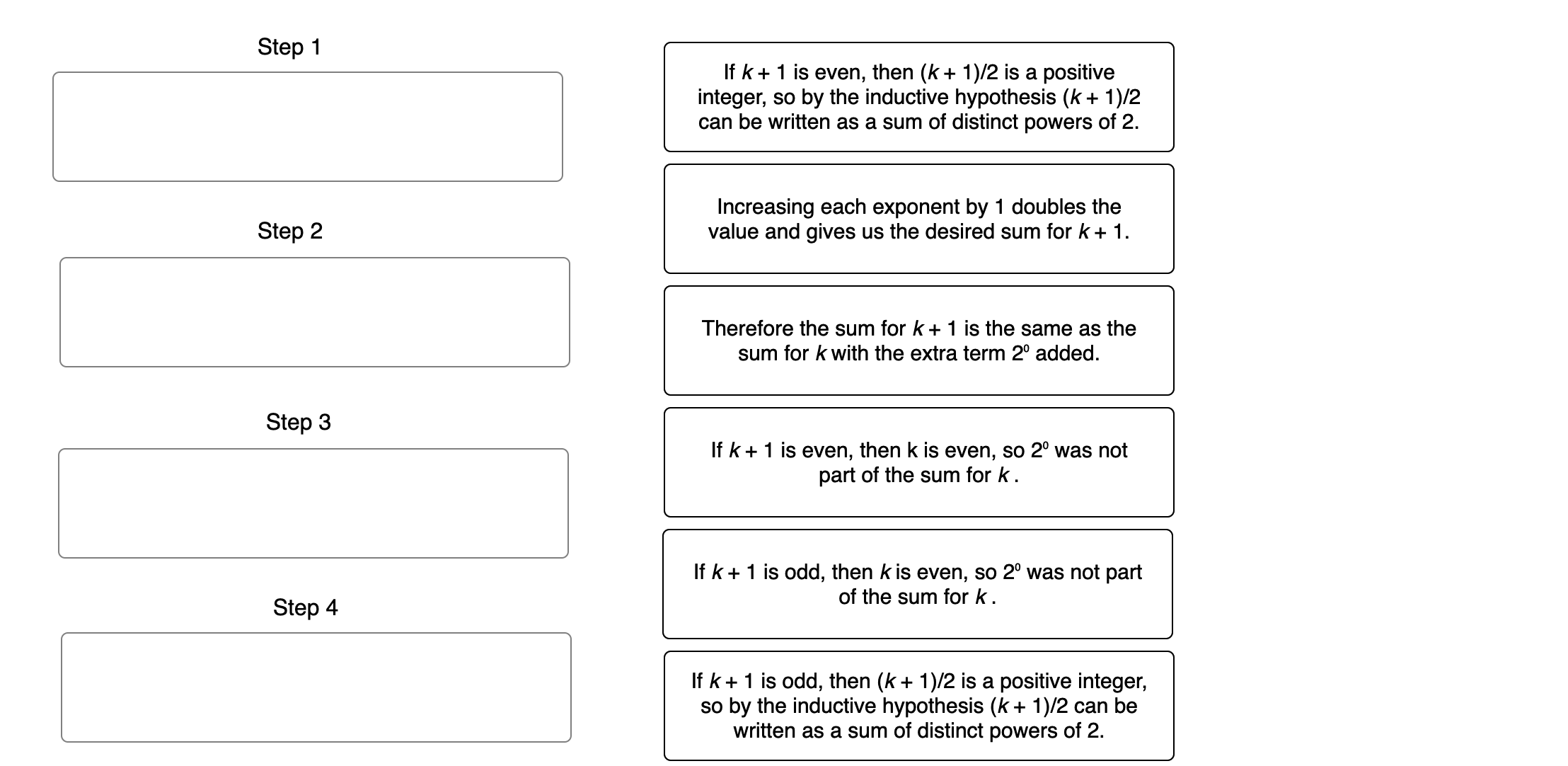
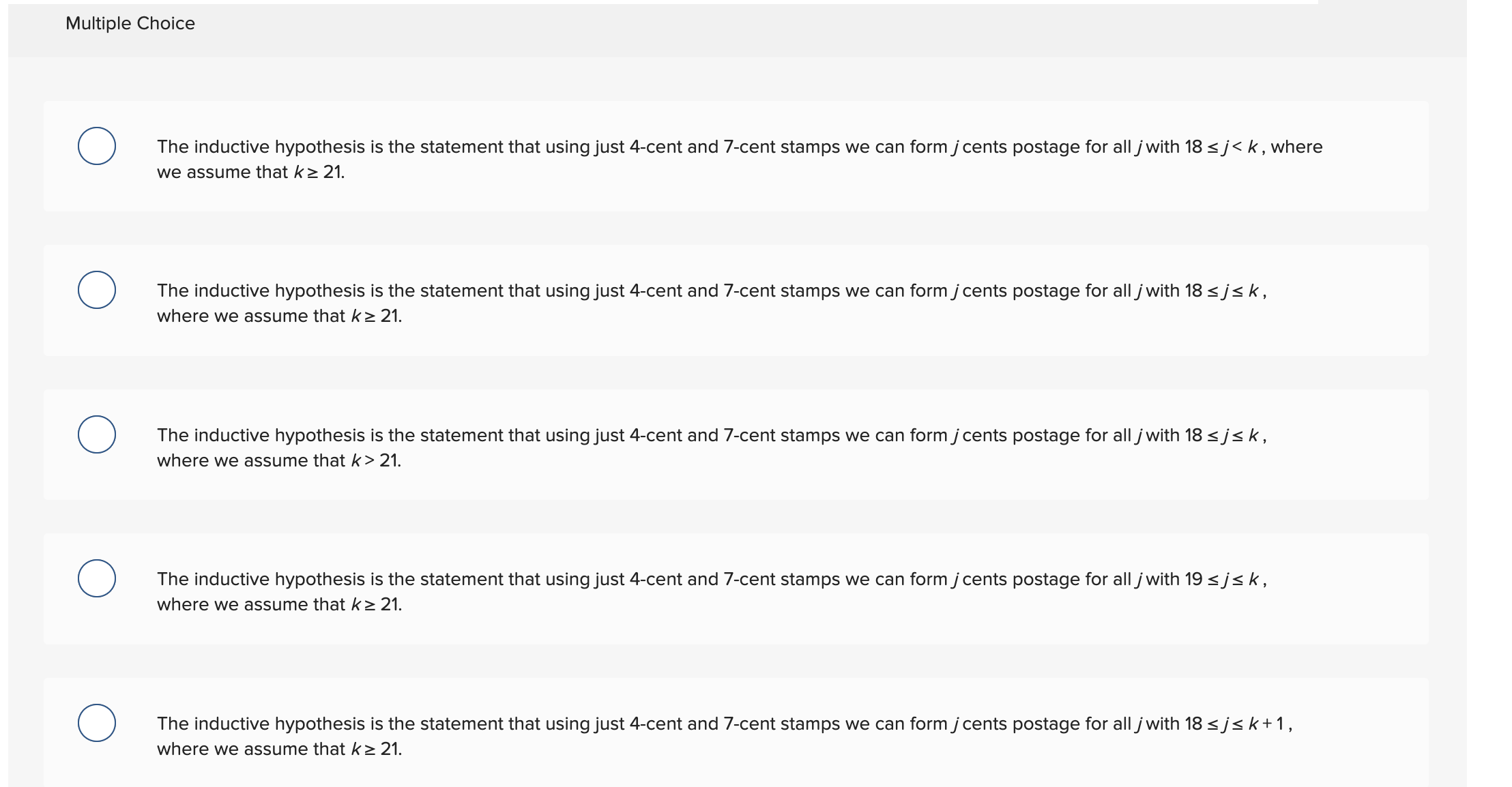
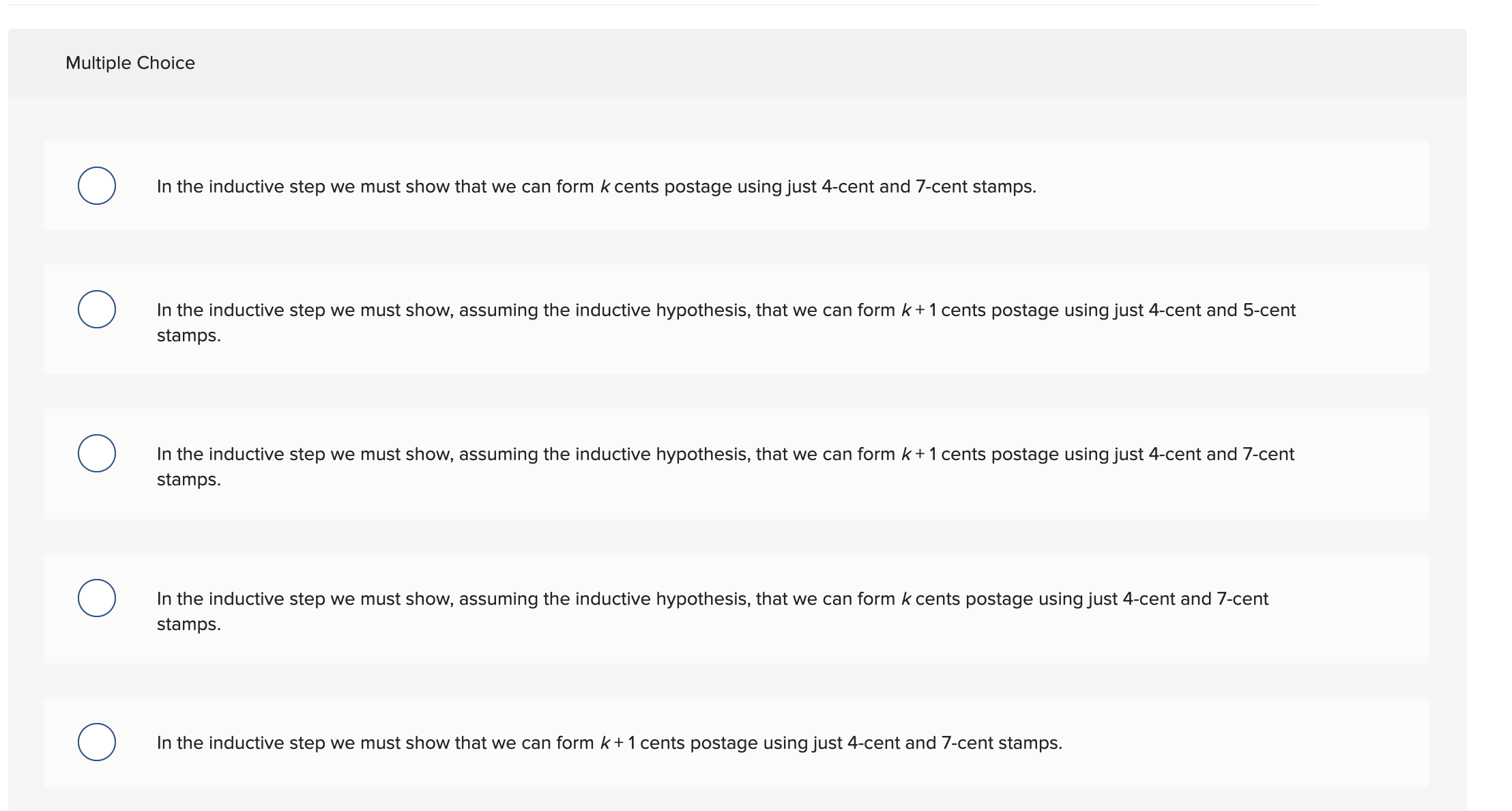
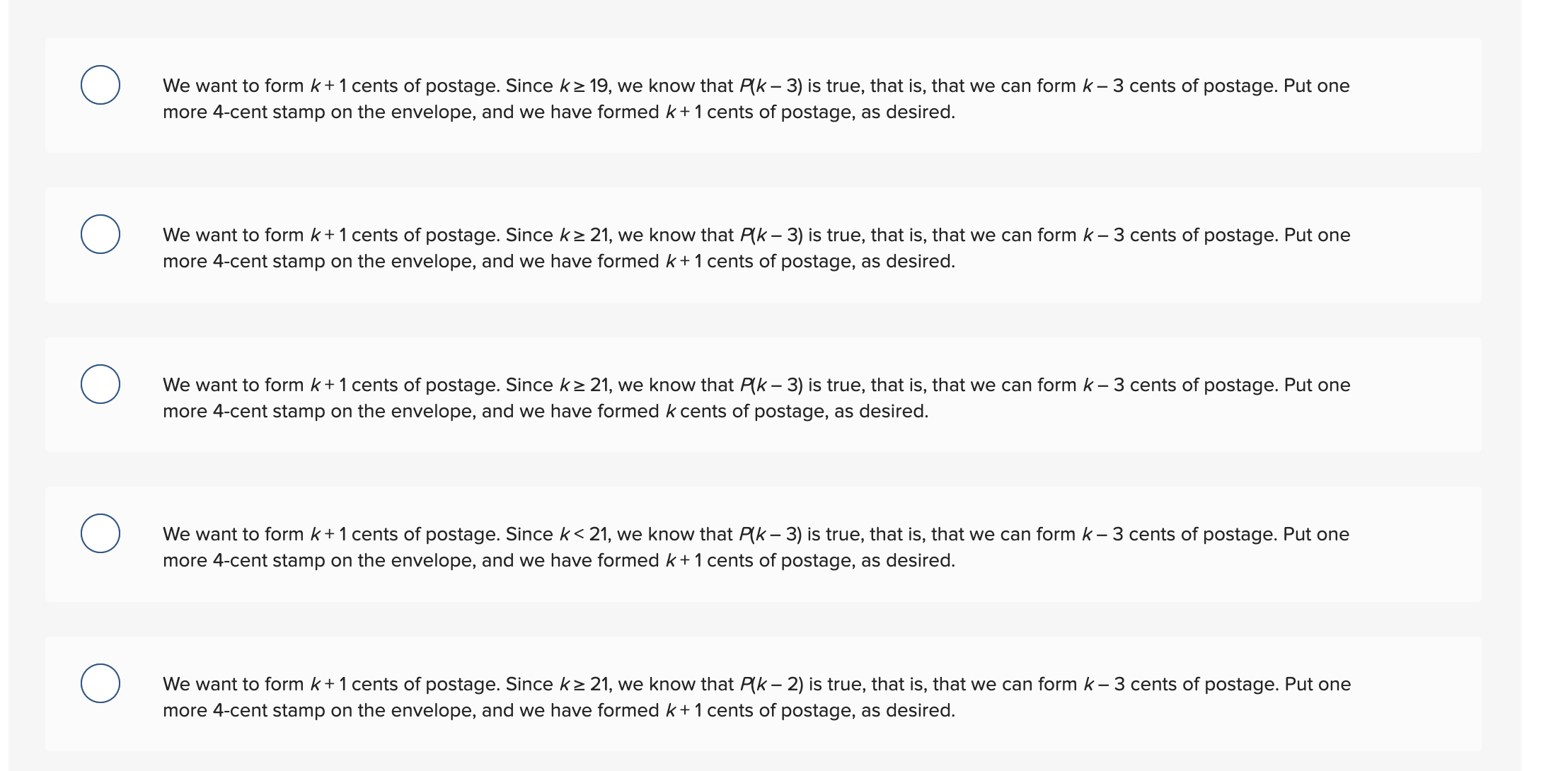
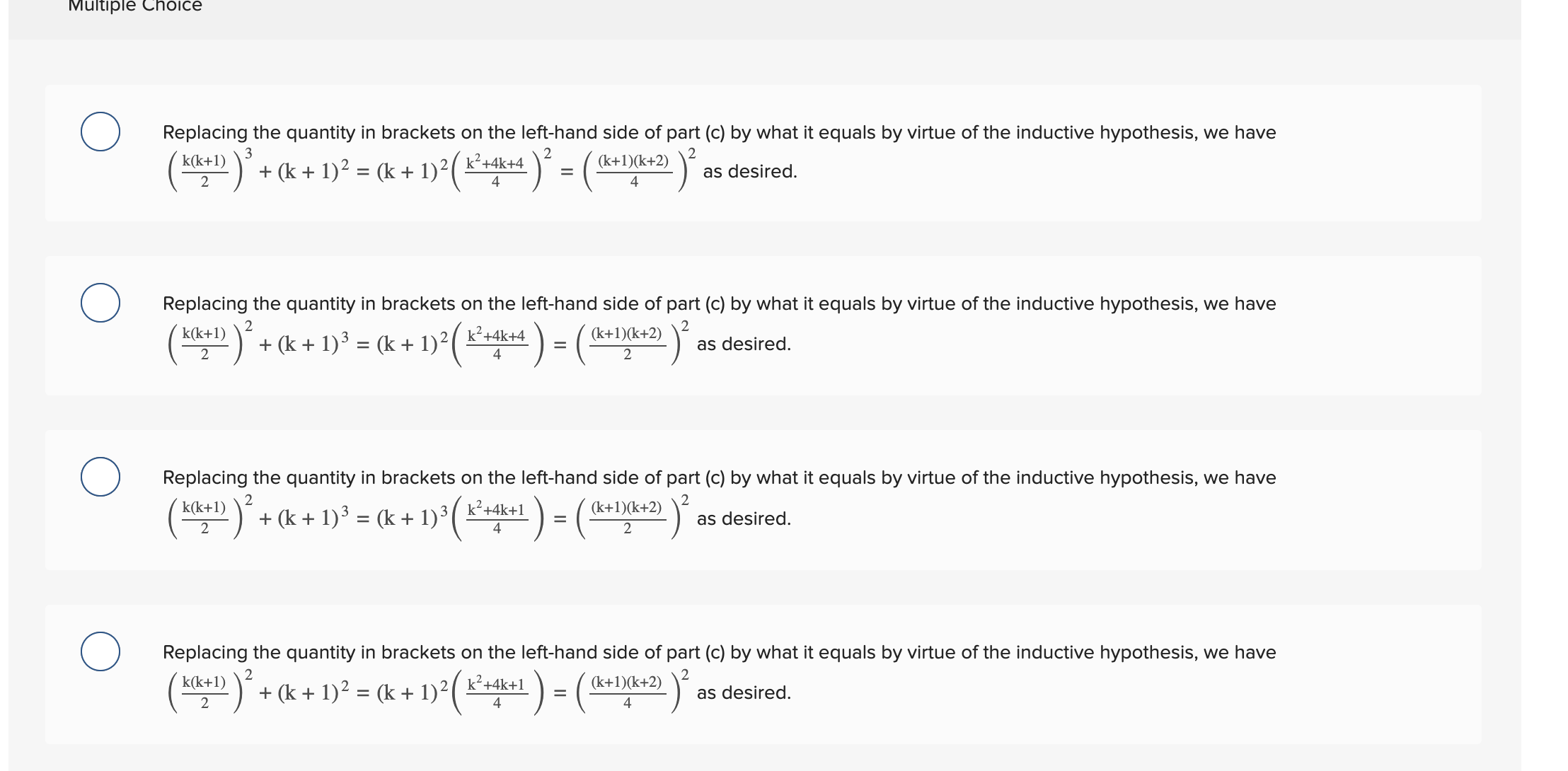
Use strong induction to show that every positive integer n can be written as a sum of distinct powers of two, that is, as a sum of a subset of the integers 20 = 1, 21 = 2, 22 = 4, and so on. Let P(n) be the proposition that the positive integer n can be written as a sum of distinct powers of 2. Identify the inductive hypothesis that proves P(n) is true.Multiple Choice 0000 Every positive integer up to k can be written as a sum of distinct powers of 2. Every positive integer up to k can be written as a difference of distinct powers of 2. Every positive integer up to [(+1 can be written as a sum of distinct powers of 2. Every positive integer up to [(+1 can be written as the distinct powers of 2' Every positive integer up to k 1 can be written as a sum of distinct powers of 2. Use strong induction to show that every positive integer n can be written as a sum of distinct powers'of two, that is, as a sum of a subset ofthe integers 20 =1, 21= 2, 22 = 4, and so on. Let P(n) be the proposition that the positive integer n can be written as a sum of distinct powers of 2. Click and drag the given steps (in the right) to the corresponding step names (in the left) to show that if P(I) is true for alljs k, then P(k+ 1) is also true. First prove the above statement when k+1 is odd and then prove when k+1 is even. Step 1 Step 2 Step 3 Step 4 If k+ 1 is even, then (k+ 1)/2 is a positive integer, so by the inductive hypothesis (k + 1)/2 can be written as a sum of distinct powers of 2. Increasing each exponent by 1 doubles the value and gives us the desired sum for k+ 1. Therefore the sum for k+ 1 is the same as the sum for kwith the extra term 2" added. If k+ 1 is even, then k is even, so 2 was not part of the sum for k. It k+ 1 is odd, then k is even, so 2 was not part of the sum for k. If k+ 1 is odd, then (k+ 1)/2 is a positive integer, so by the inductive hypothesis (k+ 1)/2 can be written as a sum of distinct powers of 2. Let P(n) be the statement that a postage of n cents can be formed using just 4-cent stamps and 7-cent stamps. The parts of this exercise outline a strong induction proof that P(n) is true for / 2 18. What is the inductive hypothesis of the proof?Multiple Choice 0 The inductive hypothesis is the statement that using just 4cent and 7cent stamps we can formjcents postage for alljwith 18 5] 21. O The inductive hypothesis is the statement that using just 4cent and 7cent stamps we can formjcents postage for alljwith 19 sjs k, where we assume that k2 21. O The inductive hypothesis is the statement that using just 4cent and 7cent stamps we can formjcents postage for alljwith 18 sjs k +1 , where we assume that kg 21. .._ ._ _. ..._._. ,___._ _-_.._... -.._- .s\" .. .. .. ___......__, 1-- .. .. ...- \"n.0,... _- .--_... ...._ ,.._.._. Let P(n) be the statement that a postage of n cents can be formed using just 4cent stamps and 7cent stamps. The parts ofthis exercise outline a strong induction proof that P(n) is true for n 218. What do you need to prove in the inductive step? Multiple Choice 0 In the inductive step we must show that we can form k cents postage using just 4cent and 7cent stamps. O In the inductive step we must show, assuming the inductive hypothesis, that we can form [(+1 cents postage using just 4-cent and 5-cent Stamps. 0 In the inductive step we must show, assuming the inductive hypothesis, that we can form [(+1 cents postage using just 4-cent and 7cent Stamps. 0 In the inductive step we must show, assuming the inductive hypothesis, that we can form k cents postage using just 4cent and 7cent Stamps. 0 In the inductive step we must show that we can form k + 1 cents postage usingjust 4cent and 7cent stamps. Let P(n) be the statement that a postage of n cents can be formed using just 4cent stamps and 7cent stamps. The parts ofthis exercise outline a strong induction proof that P(n) is true for n 218. Complete the inductive step for k 2 21. We want to form k+1 cents of postage. Since k z 19, we know that Fik 3) is true, that is, that we can form k 3 cents of postage more 4cent stamp on the envelope, and we have formed k+ 1 cents of postage, as desired. We want to form k+1 cents of postage. Since k z 21, we know that P(k 3) is true, that is, that we can form k 3 cents of postage more 4cent stamp on the envelope, and we have formed k+ 1 cents of postage, as desired. We want to form k+1 cents of postage. Since k 2 21, we know that P(k 3) is true, that is, that we can form k 3 cents of postage more 4-cent stamp on the envelope, and we have formed kcents of postage, as desired. . Put one . Put one . Put one We want to form k+1 cents of postage. Since k
Step by Step Solution
There are 3 Steps involved in it
1 Expert Approved Answer
Step: 1 Unlock
Question Has Been Solved by an Expert!
Get step-by-step solutions from verified subject matter experts
Step: 2 Unlock
Step: 3 Unlock
Students Have Also Explored These Related Mathematics Questions!















 Study Help