







Question: PLEASE HELP ME COMPLETE THE YELLOW SECTION ON THE EXCEL FORM Process Costing and the Weighted-Average Method using Excel's SUM and Basic Math Functions Hayword,
PLEASE HELP ME COMPLETE THE YELLOW SECTION ON THE EXCEL FORM
Process Costing and the Weighted-Average Method using Excel's SUM and Basic Math Functions
Hayword, Inc. uses weighted-average costing and has two departments and has provided data related to its mixing department for the month of July. The Controller has asked you prepare a cost reconciliation report and provide the related computations. Use the information included in the Excel Simulation and the Excel functions described below to complete the task.
- Cell Reference: Allows you to refer to data from another cell in the worksheet. From the Excel Simulation below, if in a blank cell, =B5 was entered, the formula would output the result from cell B5, or 300 in this example.
- Basic Math functions: Allows you to use the basic math symbols to perform mathematical functions. You can use the following keys: + (plus sign to add), - (minus sign to subtract), * (asterisk sign to multiply), and / (forward slash to divide). From the Excel Simulation below, if in a blank cell =B9+B10 was entered, the formula would add the values from those cells and output the result, or 17,250 in this example. If using the other math symbols the result would output an appropriate answer for its function.
- SUM function: Allows you to refer to multiple cells and adds all the values. You can add individual cell references or ranges to utilize this function. From the Excel Simulation below, if in a blank cell =SUM(B13,B14) was entered, the formula would output the result of adding those two separate cells, or 737,320 in this example. Similarly, if in a blank cell =SUM(B13:B14) was entered, the formula would output the same result of adding those cells, except they are expressed as a range in the formula, and the result would be 737,320 in this example.
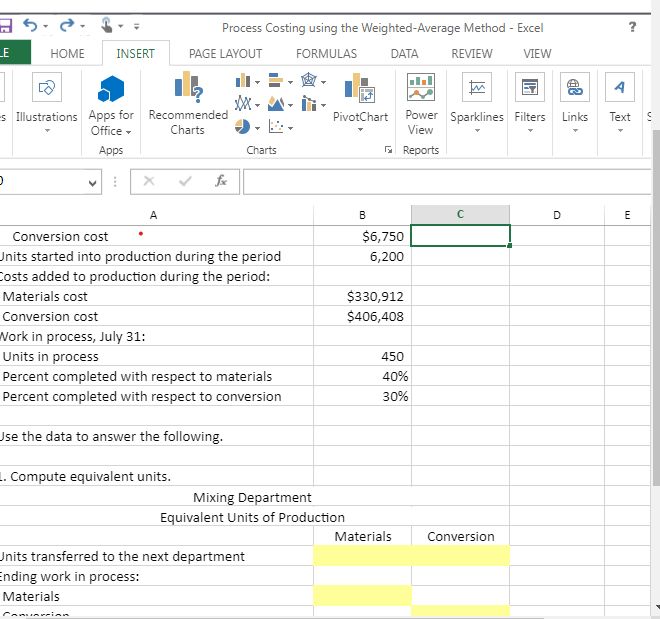
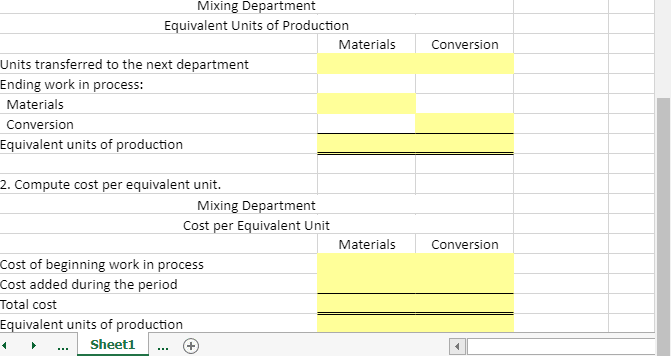
\begin{tabular}{l} \hline Process Costing using the Weighted-Average Method - Excel \\ \hline \end{tabular} Jse the data to answer the following. . Compute equivalent units. Mixing Department Equivalent Units of Production Units transferred to the next department inding work in process: Materials Mixing Department Equivalent Units of Production Materials Conversion Units transferred to the next department Ending work in process: Materials Conversion Equivalent units of production 2. Compute cost per equivalent unit. Mixing Department Cost per Equivalent Unit Cost of beginning work in process Cost added during the period Total cost Equivalent units of production \begin{tabular}{l} \hline Process Costing using the Weighted-Average Method - Excel \\ \hline \end{tabular} Jse the data to answer the following. . Compute equivalent units. Mixing Department Equivalent Units of Production Units transferred to the next department inding work in process: Materials Mixing Department Equivalent Units of Production Materials Conversion Units transferred to the next department Ending work in process: Materials Conversion Equivalent units of production 2. Compute cost per equivalent unit. Mixing Department Cost per Equivalent Unit Cost of beginning work in process Cost added during the period Total cost Equivalent units of production
Step by Step Solution
There are 3 Steps involved in it

Get step-by-step solutions from verified subject matter experts
 Study Help