Question: Please help me edit this essay i need to add quotes from the book to support my answer The role of secondary characters in Charlotte's
Please help me edit this essay i need to add quotes from the book to support my answer
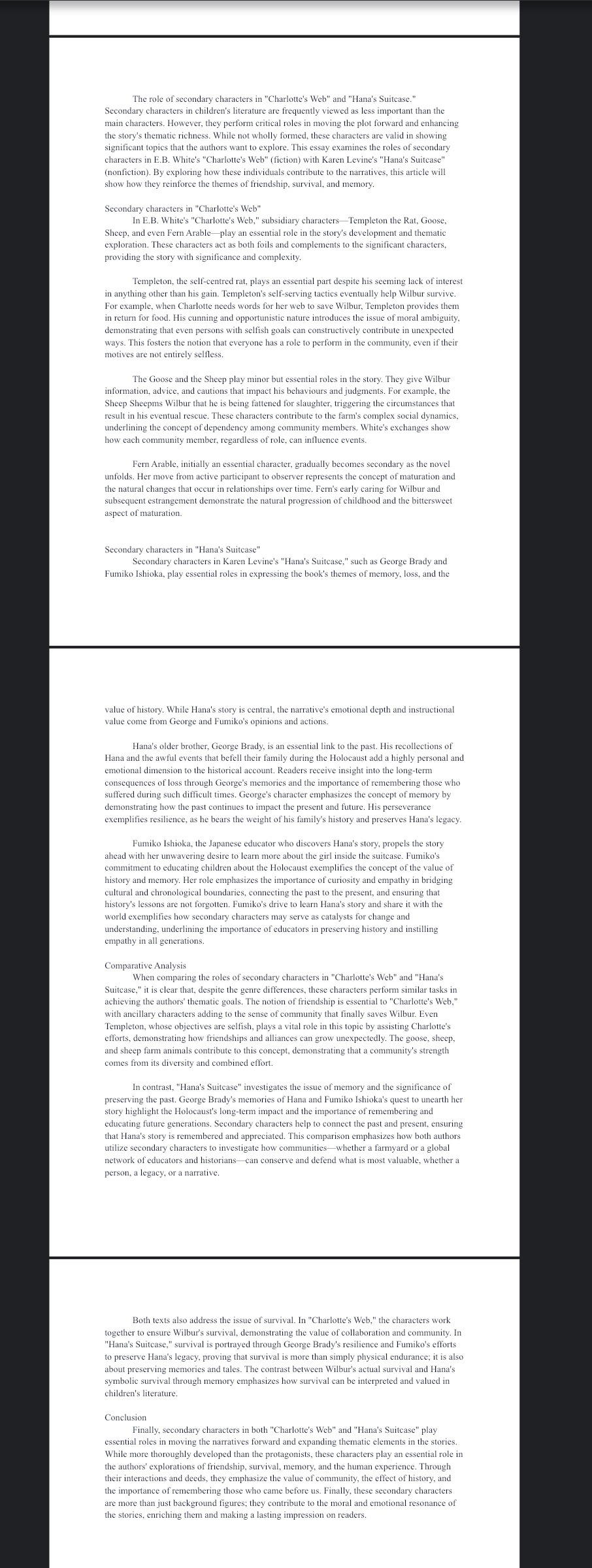
The role of secondary characters in "Charlotte's Web" and "Hana's Suitcase." Secondary characters in children's literature are frequently viewed as less important than the main characters. However, they perform critical roles in moving the plot forward and enhancing the story's thematic richness. While not wholly formed, these characters are valid in showing significant topics that the authors want to explore. This essay examines the roles of secondary characters in E.B. White's "Charlotte's Web" (fiction) with Karen Levine's "Hana's Suitcase" (nonfiction). By exploring how these individuals contribute to the narratives, this article will show how they reinforce the themes of friendship, survival, and memory. Secondary characters in "Charlotte's Web" In E.B. White's "Charlotte's Web," subsidiary characters-Templeton the Rat, Goose, Sheep, and even Fern Arable-play an essential role in the story's development and thematic exploration. These characters act as both foils and complements to the significant characters, providing the story with significance and complexity. Templeton, the self-centred rat, plays an essential part despite his seeming lack of interest in anything other than his gain. Templeton's self-serving tactics eventually help Wilbur survive. For example, when Charlotte needs words for her web to save Wilbur, Templeton provides them in return for food. His cunning and opportunistic nature introduces the issue of moral ambiguity, demonstrating that even persons with selfish goals can constructively contribute in unexpected ways. This fosters the notion that everyone has a role to perform in the community, even if their motives are not entirely selfless. The Goose and the Sheep play minor but essential roles in the story. They give Wilbur information, advice, and cautions that impact his behaviours and judgments. For example, the Sheep Sheepms Wilbur that he is being fattened for slaughter, triggering the circumstances that result in his eventual rescue. These characters contribute to the farm's complex social dynamics, underlining the concept of dependency among community members. White's exchanges show how each community member, regardless of role, can influence events. Fern Arable, initially an essential character, gradually becomes secondary as the novel unfolds. Her move from active participant to observer represents the concept of maturation and the natural changes that occur in relationships over time. Fern's early caring for Wilbur and subsequent estrangement demonstrate the natural progression of childhood and the bittersweet aspect of maturation. Secondary characters in "Hana's Suitcase" Secondary characters in Karen Levine's "Hana's Suitcase," such as George Brady and Fumiko Ishioka, play essential roles in expressing the book's themes of memory, loss, and the value of history. While Hana's story is central, the narrative's emotional depth and instructional value come from George and Fumiko's opinions and actions. Hana's older brother, George Brady, is an essential link to the past. His recollections of Hana and the awful events that befell their family during the Holocaust add a highly personal and emotional dimension to the historical account. Readers receive insight into the long-term consequences of loss through George's memories and the importance of remembering those who suffered during such difficult times. George's character emphasizes the concept of memory by demonstrating how the past continues to impact the present and future. His perseverance exemplifies resilience, as he bears the weight of his family's history and preserves Hana's legacy. Fumiko Ishioka, the Japanese educator who discovers Hana's story, propels the story ahead with her unwavering desire to learn more about the girl inside the suitcase. Fumiko's commitment to educating children about the Holocaust exemplifies the concept of the value of history and memory. Her role emphas s the importance of curiosity and empathy in bridging cultural and chronological boundaries, connecting the past to the present, and ensuring that history's lessons are not forgotten. Fumiko's drive to learn Hana's story and share it with the world exemplifies how secondary characters may serve as catalysts for change and understanding, underlining the importance of educators in preserving history and instilling empathy in all generations. Comparative Analysis When comparing the roles of secondary characters in "Charlotte's Web" and "Hana's Suitcase," it is clear that, despite the genre differences, these characters perform similar tasks in achieving the authors' thematic goals. The notion of friendship is essential to "Charlotte's Web," with ancillary characters adding to the sense of community that finally saves Wilbur. Even Templeton, whose objectives are selfish, plays a vital role in this topic by assisting Charlotte's efforts, demonstrating how friendships and alliances can grow unexpectedly. The goose, sheep, and sheep farm animals contribute to this concept, demonstrating that a community's strength comes from its diversity and combined effort. In contrast, "Hana's Suitcase" investigates the issue of memory and the significance of preserving the past. George Brady's memories of Hana and Fumiko Ishioka's quest to unearth her story highlight the Holocaust's long-term impact and the importance of remembering and educating future generations. Secondary characters help to connect the past and present, ensuring that Hana's story is remembered and appreciated. This comparison emphasizes how both authors utilize secondary characters to investigate how communities-whether a farmyard or a global network of educators and historians-can conserve and defend what is most valuable, whether a person, a legacy, or a narrative. Both texts also address the issue of survival. In "Charlotte's Web," the characters work together to ensure Wilbur's survival, demonstrating the value of collaboration and community. In "Hana's Suitcase," survival is portrayed through George Brady's resilience and Fumiko's efforts to preserve Hana's legacy, proving that survival is more than simply physical endurance; it is also about preserving memories and tales. The contrast between Wilbur's actual survival and Hana's symbolic survival through memory emphasizes how survival can be interpreted and valued in children's literature. Conclusion Finally, secondary characters in both "Charlotte's Web" and "Hana's Suitcase" play essential roles in moving the narratives forward and expanding thematic elements in the stories. While more thoroughly developed than the s, these characters play an essential role in the authors' explorations of friendship, survival, memory, and the human experience. Through their interactions and deeds, they emphasize the value of community, the effect of history, and the importance of remembering those who came before us. Finally, these secondary characters are more than just background figures; they contribute to the moral and emotional resonance of the stories, enriching them and making a lasting impression on readers









 Study Help