



Question: please help me figure out this question. I have the answers from 1 to 4, but 5 -10 still haven't been figured out. appreciate. MPKK
please help me figure out this question. I have the answers from 1 to 4, but 5 -10 still haven't been figured out. appreciate.
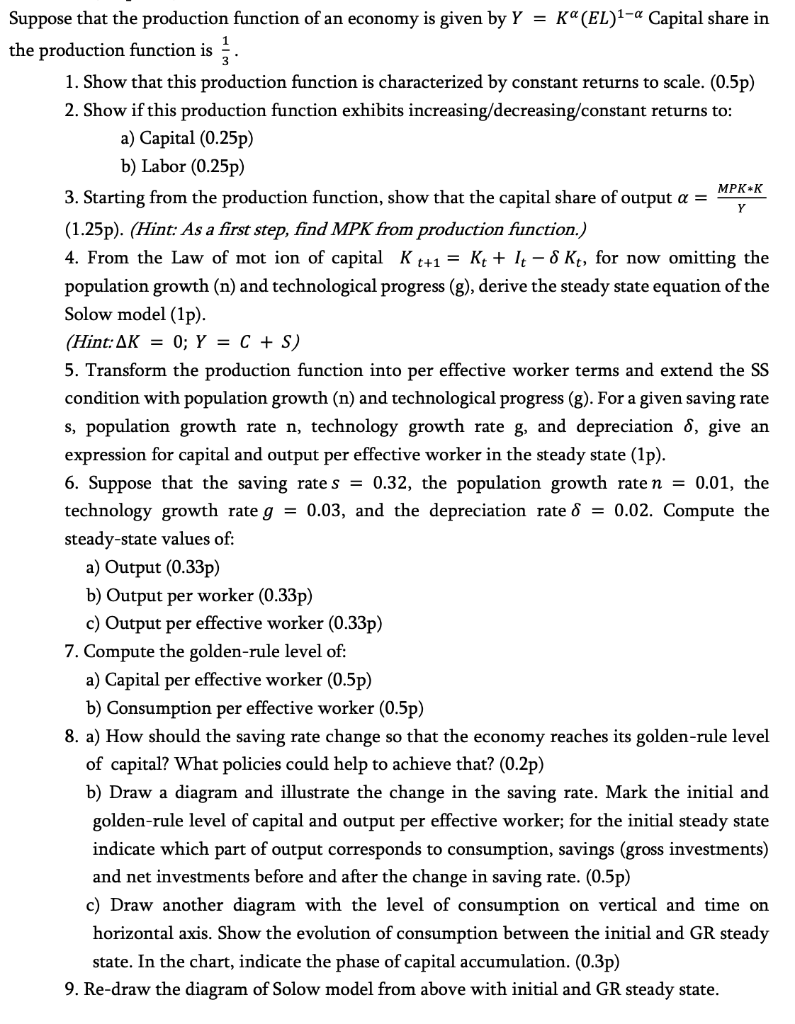
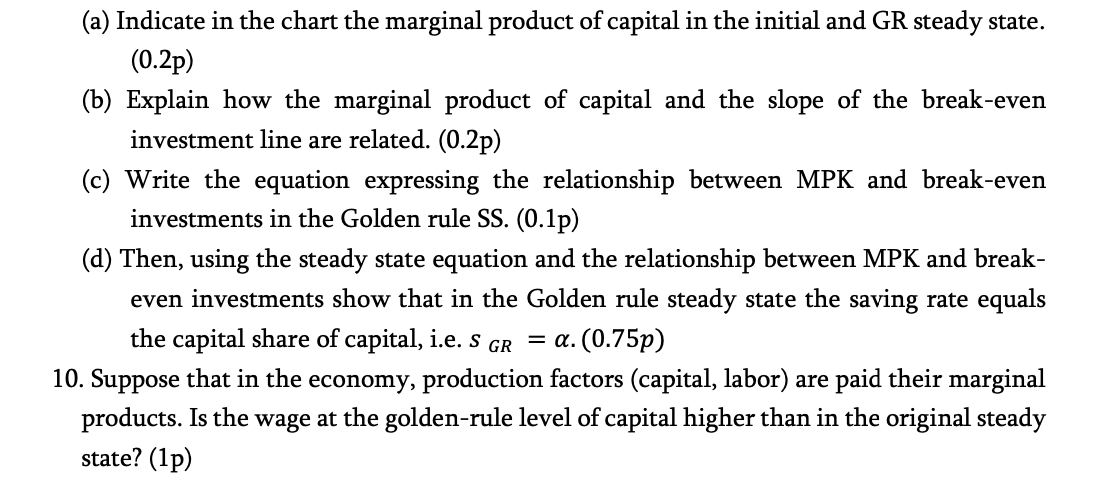
MPKK Y Suppose that the production function of an economy is given by Y = K (EL)1-a Capital share in the production function is 1. Show that this production function is characterized by constant returns to scale. (0.5p) 2. Show if this production function exhibits increasing/decreasing/constant returns to: a) Capital (0.25p) b) Labor (0.25p) 3. Starting from the production function, show that the capital share of output a = (1.25p). (Hint: As a first step, find MPK from production function.) 4. From the Law of mot ion of capital K ++1 = + It - 8 Kt, for now omitting the population growth (n) and technological progress (g), derive the steady state equation of the Solow model (1p). (Hint: AK = 0; Y = C + S) 5. Transform the production function into per effective worker terms and extend the SS condition with population growth (n) and technological progress (g). For a given saving rate s, population growth rate n, technology growth rate g, and depreciation 8, give an expression for capital and output per effective worker in the steady state (1p). 6. Suppose that the saving rate s = 0.32, the population growth rate n = 0.01, the technology growth rate g = 0.03, and the depreciation rate 8 = 0.02. Compute the steady-state values of: a) Output (0.33p) b) Output per worker (0.33p) c) Output per effective worker (0.33p) 7. Compute the golden-rule level of: a) Capital per effective worker (0.5p) b) Consumption per effective worker (0.5p) 8. a) How should the saving rate change so that the economy reaches its golden-rule level of capital? What policies could help to achieve that? (0.2p) b) Draw a diagram and illustrate the change in the saving rate. Mark the initial and golden-rule level of capital and output per effective worker; for the initial steady state indicate which part of output corresponds to consumption, savings (gross investments) and net investments before and after the change in saving rate. (0.5p) c) Draw another diagram with the level of consumption on vertical and time on horizontal axis. Show the evolution of consumption between the initial and GR steady state. In the chart, indicate the phase of capital accumulation. (0.3p) 9. Re-draw the diagram of Solow model from above with initial and GR steady state. (a) Indicate in the chart the marginal product of capital in the initial and GR steady state. (0.2p) (b) Explain how the marginal product of capital and the slope of the break-even investment line are related. (0.2p) (c) Write the equation expressing the relationship between MPK and break-even investments in the Golden rule SS. (0.1p) (d) Then, using the steady state equation and the relationship between MPK and break- even investments show that in the Golden rule steady state the saving rate equals the capital share of capital, i.e. S gr = a.(0.75p) 10. Suppose that in the economy, production factors (capital, labor) are paid their marginal products. Is the wage at the golden-rule level of capital higher than in the original steady state
Step by Step Solution
There are 3 Steps involved in it

Get step-by-step solutions from verified subject matter experts