







Question: please help me fill in the graphs and equations underneath Table 1: Observed time and non-value-added time/motion Average Standard Time = Element 2: From the
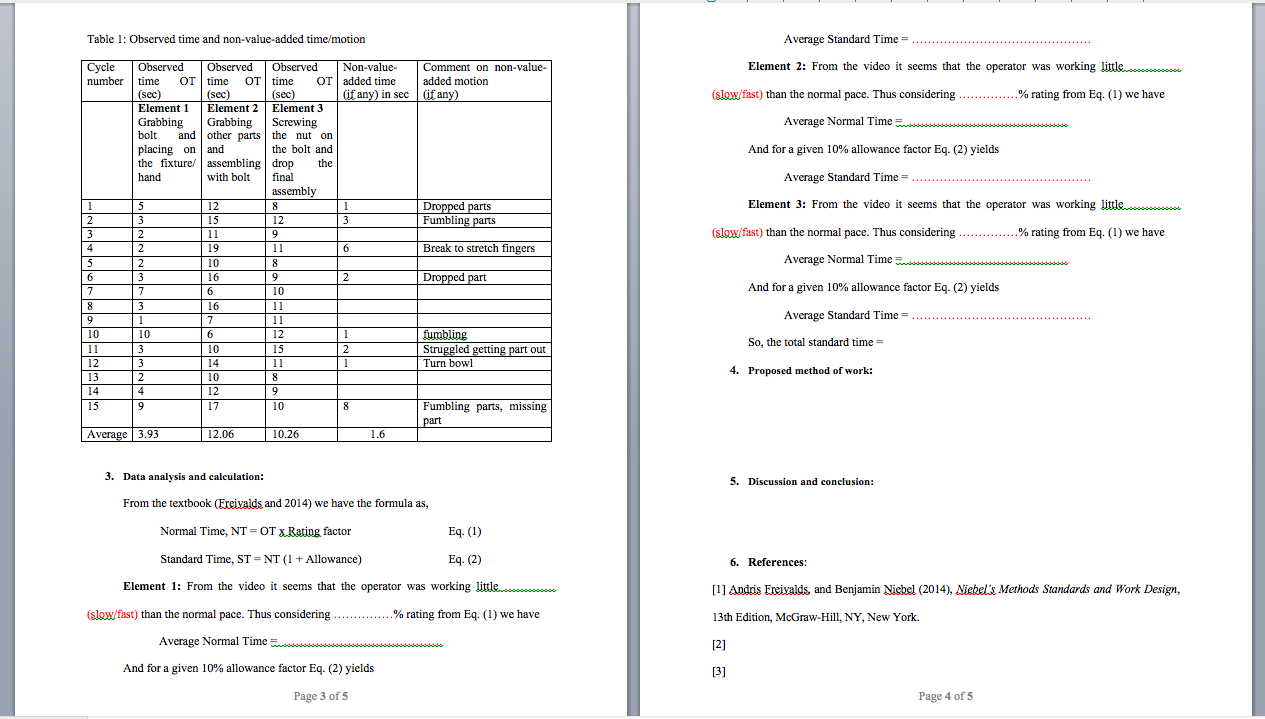
please help me fill in the graphs and equations underneath
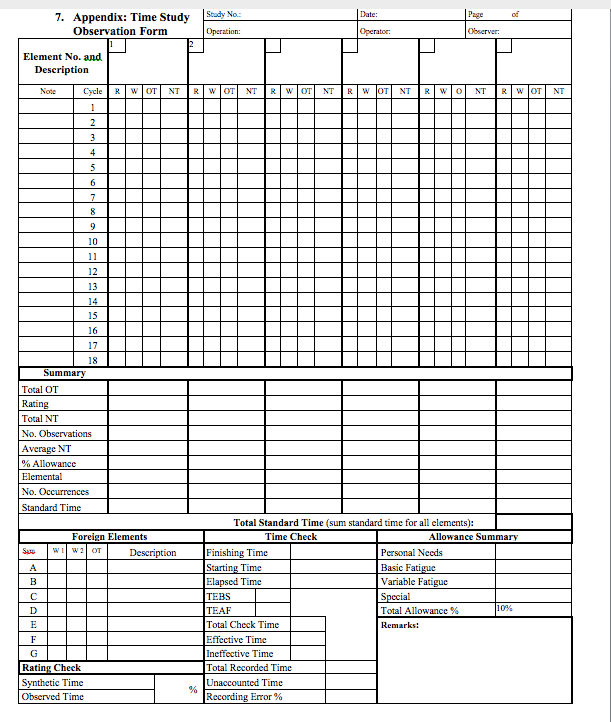
Table 1: Observed time and non-value-added time/motion Average Standard Time = Element 2: From the video it seems that the operator was working little (slow/fast) than the normal pace. Thus considering % rating from Eq. (1) we have Average Normal Times And for a given 10% allowance factor Eq. (2) yields Average Standard Time Element 3: From the video it seems that the operator was working little............... 3 (slow/fast) than the normal pace. Thus considering ...........% rating from Eq. (1) we have Cycle Observed Observed Observed Non-value Comment on non-value number time OT time OT time OT added time added motion (sec) (sec) (sec) (if any) in sec (if any) Element 1 Element 2 Element 3 Grabbing Grabbing Screwing bolt and other parts the nut on placing on and the bolt and the fixture/ assembling drop the hand with bolt final assembly 1 1 S 12 8 1 Dropped parts 2 3 15 12 3 Fumbling parts 3 2 11 9 4 2 19 11 6 Break to stretch fingers 5 2 10 8 6 3 16 9 2 Dropped part 7 7 7 6 10 8 3 16 11 9 1 7 11 10 10 6 12 1 fumbling 11 3 10 15 2 Struggled getting part out 12 3 14 11 1 Turn bowl 13 2 10 8 14 4 12 9 15 9 17 10 | 8 Fumbling parts, missing part | Average 3.93 12.06 10.26 1.6 Average Normal Time = And for a given 10% allowance factor Eq. (2) yields Average Standard Time So, the total standard time = 4. Proposed method of work: 3. Data analysis and calculation: 5. Discussion and conclusion: From the textbook (Freivalds and 2014) we have the formula as, Normal Time, NT = OT X Rating factor , x Eq. (1) Standard Time, ST NT (1 + Allowance) Eq. (2) 6. References: Element 1: From the video it seems that the operator was working little............... [1] Andris Freivalds, and Benjamin Niebel (2014), Niebel's Methods Standards and Work Design, (slow/fast) than the normal pace. Thus considering % rating from Eq. (1) we have 13th Edition, McGraw-Hill, NY, New York. [2] Average Normal Time And for a given 10% allowance factor Eq. (2) yields [3] Page 3 of 5 Page 4 of 5 Stady No: Date: Page of 7. Appendix: Time Study Observation Form Operation: Operator: Observer: Element No. and Description Note Cycle R WOT NT R WOT NT R WOT| NT RW JOT NT Rwo NT R WOT NT 2 3 4 5 6 7 8 9 10 11 12 13 14 15 16 17 18 Summary Total OT Rating Total NT No. Observations Average NT % Allowance Elemental No. Occurrences Standard Time Foreign Elements Description WL OT A B D Total Standard Time (sum standard time for all elements): Time Check Allowance Summary Finishing Time Personal Needs Starting Time Basic Fatigue Elapsed Time Variable Fatigue TEBS Special TEAF Total Allowance % 10% Total Check Time Remarks: Effective Time Ineffective Time Total Recorded Time Unaccounted Time Recording Error % E F G Rating Check Synthetic Time Observed Time % Table 1: Observed time and non-value-added time/motion Average Standard Time = Element 2: From the video it seems that the operator was working little (slow/fast) than the normal pace. Thus considering % rating from Eq. (1) we have Average Normal Times And for a given 10% allowance factor Eq. (2) yields Average Standard Time Element 3: From the video it seems that the operator was working little............... 3 (slow/fast) than the normal pace. Thus considering ...........% rating from Eq. (1) we have Cycle Observed Observed Observed Non-value Comment on non-value number time OT time OT time OT added time added motion (sec) (sec) (sec) (if any) in sec (if any) Element 1 Element 2 Element 3 Grabbing Grabbing Screwing bolt and other parts the nut on placing on and the bolt and the fixture/ assembling drop the hand with bolt final assembly 1 1 S 12 8 1 Dropped parts 2 3 15 12 3 Fumbling parts 3 2 11 9 4 2 19 11 6 Break to stretch fingers 5 2 10 8 6 3 16 9 2 Dropped part 7 7 7 6 10 8 3 16 11 9 1 7 11 10 10 6 12 1 fumbling 11 3 10 15 2 Struggled getting part out 12 3 14 11 1 Turn bowl 13 2 10 8 14 4 12 9 15 9 17 10 | 8 Fumbling parts, missing part | Average 3.93 12.06 10.26 1.6 Average Normal Time = And for a given 10% allowance factor Eq. (2) yields Average Standard Time So, the total standard time = 4. Proposed method of work: 3. Data analysis and calculation: 5. Discussion and conclusion: From the textbook (Freivalds and 2014) we have the formula as, Normal Time, NT = OT X Rating factor , x Eq. (1) Standard Time, ST NT (1 + Allowance) Eq. (2) 6. References: Element 1: From the video it seems that the operator was working little............... [1] Andris Freivalds, and Benjamin Niebel (2014), Niebel's Methods Standards and Work Design, (slow/fast) than the normal pace. Thus considering % rating from Eq. (1) we have 13th Edition, McGraw-Hill, NY, New York. [2] Average Normal Time And for a given 10% allowance factor Eq. (2) yields [3] Page 3 of 5 Page 4 of 5 Stady No: Date: Page of 7. Appendix: Time Study Observation Form Operation: Operator: Observer: Element No. and Description Note Cycle R WOT NT R WOT NT R WOT| NT RW JOT NT Rwo NT R WOT NT 2 3 4 5 6 7 8 9 10 11 12 13 14 15 16 17 18 Summary Total OT Rating Total NT No. Observations Average NT % Allowance Elemental No. Occurrences Standard Time Foreign Elements Description WL OT A B D Total Standard Time (sum standard time for all elements): Time Check Allowance Summary Finishing Time Personal Needs Starting Time Basic Fatigue Elapsed Time Variable Fatigue TEBS Special TEAF Total Allowance % 10% Total Check Time Remarks: Effective Time Ineffective Time Total Recorded Time Unaccounted Time Recording Error % E F G Rating Check Synthetic Time Observed Time %Step by Step Solution
There are 3 Steps involved in it
1 Expert Approved Answer
Step: 1 Unlock

Question Has Been Solved by an Expert!
Get step-by-step solutions from verified subject matter experts
Step: 2 Unlock
Step: 3 Unlock
 Study Help