







Question: Please help me finish the code segment! This is x86 assembly language in C++. The program should calculate the expression: total = (num3 + num4)
Please help me finish the code segment! This is x86 assembly language in C++.
The program should calculate the expression: total = (num3 + num4) - (num1 + num2) + 1
I'm confused about how to add each array element value to each data label part. Also, please don't reuse answers from another post!
I've only done the data segment:
.386
.model flat, stdcall
.stack 4096
ExitProcess proto dwExitCode: word
.data
array1 sword 1000h, 2000h, 3000h, 4000h
num1 = 1
num2 = 2
num3 = 4
num4 = 8
total = ?
.code
main proc
(confusion)
INVOKE ExitProcess, 0
main endp
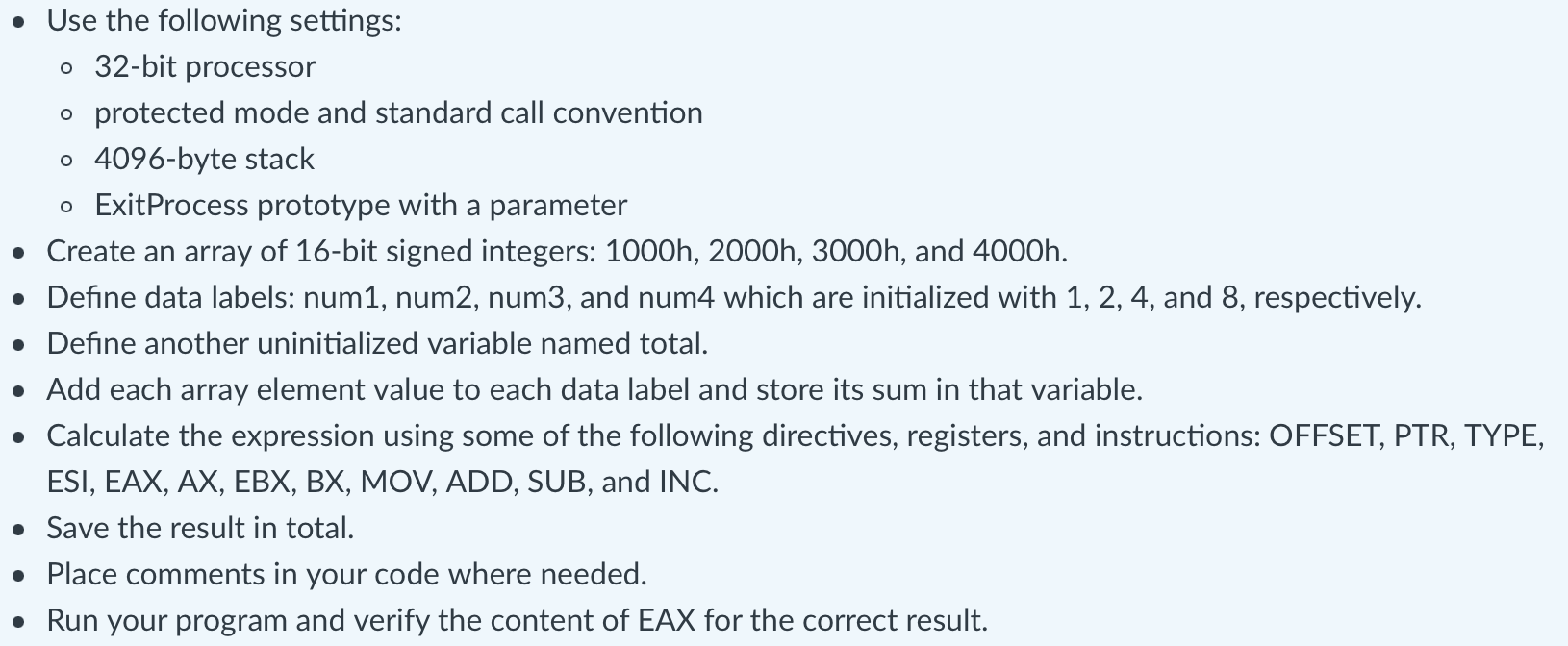
- Use the following settings: - 32-bit processor - protected mode and standard call convention - 4096-byte stack - ExitProcess prototype with a parameter - Create an array of 16-bit signed integers: 1000h, 2000h, 3000h, and 4000h. - Define data labels: num1, num2, num3, and num4 which are initialized with 1, 2, 4, and 8, respectively. - Define another uninitialized variable named total. - Add each array element value to each data label and store its sum in that variable. - Calculate the expression using some of the following directives, registers, and instructions: OFFSET, PTR, TYPE, ESI, EAX, AX, EBX, BX, MOV, ADD, SUB, and INC. - Save the result in total. - Place comments in your code where needed. - Run your program and verify the content of EAX for the correct result
Step by Step Solution
There are 3 Steps involved in it

Get step-by-step solutions from verified subject matter experts
 Study Help