







Question: Please help me, general calculus multiple choice part 3, need help asap will give helpful What formula would be used to calculate the right rectangle
![= (0.4){[2(o.4) + 2] + 2[(0.8) + 2] + 2[(1.2) + 2]](https://s3.amazonaws.com/si.experts.images/answers/2024/06/667776632633e_123667776630e7a0.jpg)
Please help me, general calculus multiple choice part 3, need help asap will give helpful
![+ 2[(1.6) + 2] + 2[(2.0)+ 2]} 0 R5 = (0.4){[2(o.2) +](https://s3.amazonaws.com/si.experts.images/answers/2024/06/6677766372cc4_123667776635c77c.jpg)
![2] + 2[(0.6) + 2] + 2[(1.0) + 2] + 2[(1.4) +](https://s3.amazonaws.com/si.experts.images/answers/2024/06/66777663c4282_12366777663acfaf.jpg)
![2] + 2[(1.a)+ 2]} 0 R5 = (0.2){[2(o.2) + 2] + 2[(0.6)](https://s3.amazonaws.com/si.experts.images/answers/2024/06/667776642f2b7_124667776641a398.jpg)
![+ 2] + 2[(1.0) + 2] + 2[(1.4) + 2] + 2[(1.a)+](https://s3.amazonaws.com/si.experts.images/answers/2024/06/6677766480dac_124667776646b8ef.jpg)
![2]} 0 R5 = (0.4){[2(o.0) + 2] + 2[(o.4) + 2] +](https://s3.amazonaws.com/si.experts.images/answers/2024/06/6677766513c04_12466777664ca887.jpg)
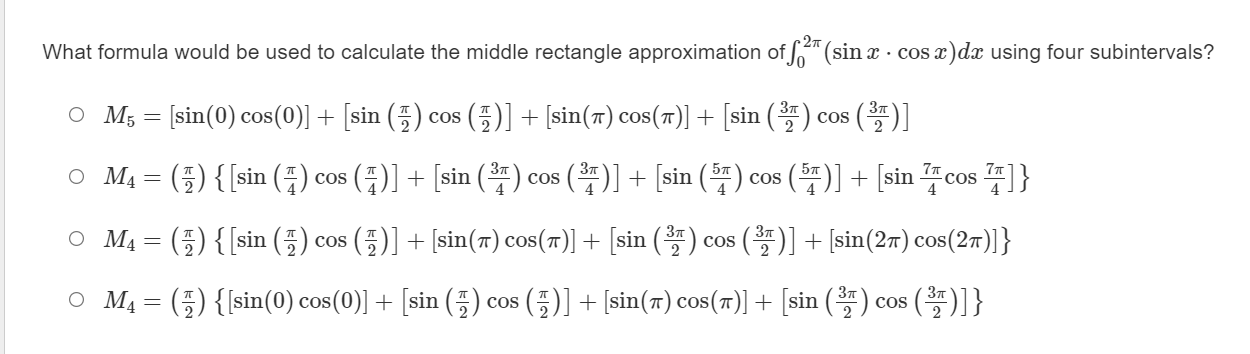
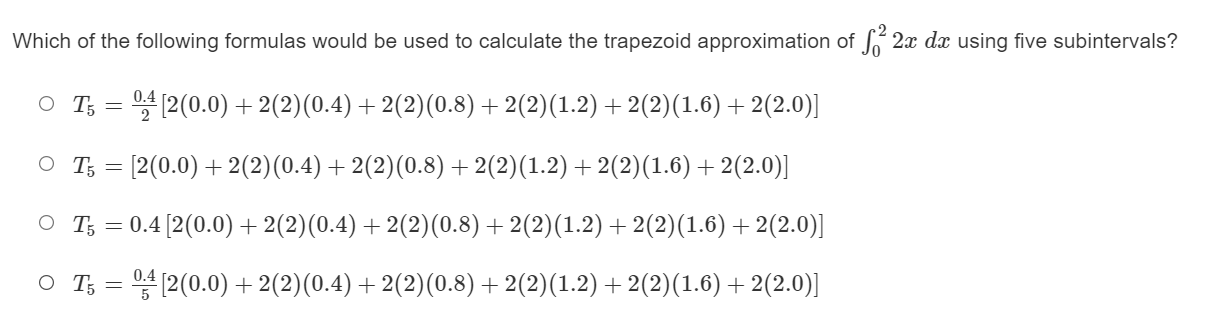
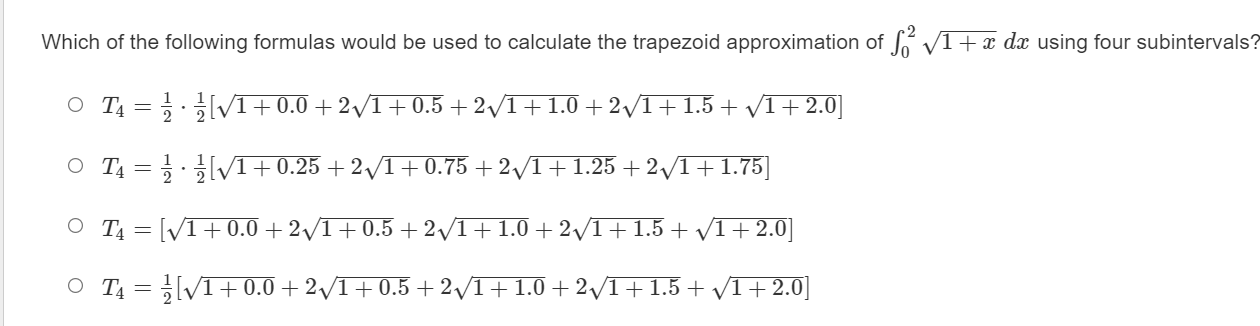
What formula would be used to calculate the right rectangle approximation of [02(232 + 2)d2': using five subintervals? 0 R5 = (0.4){[2(o.4) + 2] + 2[(0.8) + 2] + 2[(1.2) + 2] + 2[(1.6) + 2] + 2[(2.0)+ 2]} 0 R5 = (0.4){[2(o.2) + 2] + 2[(0.6) + 2] + 2[(1.0) + 2] + 2[(1.4) + 2] + 2[(1.a)+ 2]} 0 R5 = (0.2){[2(o.2) + 2] + 2[(0.6) + 2] + 2[(1.0) + 2] + 2[(1.4) + 2] + 2[(1.a)+ 2]} 0 R5 = (0.4){[2(o.0) + 2] + 2[(o.4) + 2] + 2[(0.8) + 2] + 2[(1.2) + 2] + 2[(1.6)+ 2]} What formula would be used to calculate the middle rectangle approximation of (sin x . cosa ) da using four subintervals? O Ms = [sin(0) cos(0)] + [sin () cos ( )] + [sin(7) cos(7)] + [sin (" ) cos ( ) ] O MA = (#) { [sin (#) cos (#) ] + [sin (34 ) cos ( 34 ) ] + [sin (5x ) cos (5x ) ] + [sin In O MA = (5) { [sin ( ) cos (7)] + [sin() cos(7)] + [sin (', ) cos (" ) ] + [sin(27) cos(27)]} O MA = (5) { [sin(0) cos(0)] + [sin () cos ( 7)] + [sin() cos(7)] + [sin (," ) cos (3 ) ]}Which of the following formulas would be used to calculate the trapezoid approximation of 162 22: d1]? using ve subintervals'? 0 T5 = j4[2(0.0) + 2(2)(0.4) + 2(2)(0.8) + 2(2)(1.2) + 2(2)(1.6) + 2(2.0)] 0 T5 = [2(0.0) + 2(2)(0.4) + 2(2)(0.8) + 2(2)(1.2) + 2(2)(1.6) + 2(2.0)] 0 T5 = 0.4 [2(0.0) + 2(2)(0.4) + 2(2)(0.8) + 2(2)(1.2) + 2(2)(1.6) + 2(2.0)] 0 T5 = 4203.0) + 2(2)(0.4) + 2(2)(0.3) + 2(2)(1.2) + 2(2)(1.6) + 2(2.0)] 5 Which of the following formulas would be used to calculate the trapezoid approximation of 162 1/1 + :3 d2? using four subintervals? 0 T4 %-%[1+0.0+2\\/1+0.5 +2\\/1+1.0 +21+1.5+ 1+2.0] 0 T4 %-%['/1 + 0.25 + 2V1 + 0.75 + 2\\/1 + 1.25 + 2J1 + 1.75] 0 T4 : [x/l + 0.0 + 2q/1 + 0.5 + 2M1 + 1.0 + 21/1 + 1.5 + \\/1 + 2.0] 0 T4 = %['/1+0.0+21+0.5+2'/1+1.0+21+1.5+1+2.0] Can the Fundamental Theorem of Calculus be used to tindf2 22243 do: ? 1/5 0 Yes, f(:13) : f: 23233 do: is continuous on the given interval and its antiderivative exists. 0 No, f(.'.t':) : 2 23223' do: is not continuous on the given interval and its antiderivative does not exist. 0 0 Yes, m) : f: 23233 do: is continuous on the given interval but its antiderivative does not exist. O No, at) : 2 22223 do: is not continuous on the given interval but its antiderivative exists. 0 1/5
Step by Step Solution
There are 3 Steps involved in it

Get step-by-step solutions from verified subject matter experts
 Study Help