







Question: please help me get the solutions step by step Question 1 Linearize f(x)=x3 when x=2 [8 marks] Question 2 Figure 1 shows a liquid flow
![f(x)=x3 when x=2 [8 marks] Question 2 Figure 1 shows a liquid](https://dsd5zvtm8ll6.cloudfront.net/si.experts.images/questions/2024/09/66f1149e8cf14_48666f1149e2c7f0.jpg)
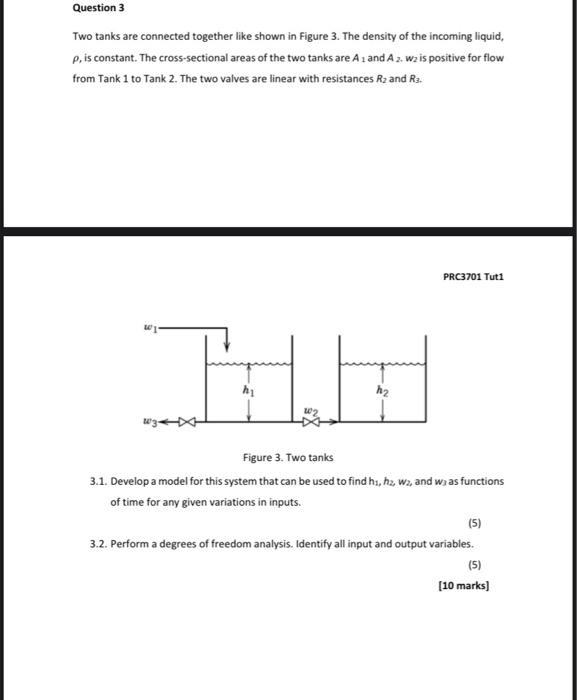
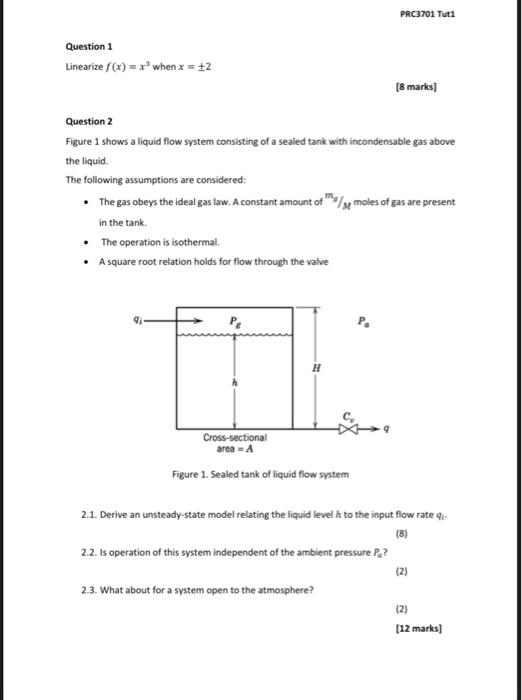
Question 1 Linearize f(x)=x3 when x=2 [8 marks] Question 2 Figure 1 shows a liquid flow system consisting of a sealed tank with incondensable gas above the liquid. The following assumptions are considered: - The gas obeys the ideal gas law. A constant amount of m/M moles of gas are present in the tank. - The operation is isothermal. - A square root relation holds for flow through the valve Figure 1. Sealed tank of liquid flow system 2.1. Derive an unsteady-state model relating the liquid level h to the input flow rate q1 - (B) 2.2. Is operation of this system independent of the ambient pressure P4 ? (2) 2.3. What about for a system open to the atmosphere? (2) [12 marks] A perfectly stirred, constant-volume tank has two input streams, both consisting of the same liquid shown in Figure 2. The temperature and flow rate of each of the streams can vary with time. 2.1. Derive a dynamic model that will describe transient operation. Make a degrees of freedom analysis assuming that both Streams 1 and 2 come from upstream units (i.e., their flow rates and temperatures are known functions of time). (7) 2.2. Simplify your model, if possible, to one or more differential equations by eliminating any algebraic equations. Also, simplify any derivatives of products of variables. Question 3 Two tanks are connected together like shown in Figure 3. The density of the incoming liquid, , is constant. The cross-sectional areas of the two tanks are A1 and A2, W2 is positive for flow from Tank 1 to Tank 2 . The two valves are linear with resistances R2 and R3. PRC3701 Tut1 Figure 3. Two tanks 3.1. Develop a model for this system that can be used to find h1,h2,w2, and w3 as functions of time for any given variations in inputs. (5) 3.2. Perform a degrees of freedom analysis. Identify all input and output variables
Step by Step Solution
There are 3 Steps involved in it

Get step-by-step solutions from verified subject matter experts
 Study Help