







Question: please help me here plz its due now in a hours time The business case for diversity in the workplace is now overwhelming Diversity in
please help me here plz its due now in a hours time
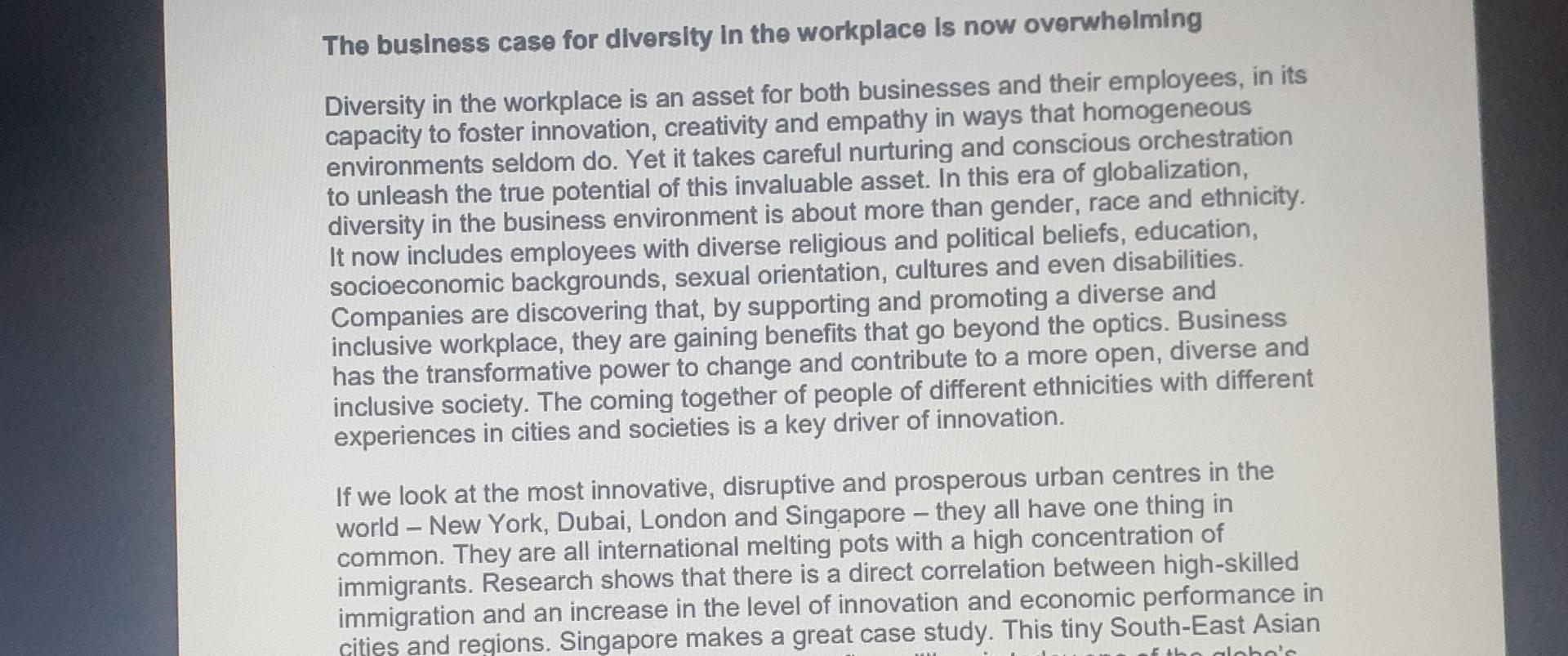
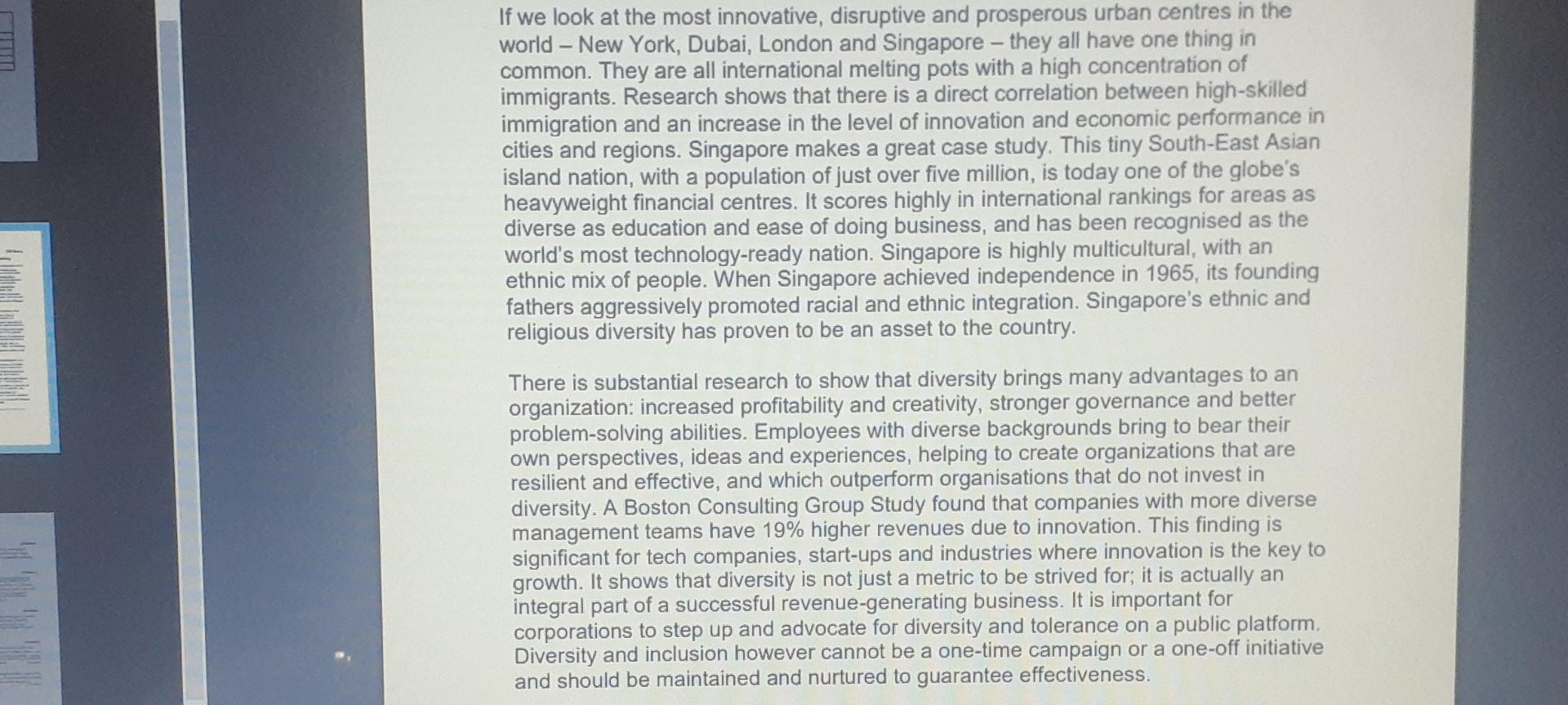
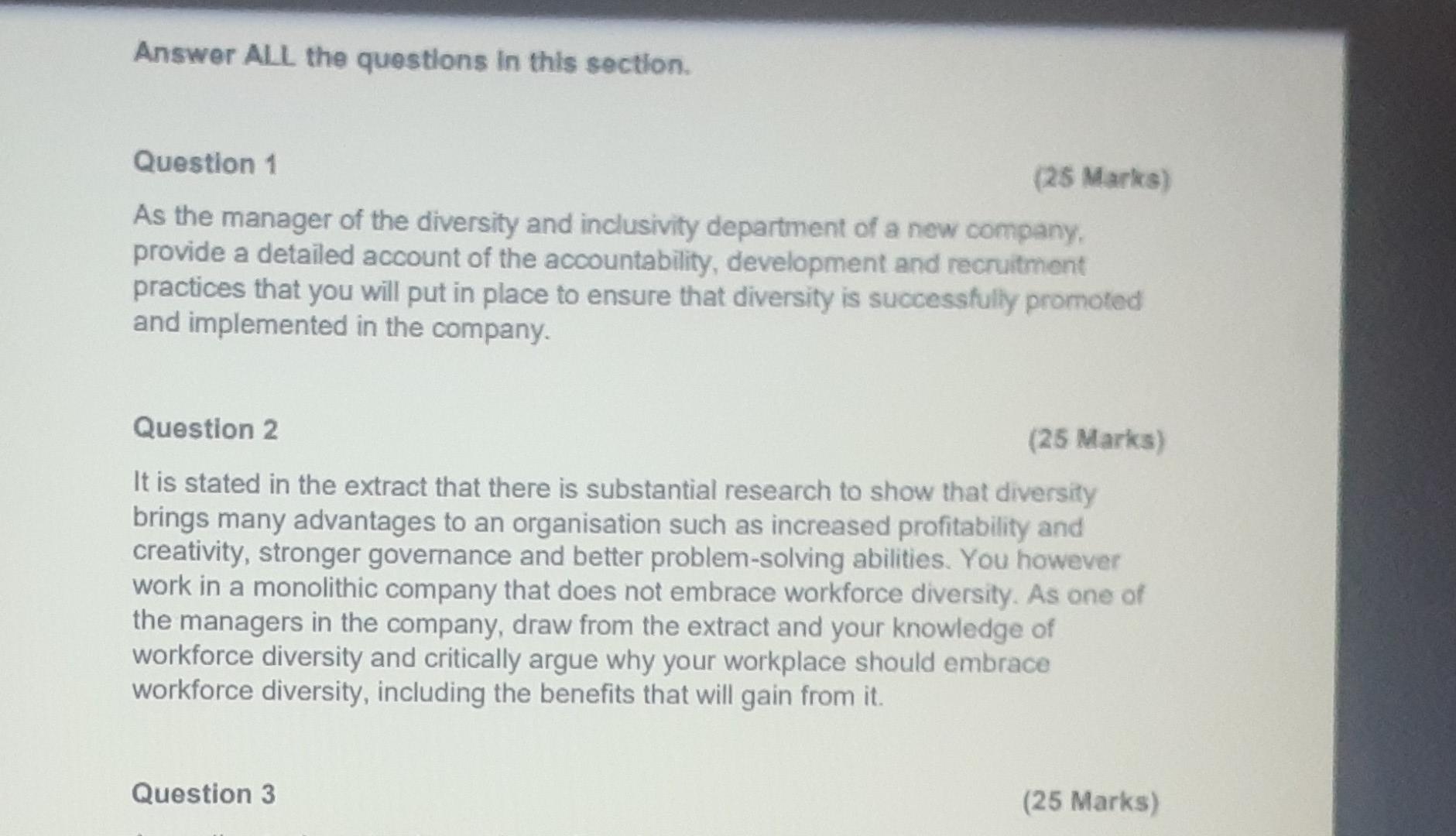
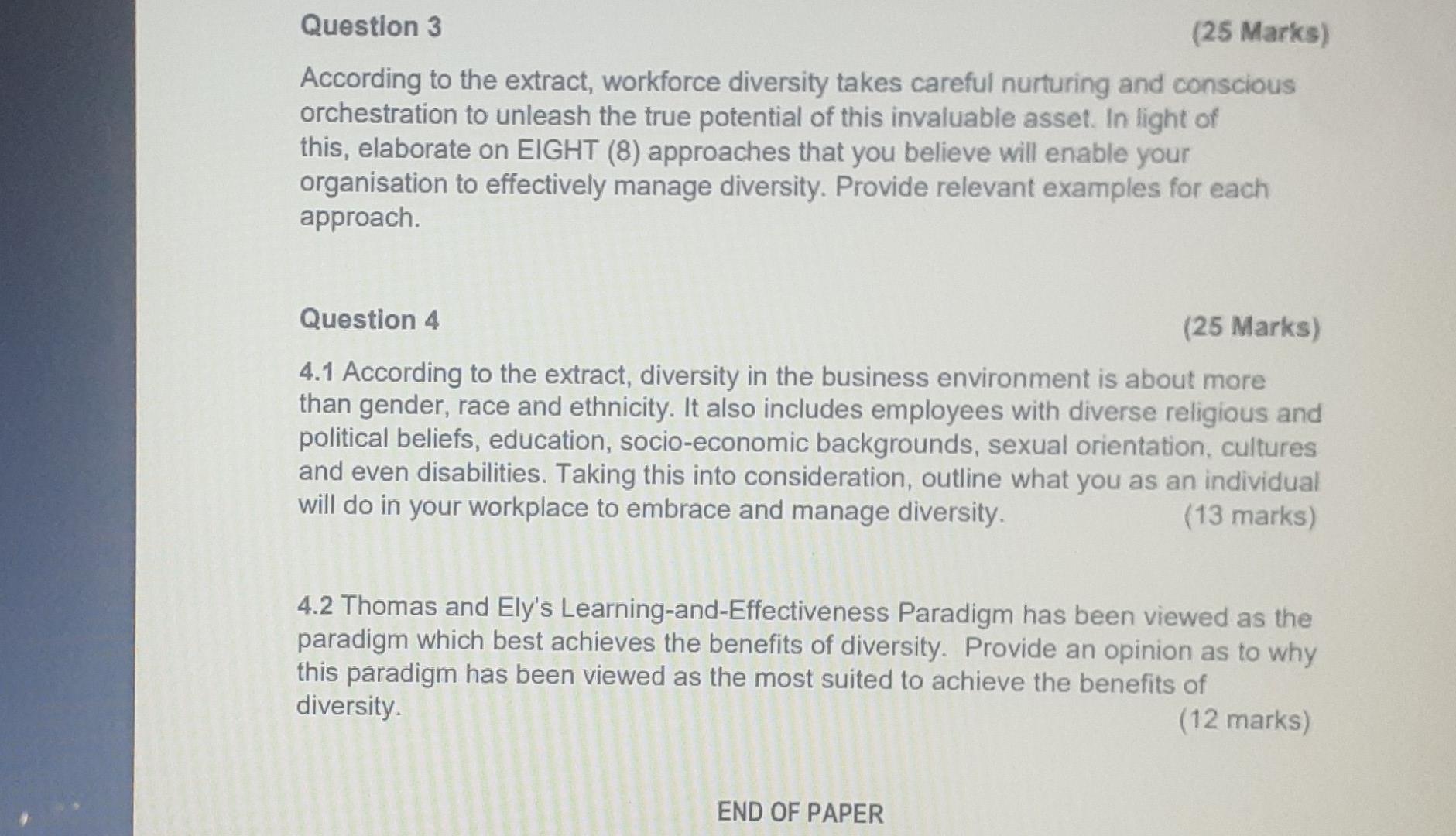
The business case for diversity in the workplace is now overwhelming Diversity in the workplace is an asset for both businesses and their employees, in its capacity to foster innovation, creativity and empathy in ways that homogeneous environments seldom do. Yet it takes careful nurturing and conscious orchestration to unleash the true potential of this invaluable asset. In this era of globalization, diversity in the business environment is about more than gender, race and ethnicity. It now includes employees with diverse religious and political beliefs, education, socioeconomic backgrounds, sexual orientation, cultures and even disabilities. Companies are discovering that, by supporting and promoting a diverse and inclusive workplace, they are gaining benefits that go beyond the optics. Business has the transformative power to change and contribute to a more open, diverse and inclusive society. The coming together of people of different ethnicities with different experiences in cities and societies is a key driver of innovation. If we look at the most innovative, disruptive and prosperous urban centres in the world - New York, Dubai, London and Singapore they all have one thing in common. They are all international melting pots with a high concentration of immigrants. Research shows that there is a direct correlation between high-skilled immigration and an increase in the level of innovation and economic performance in cities and regions. Singapore makes a great case study. This tiny South-East Asian if the globo's TITTI If we look at the most innovative, disruptive and prosperous urban centres in the world - New York, Dubai, London and Singapore - they all have one thing in common. They are all international melting pots with a high concentration of immigrants. Research shows that there is a direct correlation between high-skilled immigration and an increase in the level of innovation and economic performance in cities and regions. Singapore makes a great case study. This tiny South-East Asian island nation, with a population of just over five million, is today one of the globe's heavyweight financial centres. It scores highly in international rankings for areas as diverse as education and ease of doing business, and has been recognised as the world's most technology-ready nation. Singapore is highly multicultural, with an ethnic mix of people. When Singapore achieved independence in 1965, its founding fathers aggressively promoted racial and ethnic integration. Singapore's ethnic and religious diversity has proven to be an asset to the country. There is substantial research to show that diversity brings many advantages to an organization: increased profitability and creativity, stronger governance and better problem-solving abilities. Employees with diverse backgrounds bring to bear their own perspectives, ideas and experiences, helping to create organizations that are resilient and effective, and which outperform organisations that do not invest in diversity. A Boston Consulting Group Study found that companies with more diverse management teams have 19% higher revenues due to innovation. This finding is significant for tech companies, start-ups and industries where innovation is the key to growth. It shows that diversity is not just a metric to be strived for; it is actually an integral part of a successful revenue-generating business. It is important for corporations to step up and advocate for diversity and tolerance on a public platform, Diversity and inclusion however cannot be a one-time campaign or a one-off initiative and should be maintained and nurtured to guarantee effectiveness. Answer ALL the questions in this section. Question 1 (25 Marks) As the manager of the diversity and inclusivity department of a new company, provide a detailed account of the accountability, development and recruitment practices that you will put in place to ensure that diversity is successfully promoted and implemented in the company. Question 2 (25 Marks) It is stated in the extract that there is substantial research to show that diversity brings many advantages to an organisation such as increased profitability and creativity, stronger governance and better problem-solving abilities. You however work in a monolithic company that does not embrace workforce diversity. As one of the managers in the company, draw from the extract and your knowledge of workforce diversity and critically argue why your workplace should embrace workforce diversity, including the benefits that will gain from it. Question 3 (25 Marks) Question 3 (25 Marks) According to the extract, workforce diversity takes careful nurturing and conscious orchestration to unleash the true potential of this invaluable asset. In light of this, elaborate on EIGHT (8) approaches that you believe will enable your organisation to effectively manage diversity. Provide relevant examples for each approach. Question 4 (25 Marks) 4.1 According to the extract, diversity in the business environment is about more than gender, race and ethnicity. It also includes employees with diverse religious and political beliefs, education, socio-economic backgrounds, sexual orientation, cultures and even disabilities. Taking this into consideration, outline what you as an individual will do in your workplace to embrace and manage diversity. (13 marks) 4.2 Thomas and Ely's Learning-and-Effectiveness Paradigm has been viewed as the paradigm which best achieves the benefits of diversity. Provide an opinion as to why this paradigm has been viewed as the most suited to achieve the benefits of diversity (12 marks) END OF PAPER The business case for diversity in the workplace is now overwhelming Diversity in the workplace is an asset for both businesses and their employees, in its capacity to foster innovation, creativity and empathy in ways that homogeneous environments seldom do. Yet it takes careful nurturing and conscious orchestration to unleash the true potential of this invaluable asset. In this era of globalization, diversity in the business environment is about more than gender, race and ethnicity. It now includes employees with diverse religious and political beliefs, education, socioeconomic backgrounds, sexual orientation, cultures and even disabilities. Companies are discovering that, by supporting and promoting a diverse and inclusive workplace, they are gaining benefits that go beyond the optics. Business has the transformative power to change and contribute to a more open, diverse and inclusive society. The coming together of people of different ethnicities with different experiences in cities and societies is a key driver of innovation. If we look at the most innovative, disruptive and prosperous urban centres in the world - New York, Dubai, London and Singapore they all have one thing in common. They are all international melting pots with a high concentration of immigrants. Research shows that there is a direct correlation between high-skilled immigration and an increase in the level of innovation and economic performance in cities and regions. Singapore makes a great case study. This tiny South-East Asian if the globo's TITTI If we look at the most innovative, disruptive and prosperous urban centres in the world - New York, Dubai, London and Singapore - they all have one thing in common. They are all international melting pots with a high concentration of immigrants. Research shows that there is a direct correlation between high-skilled immigration and an increase in the level of innovation and economic performance in cities and regions. Singapore makes a great case study. This tiny South-East Asian island nation, with a population of just over five million, is today one of the globe's heavyweight financial centres. It scores highly in international rankings for areas as diverse as education and ease of doing business, and has been recognised as the world's most technology-ready nation. Singapore is highly multicultural, with an ethnic mix of people. When Singapore achieved independence in 1965, its founding fathers aggressively promoted racial and ethnic integration. Singapore's ethnic and religious diversity has proven to be an asset to the country. There is substantial research to show that diversity brings many advantages to an organization: increased profitability and creativity, stronger governance and better problem-solving abilities. Employees with diverse backgrounds bring to bear their own perspectives, ideas and experiences, helping to create organizations that are resilient and effective, and which outperform organisations that do not invest in diversity. A Boston Consulting Group Study found that companies with more diverse management teams have 19% higher revenues due to innovation. This finding is significant for tech companies, start-ups and industries where innovation is the key to growth. It shows that diversity is not just a metric to be strived for; it is actually an integral part of a successful revenue-generating business. It is important for corporations to step up and advocate for diversity and tolerance on a public platform, Diversity and inclusion however cannot be a one-time campaign or a one-off initiative and should be maintained and nurtured to guarantee effectiveness. Answer ALL the questions in this section. Question 1 (25 Marks) As the manager of the diversity and inclusivity department of a new company, provide a detailed account of the accountability, development and recruitment practices that you will put in place to ensure that diversity is successfully promoted and implemented in the company. Question 2 (25 Marks) It is stated in the extract that there is substantial research to show that diversity brings many advantages to an organisation such as increased profitability and creativity, stronger governance and better problem-solving abilities. You however work in a monolithic company that does not embrace workforce diversity. As one of the managers in the company, draw from the extract and your knowledge of workforce diversity and critically argue why your workplace should embrace workforce diversity, including the benefits that will gain from it. Question 3 (25 Marks) Question 3 (25 Marks) According to the extract, workforce diversity takes careful nurturing and conscious orchestration to unleash the true potential of this invaluable asset. In light of this, elaborate on EIGHT (8) approaches that you believe will enable your organisation to effectively manage diversity. Provide relevant examples for each approach. Question 4 (25 Marks) 4.1 According to the extract, diversity in the business environment is about more than gender, race and ethnicity. It also includes employees with diverse religious and political beliefs, education, socio-economic backgrounds, sexual orientation, cultures and even disabilities. Taking this into consideration, outline what you as an individual will do in your workplace to embrace and manage diversity. (13 marks) 4.2 Thomas and Ely's Learning-and-Effectiveness Paradigm has been viewed as the paradigm which best achieves the benefits of diversity. Provide an opinion as to why this paradigm has been viewed as the most suited to achieve the benefits of diversity (12 marks) END OF PAPERStep by Step Solution
There are 3 Steps involved in it
1 Expert Approved Answer
Step: 1 Unlock

Question Has Been Solved by an Expert!
Get step-by-step solutions from verified subject matter experts
Step: 2 Unlock
Step: 3 Unlock
 Study Help