







Question: Please help me improve my assignment by adjusting the structure and flow of the essay. Please also improve where necessary: Essay topic: explain how memes
Please help me improve my assignment by adjusting the structure and flow of the essay. Please also improve where necessary:
Essay topic: explain how memes can be used as a form of media activism
Explain what media activism is - its different forms and function in society - citing some examples of activist movements
- What is media activism?
- Media activism encompasses a variety of efforts aimed at creating social or political change through media platforms and communication channels. It involves using traditional media outlets as well as social media to raise awareness, build support, expose corruption, advocate for equal rights, and challenge dominant ideologies. Media activism takes various forms, including large-scale demonstrations, social media campaigns, and individual actions against political inaction.
- What is technology's role in media activism?
- Technology plays a crucial role in media activism by providing alternative sources of power and facilitating collective intelligence. The internet allows for the rapid dissemination of information, bypasses traditional media models, and offers diverse viewpoints from a wide range of sources.
- Culture Jamming?
- Additionally, culture jamming, a form of anti-corporate activism, disrupts the preferred reading process by modifying corporate branding and messaging.
- Example of media activism
- One prominent example of media activism is the Black Lives Matter (BLM) movement. BLM effectively utilizes various media forms, including hashtags on social media platforms, to raise awareness about systemic racism and police brutality. The movement organizes protests, rallies, and events through social media, educating the public and advocating for policy changes and reforms.
- Challenges to media activism by the media elite
- Despite its positive impact, media activism faces challenges from the media elite, who hold the power to frame narratives, misrepresent movements, and limit access to mainstream media platforms. In response, activists must continue to create their own media content, leverage social media, and challenge misrepresentations to push for accurate and fair representation in the media.
- In essence, media activism serves as a critical tool for driving social and political change by harnessing the power of media and communication to advocate for equality, justice, and reform.
Provide a general overview of memes, drawing on meme theory and memetics to highlight their common characteristics and why and how they are expressions of activism (also refer to the 'Communication and media power' topic)
- Origin of memes
- Memes, originating from the Greek word "mimeme," meaning "imitated thing," were first conceptualized by Professor Richard Dawkins in his book The Selfish Gene (1976). Drawing an analogy to genes, Dawkins argued that memes are replicators, units of cultural transmission that copy and reproduce themselves, allowing for the spread of cultural and contextual ideas to a wider audience. In the realm of internet culture, memes take familiar reference points and well-known stories, placing them in new contexts for new audiences, thereby producing new meanings.
- Characterising internet memes
- Internet memes, unlike genes, are intentionally altered and remixed, leveraging human creativity. Their visual format and semiotic elements are vital for communicating meaning and are characterized by replicability, adaptability, shareability, and shared meaning. They are catalysts for activist expressions as they draw on real events and serious issues, often using humor to engage a wider audience in meme culture.
Furthermore, meme content involves ideological meanings that are encoded into the memes, and for a meme to 'survive,' it needs to be adapted and shared while demanding a shared understanding of its meaning. In essence, memes serve as a powerful medium for expressing activism, permitting the dissemination of ideas and ideologies to a broad audience in an easily digestible and engaging format.
- What are Semiotics?
- Semiotics is the scientific study of signs and meaning systems, explaining how meanings are produced and interpreted, and how power is created and maintained through signs. Signs can take the form of communication such as images, colors, objects, words, letters, gestures, and sounds. They can only be understood within the context of their relevant semiotic code. These codes include social codes like verbal and body language, and textual codes such as scientific equations, art, literature, and film.
- How signs are used in media texts
- Media messages contain cultural references that produce meaning based on collective experiences. Intertextuality, or the relationship between texts, involves remixing and mashing content to create something familiar but different.
- Stuart Hall Audience theory
- Stuart Hall, a leading semiotician, conducted significant work in the 1970s and 1980s focusing on how media texts create meaning for audiences. According to Hall, audiences adopt three reading positions when engaging with media:
- 1. Preferred reading: The audience accepts both the message of the text and the ideologies underpinning that message - the ideal reading the creators are aiming for.
- 2. Negotiated reading: The audience accepts part of the text's overall message and the meaning and ideologies it presents, but rejects other parts.
- 3. Oppositional reading: The audience rejects both the message of the text and the ideologies or social structures underpinning it.
- Oppositional reading is closely related to media activism, as it involves rejecting both the message of the text and the ideologies or social structures underpinning it. Media activism seeks to challenge and change the dominant meanings projected by signs in media texts and encourages audiences to critically engage with and question the messages they receive.
- Stuart Hall, a leading semiotician, conducted significant work in the 1970s and 1980s focusing on how media texts create meaning for audiences. According to Hall, audiences adopt three reading positions when engaging with media:
- What is communication power?
- Communication power encompasses the intricate web of influence, control, and negotiation inherent in societal dynamics. At its core, power relies on the control of communication, while counterpower involves breaking through such control. Mass communication, which has the potential to reach society at large, is shaped and managed by power relationships deeply rooted in the media's business and the politics of the state. This underscores the pivotal role of communication power in the structure and functioning of society.
- Cultural Hegemony
- Cultural hegemony, stemming from the Greek word 'hegemon,' incorporates the maintenance of power over populations not through coercion or military control, but through negotiation, persuasion, and consent. It establishes a power relationship that involves the participation of both the ruling class and the ruled. Cultural domination ensures that the ruling class can control populations through consent, and ideologies are borne from this hegemony. The perceived personal gains play a significant role in upholding and consenting to this power relationship.
- Referent/ Social Power
- In terms of Referent/Social Power, individuals hold the potential to attract attention and a public following. This is evident in the influence of politicians, religious leaders, media personalities, and celebrities, who wield social and cultural power through their charismatic qualities, interpersonal skills, and persuasive appeal, thereby transferring influence through the endorsement of products and brands.
- Counterpower
- Counterpower, on the other hand, embodies empowerment through agency and decision-making. As Castells pointed out, "Wherever there is power, there is always counterpower." Media activism serves as a potent form of counterpower, utilizing communication technologies to protest, inform, or inspire change. It represents the means through which individuals and groups exercise agency to challenge and transform existing power dynamics, thus highlighting the indispensable role of counterpower in shaping our societal discourse and progress.
Introduce and describe your meme collection (three or more interrelated images that show changes in form and content), providing necessary context regarding the issue/s they relate to
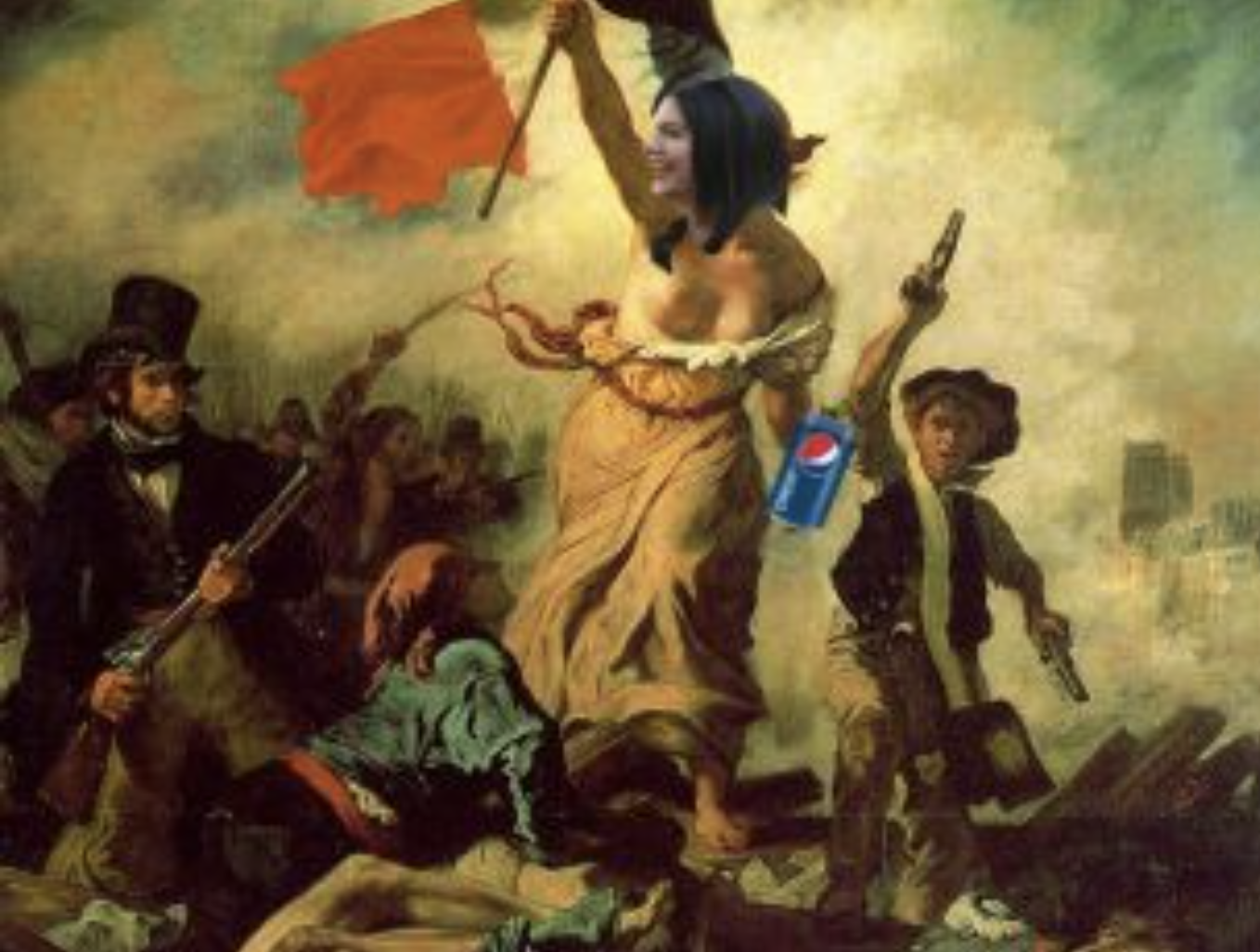
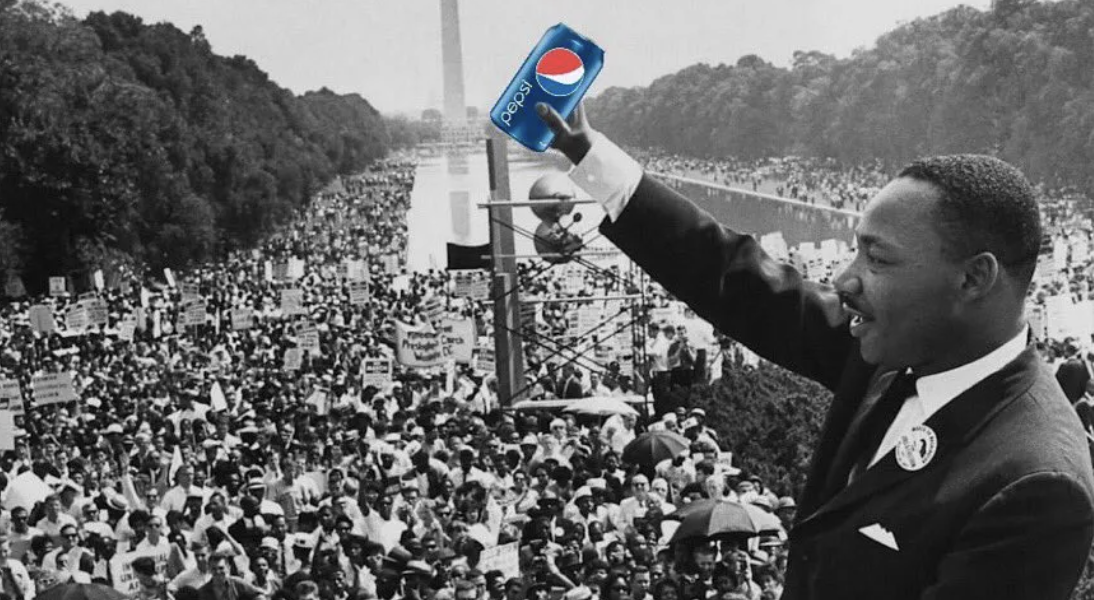
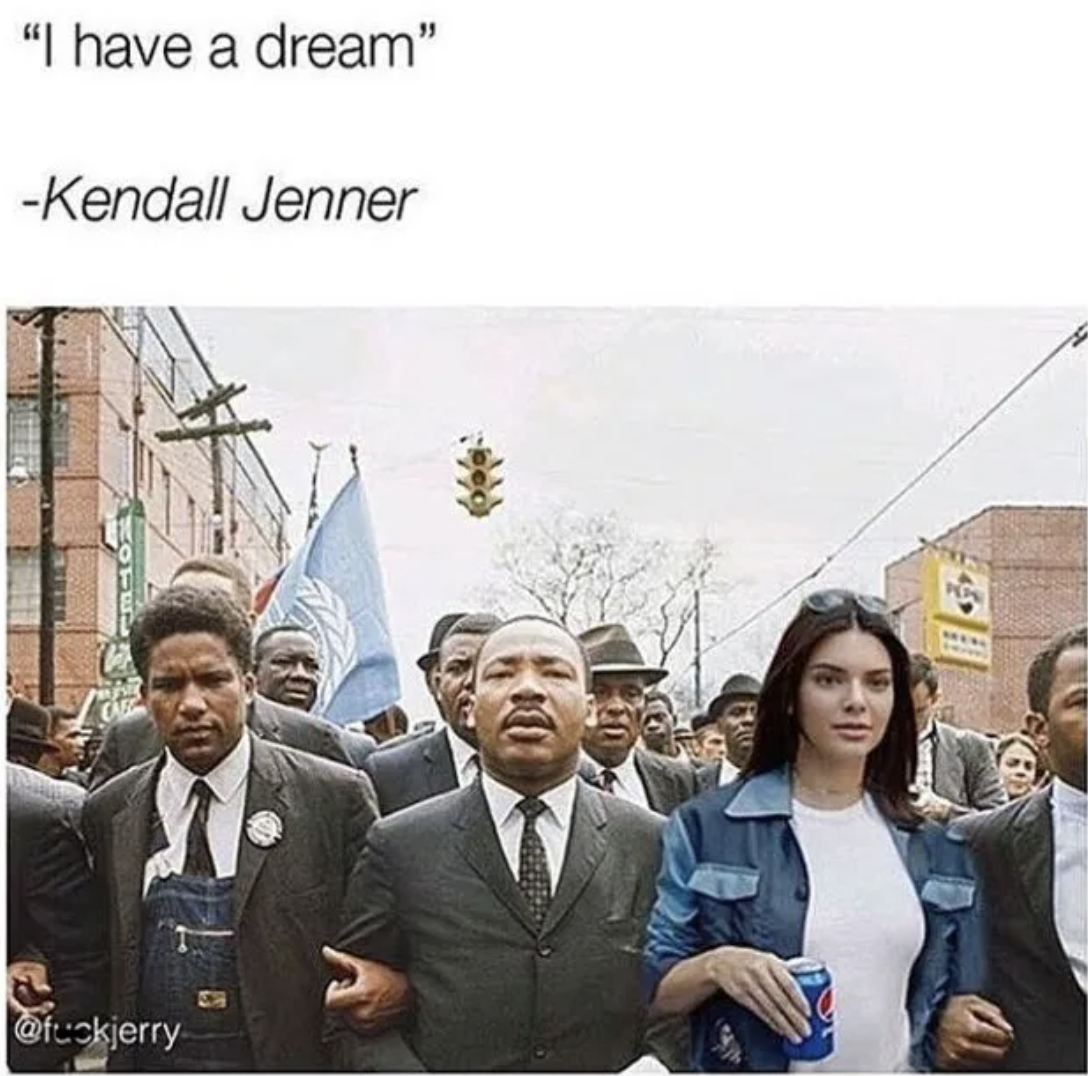
- The meme of Kendall Jenner's Pepsi commercial can be seen as an example of media activism due to its role in critiquing and raising awareness about the commercial's insensitivity towards important social issues. The meme, which often features sarcastic or critical captions alongside screenshots or gifs from the commercial, serves as a form of social commentary. By using humor and satire to highlight the commercial's trivialization of serious issues such as police brutality and racial injustice, the meme prompts discussions and reflections on the responsibility of media and advertising in addressing social issues.
- Moreover, the widespread circulation of the meme amplifies the initial backlash against the commercial, keeping the conversation alive and maintaining pressure on corporations to be more conscientious in their marketing. In this way, the meme not only serves as a means of dissent and critique but also as a tool for holding powerful entities accountable for their representations and actions. Therefore, the Kendall Jenner Pepsi commercial meme exemplifies how digital media and user-generated content can be harnessed as a form of activism to challenge and subvert problematic narratives perpetuated by mainstream media.
Apply what you have already outlined in step 2 to your chosen memes (e.g. the content and format; characteristics; spreadable/shareable qualities; use of intertextuality) to illustrate how your meme works as a form of media activism.
The Kendall Jenner Pepsi commercial meme effectively demonstrates media activism through its content and format, characteristics, spreadable/shareable qualities, and use of intertextuality. The meme juxtaposes images from the commercial with real-life protest scenes, effectively critiquing the commercial's trivialization of serious social issues. This contrast initiates discussions about corporate exploitation of social movements and highlights the oversimplification and commercialization of these movements.
- Characteristics
- In terms of characteristics, the meme incorporates humor, satire, and irony, making complex social issues more accessible and engaging. This use of irony effectively criticizes the commercial's message, serving as a powerful tool for media activism. Additionally, the meme's use of humor renders the critique more shareable and relatable to a wide audience.
- Spreadable/ Shareable qualities
- The meme's spreadable qualities are evident in its easily shareable format on social media platforms, enabling it to quickly reach a wide audience and effectively spread activist messages. Furthermore, the meme's use of remix culture allows users to repurpose existing content to generate new meanings or commentary, fostering wider dissemination as individuals integrate their own viewpoints and circulate them throughout their networks.
- Intertextuality
- Intertextuality plays a crucial role in the meme's demonstration of media activism, as it encompasses a complex relationship between the commercial and broader cultural, social, and political references. By linking the commercial to real-world events and social movements, such as the Black Lives Matter protests, the meme effectively critiques the commercial's oversimplification and commercialization of these movements. Moreover, the meme draws on historical contexts of protests and activism, contrasting the commercial's portrayal with historical acts of resistance, thereby situating the critique within a larger historical narrative of struggle and resistance.
In essence, the Kendall Jenner Pepsi commercial meme demonstrates media activism through its content and format, characteristics, spreadable/shareable qualities, and use of intertextuality, effectively critiquing the commercial's trivialization of social issues and engaging a wide audience in discussions about corporate exploitation of social movements.
Below I have attached my meme collection (Kendall Jenner Pepsi commercial meme)
Step by Step Solution
There are 3 Steps involved in it

Get step-by-step solutions from verified subject matter experts
 Study Help