







Question: Please help me on Question C and D Thanks! 4. There are two towns that each has 100 residents: Weston and Easton. The towns are
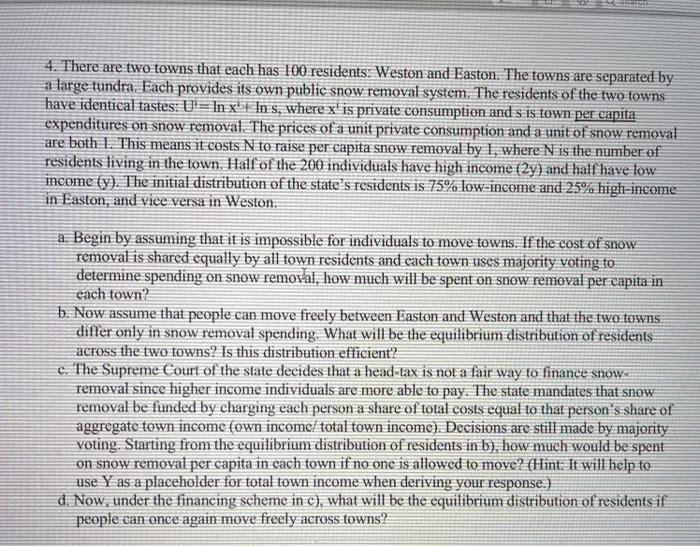
4. There are two towns that each has 100 residents: Weston and Easton. The towns are separated by a large tundra. Fach provides its own public snow removal system. The residents of the two towns have identical tastes: U = In x' In s, where x is private consumption and s is town per capita expenditures on snow removal. The prices of a unit private consumption and a unit of snow removal are both 1. This means it costs N to raise per capita snow removal by I, where N is the number of residents living in the town. Half of the 200 individuals have high income (2y) and half have low income (y). The initial distribution of the state's residents is 75% low-income and 25% high-income in Easton, and vice versa in Weston. a. Begin by assuming that it is impossible for individuals to move towns. If the cost of snow removal is shared equally by all town residents and cach town uses majority voting to determine spending on show removal, how much will be spent on snow removal per capita in each town? b. Now assume that people can move freely between Easton and Weston and that the two towns diller only in snow removal spending. What will be the equilibrium distribution of residents across the two towns? Is this distribution efficient? c. The Supreme Court of the state decides that a head-tax is not a fair way to finance snow removal since higher income individuals are more able to pay. The state mandates that snow removal be funded by charging each person a share of total costs equal to that person's share of aggregate town income (own income total town income). Decisions are still made by majority voting. Starting from the equilibrium distribution of residents in b), how much would be spent on snow removal per capita in each town if no one is allowed to move? (Hint It will help to use Y as a placeholder for total town income when deriving your response.) d. Now, under the financing scheme in c), what will be the equilibrium distribution of residents if people can once again move freely across towns? 4. There are two towns that each has 100 residents: Weston and Easton. The towns are separated by a large tundra. Fach provides its own public snow removal system. The residents of the two towns have identical tastes: U = In x' In s, where x is private consumption and s is town per capita expenditures on snow removal. The prices of a unit private consumption and a unit of snow removal are both 1. This means it costs N to raise per capita snow removal by I, where N is the number of residents living in the town. Half of the 200 individuals have high income (2y) and half have low income (y). The initial distribution of the state's residents is 75% low-income and 25% high-income in Easton, and vice versa in Weston. a. Begin by assuming that it is impossible for individuals to move towns. If the cost of snow removal is shared equally by all town residents and cach town uses majority voting to determine spending on show removal, how much will be spent on snow removal per capita in each town? b. Now assume that people can move freely between Easton and Weston and that the two towns diller only in snow removal spending. What will be the equilibrium distribution of residents across the two towns? Is this distribution efficient? c. The Supreme Court of the state decides that a head-tax is not a fair way to finance snow removal since higher income individuals are more able to pay. The state mandates that snow removal be funded by charging each person a share of total costs equal to that person's share of aggregate town income (own income total town income). Decisions are still made by majority voting. Starting from the equilibrium distribution of residents in b), how much would be spent on snow removal per capita in each town if no one is allowed to move? (Hint It will help to use Y as a placeholder for total town income when deriving your response.) d. Now, under the financing scheme in c), what will be the equilibrium distribution of residents if people can once again move freely across towns
Step by Step Solution
There are 3 Steps involved in it

Get step-by-step solutions from verified subject matter experts
 Study Help